Yes, you can wear a statement shirt at work in many U.S. offices, but the answer depends on your employer’s dress code, your industry and what the shirt says. Private employers generally decide what employees wear, so the smart move is to read your policy, look at what colleagues wear, and pick a message and an outfit that fit the room. Done well, a shirt with a message can start a good conversation without costing you any professionalism.
TL;DR
- Private-sector employers in the U.S. generally can regulate the messages on your clothes, so check your written dress code before you wear a graphic tee.
- Some workplaces, including government agencies, ask that clothing not promote a personal, political, moral or religious opinion. Others allow casual tees freely.
- Let the shirt be the focal point and keep everything else quiet: tailored trousers, a blazer or structured layer, polished shoes.
- Some employee actions are protected by federal labor law, but that protection is narrow and fact-specific. It is not a blanket right to wear any slogan.
- If a manager objects, stay calm, ask what the policy says, and ask whether a layer or a different shirt solves it.
Table of Contents
- What the dress code actually says about statement shirts
- Does the First Amendment protect your shirt?
- Political shirts and protected activity
- Where mental health awareness shirts fit
- How to choose a message that works at work
- How to style a statement shirt so it looks professional
- The 3-3-3 rule and other shortcuts
- What to check before you wear an advocacy shirt
- What to do if a manager says your shirt is inappropriate
- Quiet ways to carry the message when a tee is not an option
- Our perspective
- Find a shirt that fits your workplace
- FAQ
- Sources
What the dress code actually says about statement shirts
Start with the paper, not the vibe. Dress codes range from strict to almost nonexistent, and the words used for “casual” differ from office to office. One career-services guide notes that in a casual U.S. workplace T-shirts and button-downs may be acceptable, but “casual” varies by office, and recommends asking when you are unsure.
Some policies are very specific. The Georgia Department of Human Services dress code, for example, says business-casual attire with lettering or illustrations should not promote a political, moral, religious, personal or other opinion. The same policy treats T-shirts as inappropriate in business casual unless they are layered, and allows unmarked T-shirts on casual days. It also prohibits attire that is obscene, vulgar, offensive or inflammatory.
That is one public employer’s policy, not a national rule. But it shows the three questions most policies answer:
- Is a T-shirt allowed at all? Some offices say yes every day, some only on casual days, some never.
- Are words and images allowed? Many policies separate a plain tee from one with a slogan.
- What content is off-limits? Vulgar, offensive or inflammatory content is the usual line.
If your handbook says nothing about slogans, that is not permission and it is not a ban. It means you have to read the culture and, ideally, ask.
Does the First Amendment protect your shirt?
Not at a private employer. Legal advisers point out that private-sector employees in the U.S. do not have First Amendment free speech rights at work, and that employers generally have discretion to regulate clothing messages as long as policies are enforced uniformly. The First Amendment restrains government action, so your rights can look different if you work for a public agency. If that is your situation and the stakes are real, an employment attorney is the right person to ask.
This is why a quick, friendly check with your supervisor or HR matters more than any general rule you read online. It also protects you: a yes you can point to is better than an assumption.

Political shirts and protected activity
“Are you allowed to wear political shirts at work?” is one of the most common questions here, and the honest answer is: sometimes, and it depends on facts.
The National Labor Relations Act (NLRA) is the main federal law that can protect what you wear. It guarantees employees the right to discuss wages, benefits and working conditions, and it prohibits employers from firing or disciplining employees for protected concerted activities. The National Labor Relations Board explains that employers may prohibit union-related apparel only under specific, documented special circumstances.
A 2024 decision shows how this plays out. The Board held that Home Depot violated the NLRA when it discharged an employee who refused to remove a Black Lives Matter marking on a work apron, because the marking grew out of workplace racial-discrimination protests. When an employee displays protected insignia, employer interference is presumptively unlawful unless the employer proves special circumstances that make the restriction necessary for productivity or discipline.
The key phrase is that the marking was tied to concerns about working conditions. That does not mean every slogan is protected. SHRM summarizes the landscape this way: employers may generally enforce consistently applied bans on nonwork-related attire, while employees generally keep NLRA protection for union insignia unless special circumstances exist, and the analysis is fact-specific.
What this means for you:
- A shirt tied to a shared workplace issue may sit in different legal territory than a shirt about a cause outside work.
- Consistency matters. Employers are advised to apply rules evenly, and employees can reasonably ask whether the rule applies to everyone.
- If you think a restriction crosses a legal line, the NLRB and an employment attorney are the places to ask, not a blog post.
Where mental health awareness shirts fit
Most mental health awareness shirts are not political in the partisan sense. They are personal and educational. But some policies lump all “opinion” messages together, so a shirt that says something about your own experience or about stigma can still raise a question in a strict office. In a relaxed office, it might be the shirt that gets a coworker saying, “I’ve never talked about this, but my brother has anxiety too.”
That second outcome is what we make our shirts for. Our clothing is designed to spark conversations and reduce stigma, and we know from experience that where and how you wear it matters. If you want to understand why a message on fabric can carry so much weight, our piece on the role of clothing in advocacy walks through it, and the history of fashion activism shows this is a long tradition, not a trend.
How to choose a message that works at work
Not every statement is the same statement. Think of messages on a spectrum from “quiet” to “loud” and match it to your office.
| Message type | Example | Where it usually fits |
|---|---|---|
| Small or subtle | A tiny chest print, a pin, a ring | Most offices, including formal ones |
| Positive and educational | A line about normalizing mental health | Casual and smart-casual offices |
| Blunt or provocative | Strong language or shock imagery | Rarely at work; many policies prohibit offensive or inflammatory content |
| Opinion on a divisive issue | Partisan or religious slogans | Check policy first; strict offices often ban these |
A few habits make the choice easier:
- Read it like a coworker would. Walk past your own chest. Can someone read it in two seconds and understand it kindly?
- Skip anything vulgar or aggressive. That is the line nearly every dress code draws.
- Think about your audience for the day. Client meetings, interviews and presentations call for a quieter choice than a Friday at your desk.
- Make the type readable. Bold design works because people can read it at a glance. Our guide on making bold graphic tees read explains how scale changes the effect.
For a shirt that opens a conversation rather than starting an argument, many of our customers reach for designs like the Define Normal tee in white, which asks a question instead of making a demand.
How to style a statement shirt so it looks professional
The styling idea is simple: one loud piece, everything else quiet. Think of the shirt as the focal point and build a polished frame around it.
- Choose neutral bottoms. Tailored trousers in black, charcoal, navy or camel, or a midi skirt, keep the eye on the shirt.
- Fit it well. Tuck or half-tuck a shirt, or belt an oversized cut, so the silhouette looks deliberate rather than slouchy.
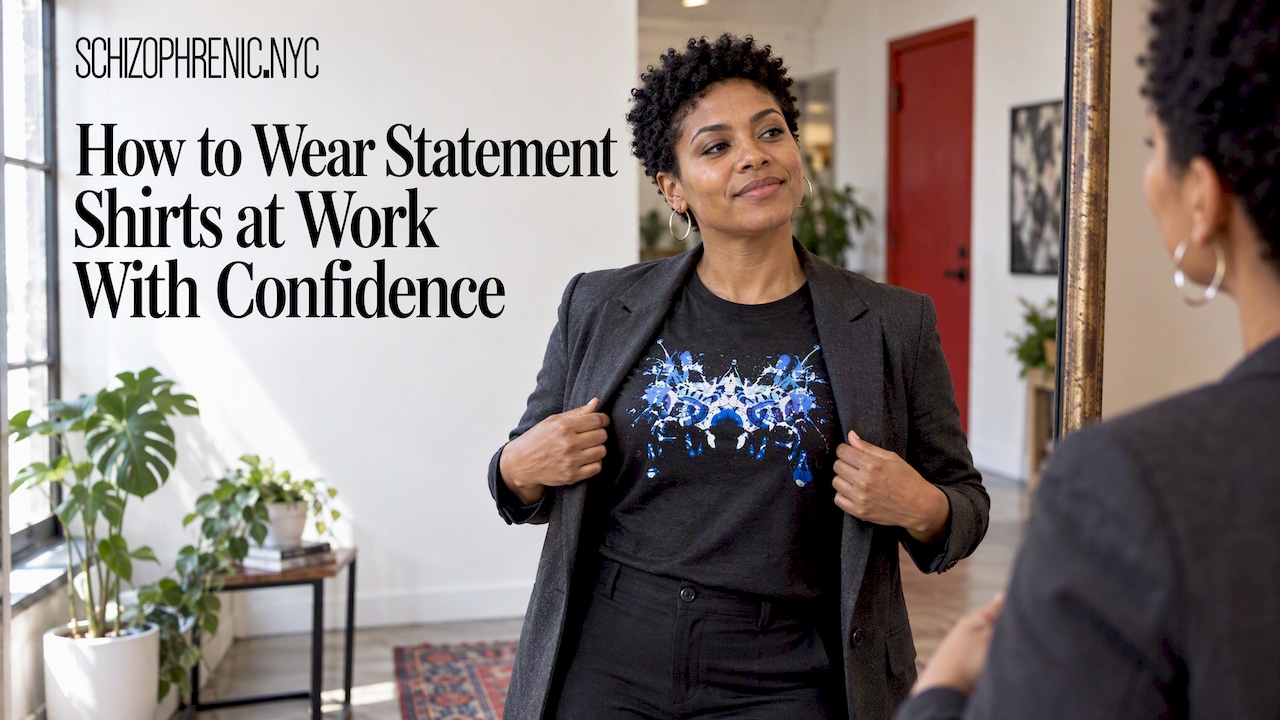
- Add a structured layer. A minimalist blazer, an open cardigan or a chore jacket makes a tee read as part of an outfit. You can wear it open so the graphic still shows.
- Keep accessories simple. A watch, small earrings or a slim bracelet. Avoid a second “statement” item competing with the shirt.
- Finish with polished shoes. Leather loafers, clean flats, ankle boots or tidy leather sneakers all say you took care.
- Check the condition. Wrinkle-free fabric and a crisp neckline matter more on a tee than on a button-down.
The layering trick has a second benefit. If someone raises a concern, you can close the blazer. A university apparel department describes semi-casual attire as allowing personal styling that remains professional, with moderate fit and appropriate shoes, and that is a good test for any outfit built around a graphic tee.
Adapting to your dress code level
The same shirt can work in one office and not in another. Here is how to think about the common levels:
- Business formal: Save the statement for off-hours. A small pin or ring can carry the message instead.
- Business casual: Dress pants or a skirt, a professional shirt, nice shoes, and a blazer or sport coat for polish. A graphic tee is best layered beneath a jacket, or skipped if your policy says tees are out.
- Smart casual: Dark jeans or casual pants and nice shoes work, and a sport coat or blazer elevates the look. A tee with a restrained design can fit here.
- Casual: T-shirts and button-downs may be acceptable. Even so, observe what colleagues wear and ask a supervisor if you are not sure.
Those levels follow the guidance in the career-services guide cited earlier, which suggests watching colleagues and asking a supervisor because expectations vary.
The 3-3-3 rule and other shortcuts
A popular wardrobe shortcut called the 3-3-3 rule suggests building outfits from three tops, three bottoms and three pairs of shoes. It is a way to simplify a capsule wardrobe, not a workplace standard, and no employer policy refers to it. It can still help here: if your three tops include one statement shirt, two plain ones and a blazer that goes with all of them, you always have an option ready for the day your office is more formal than expected.

What to check before you wear an advocacy shirt
Before the first wear, run this short checklist:
- Read the written policy. Look for words like “slogans,” “graphics,” “logos,” “T-shirts,” “casual day” and “offensive.” Dress-code policy experts advise that policies address likely conflict areas and specifically cover slogans or pictures on T-shirts, so yours may well mention them.
- Ask your supervisor. Ask about the dress code and whether expectations differ for events or certain days.
- Observe colleagues. See what people wear on ordinary days, and what senior leaders wear.
- Ask about video calls and remote work. What shows on camera counts too.
- Check for consistency. Appearance policies are meant to be inclusive and consistently enforced, and employment-law firms distinguish rules about political or social-justice messages from the special-circumstances standard for union insignia. Knowing which category your message falls into helps you ask better questions.
A friendly way to ask: “I’d like to wear a shirt with an awareness message on casual days. Is that within our dress code?” It is specific, polite and leaves a record of good faith.
What to do if a manager says your shirt is inappropriate
It can sting, especially when the shirt is about something personal. Take a breath first. Then:
- Stay calm and listen. Ask what specifically concerns them: the wording, the image, the tee itself or the setting.
- Ask what the policy says. Ask for it in writing if you have not seen it, and ask what people usually wear. The career guide suggests continuing the dialogue with a supervisor or mentor if you have questions or concerns.
- Offer a fix. Managers are advised to hold private, informative conversations and explore ways to bring attire into compliance, such as layering a jacket. You can suggest it yourself.
- Ask whether the rule applies to everyone. Policies should be applied consistently. Ask politely, without accusing.
- Escalate carefully. If you believe the restriction interferes with legally protected activity, such as union insignia or action connected to working conditions, contact HR, the NLRB or an employment attorney.
You do not have to defend your whole advocacy story in a hallway. Sometimes the best answer is, “Thanks for telling me. I’ll wear a blazer over it today and look at the policy.” Choosing your moment is not giving up your message.
Quiet ways to carry the message when a tee is not an option
If your office does not allow graphic tees, advocacy does not have to stay at home. Jewelry and small accessories are easy to fit into nearly any dress code:
- A Strap design awareness ring or one of our other mental health awareness rings is subtle and works with formal clothes.
- Awareness earrings add a point of conversation without printing a slogan on your chest.
- A pillbox on your desk is practical for anyone who takes medication, and a good way to normalize it.
- For more ideas, see our list of advocacy apparel ideas that keep wearers comfortable and safe.
Choosing a quiet piece is not hiding. It is picking the right volume for the room.
Our perspective
We started Schizophrenic.NYC because clothing can say what many people are afraid to say out loud. When I put a bold design on a shirt, I am not trying to make anyone uncomfortable. I am trying to make it normal to talk about mental illness, including schizophrenia, at the dinner table, in class and at the office.
I also know work is different. People have jobs to protect and bills to pay, and I never want anyone to feel they must choose between their paycheck and their voice. So our advice is practical: read your policy, pick the message that fits your workplace, wear it with confidence, and have a calm answer ready if someone asks.
Confidence really can get you anywhere. A tee with a message, worn thoughtfully with a blazer and good shoes, shows that a person with a mental health condition, or someone who loves one, is as professional as anyone else. That is the point of our designs: they are meant to start conversations and chip away at stigma, one outfit at a time.
Michelle
Find a shirt that fits your workplace
If you are ready to try one, browse our mental health T-shirts and pick a design that matches your office. For a gentler message that reads well under a blazer, the Psych Meds Keep It Real tee is a popular starting point, and our hoodies and sweatshirts work for casual days and the commute. Not sure where to begin? The graphic tee collection lets you compare designs side by side.
FAQ
Can you wear a T-shirt in an office?
Often yes, but it depends on your employer. Casual workplaces may allow T-shirts and button-downs, while business-casual policies may restrict them or require a layer. Some policies, like Georgia’s state human services dress code, allow unmarked tees on casual days only. Check your handbook and ask a supervisor if it is unclear.
Are you allowed to wear political shirts at work?
Usually private employers can restrict them if the rule is applied consistently, because private-sector workers do not have First Amendment rights at work. Federal labor law can protect certain activity, such as union insignia or messages connected to working conditions, unless the employer shows special circumstances. Because it is fact-specific, ask HR or an employment attorney about your situation.
How do I make a statement shirt look professional?
Let the shirt be the one loud piece. Pair it with neutral tailored trousers or a skirt, add a blazer or structured layer, keep accessories simple and wear polished shoes. Make sure it fits well and is crisp and clean, since a tee shows wear more than a button-down.
What should I do if my boss says my shirt is inappropriate?
Stay calm, ask what the dress code says, and ask what is acceptable. Offer a quick fix such as a jacket over the shirt, which is a common way to bring attire into compliance. If you believe a legally protected right is involved, talk to HR, the NLRB or an employment attorney.
Sources
- Georgia DHS Dress Code Guidelines
- The Ultimate Guide to Workplace Dress Codes
- NLRB: Board Rules Employee’s Black Lives Matter Action at Home Depot
- NLRB: Employee Rights
- Vigilant: Establish a policy on political speech on clothing
- SHRM: Can Employers Ban Political Apparel at Work?
- WSU Department of Apparel: Professional Semi-Casual to Casual
- Wolters Kluwer: Policies for workplace dress codes
- Fisher Phillips: Update Your Employee Appearance Policy