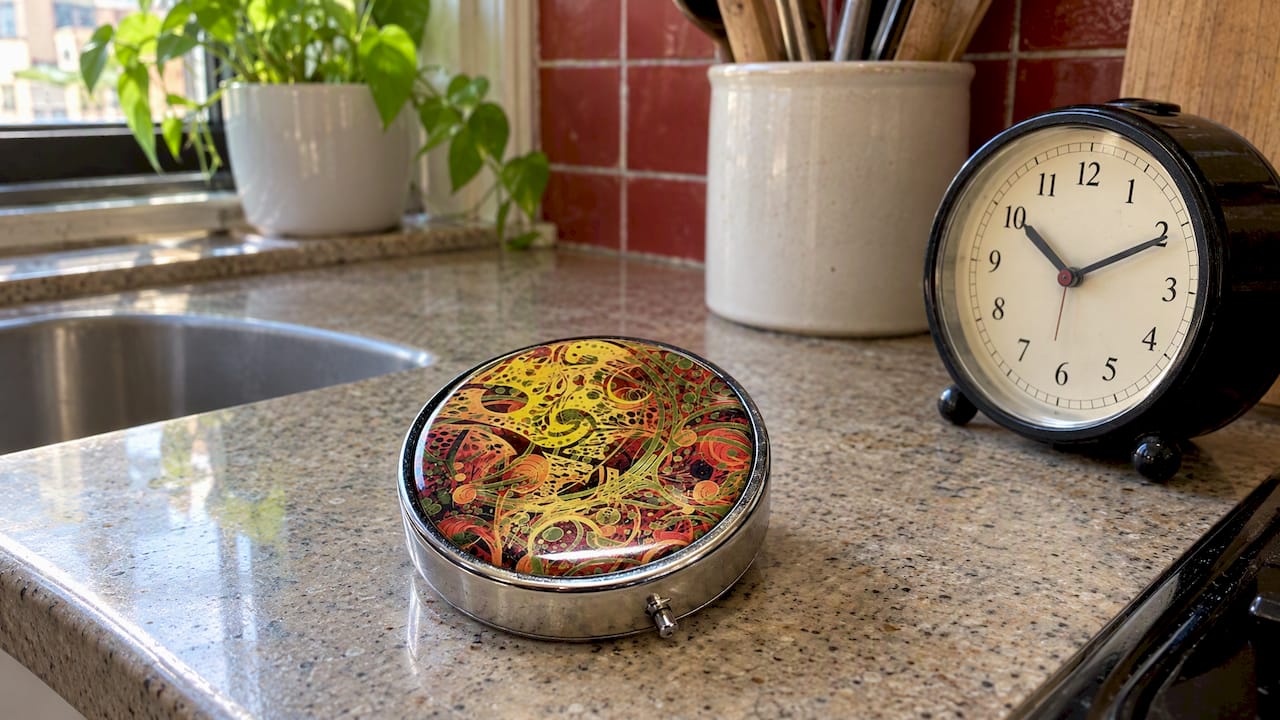
You can remember your medication without a phone. The most dependable options are a pillbox, a plain clock alarm, a paper medicine chart, and a person who checks in with you, all tied to something you already do every day, like breakfast or brushing your teeth. Some people don’t own a smartphone. Others find that phone alerts get lost among a hundred other notifications. Either way, the tools below are cheap, simple and proven in everyday life.
TL;DR
- Anchor each dose to a daily habit, such as a meal or bedtime, and keep your medicine in the same easy-to-reach spot.
- A weekly pillbox is the simplest visual reminder: if Tuesday’s compartment is full, you missed Tuesday. UW Medicine lists these at about $1 to $5.
- Add a clock alarm ($15 to $35 per UW Medicine) or a paper chart with a check-off box for every dose.
- Ask a trusted person to call or stop by. Call your provider if you keep missing doses. Never cut back or stop on your own.
Table of Contents
- Why some of us want reminders that don’t live on a phone
- Start with a routine, not a gadget
- 1. A pillbox you can read at a glance
- 2. A plain clock alarm
- 3. A programmable pager or alarm device
- 4. A paper medicine chart
- 5. A buddy, a call or a visit
- 6. Match the tool to your body and your day
- Our perspective
- If you miss a dose or can’t remember
- Where our pillboxes fit
- A simple one-week setup
- FAQ
- Sources
Why some of us want reminders that don’t live on a phone
Phones are great until they aren’t. The battery dies, the notification gets swiped away, or you simply don’t want a device that also holds your email, news and group chats to be the thing your health depends on. For some people, a phone reminder also feels like being watched. A physical tool sits quietly in your home and does one job.
If you take medication for schizophrenia or another long-term condition, consistency matters, and so does feeling in charge of your routine. The best system is the one you will actually use on a tired Wednesday, not the most impressive one. So we’ll start with the foundation and then build up.
Start with a routine, not a gadget
Before you buy anything, look at your day. MedlinePlus, the National Library of Medicine’s patient site, recommends linking your medicines to a reliable daily activity, such as a meal, and keeping your pillbox or bottles in the same accessible place. It also lists clock alarms, a medicine chart, a buddy system, and calls or visits from family as ways to stay on track without a smartphone.
Here is how that looks in practice:
- Pick your anchor. Choose something that happens every single day at roughly the same time: coffee, breakfast, brushing your teeth, the evening news.
- Put the medicine where the anchor happens. If your dose goes with breakfast, the pillbox lives near the kettle or the table, not in a bedroom drawer.
- Keep it in sight, but safe. Visible helps you remember. MedlinePlus also advises keeping medicines out of children’s reach, so think high shelf or a closed container, not the open counter, if kids visit.
- Keep it the same. Don’t move the box around. The habit only forms if the location stays put.
The California Department of Social Services makes a related point in its guidance on organizing medications at home: schedules built around meals or bedtime can reduce complexity, as long as they are consistent with your doctor’s orders. If your current schedule is complicated, ask your prescriber or pharmacist whether doses can be lined up. Don’t rearrange timing yourself.
1. A pillbox you can read at a glance
A pillbox turns an invisible question (did I take it?) into a visible answer. Open compartment, full or empty. Done.
UW Medicine’s patient guide to memory aids gives a clear rule of thumb:
- A few pills, all at the same time each day: a weekly pillbox with one compartment per day.
- Many medicines at different times: a daily box with four compartments, usually morning, noon, evening and bedtime.
A 2017 study of informal caregivers found that pillboxes help both the person taking medicine and the person helping them spot potentially missed doses. That matters if someone in your life wants to support you without hovering. One glance at the box tells the story.
Fill the box once a week at a set time, say Sunday after dinner, with the labeled bottles in front of you. Make that weekly fill part of your routine too.
We make pillboxes ourselves, and we’ll say more below. If you want to browse designs, our pillbox collection is a good place to start. If carrying one outside the house makes you nervous, our piece on carrying medication discreetly at work, school and on trips has practical ideas, and so does our guide to using a pill organizer without shame.
2. A plain clock alarm
You don’t need anything smart. A kitchen timer, a bedside alarm clock or a wristwatch alarm does the job. MedlinePlus specifically names clock alarms as an option that doesn’t need a smartphone.
Tips that make alarms work:
- Give the alarm a job. When it goes off, you walk to the pillbox. Don’t snooze it.
- Use one alarm per dose time, not a dozen. Fewer alarms means fewer to ignore.
- Put the clock across the room, so you have to get up to switch it off.
- Keep spare batteries in the same drawer as the clock.
3. A programmable pager or alarm device
If you take medicines at several different times, a dedicated device can carry the load. The UW Medicine guide describes a battery-powered pager that beeps or vibrates and displays which medicine to take. You program it with your schedule, and it was about $15 when the guide was published.
This is also where a caution belongs. A 2020 peer-reviewed usability study tested 21 electronic adherence products and found setup took an average of 15.19 minutes and 12.7 steps. Participants completed every step without help only 55.3% of the time, and usability varied widely between products. The authors concluded that these products should be checked for usability before anyone recommends them. In plain words: if you choose a device, have someone set it up with you, and test it for a few days with your eyes on the clock, not just trust it.

What it costs
UW Medicine’s 2019 patient guide gives these US price ranges. Prices have likely moved since, so treat them as ballpark figures.
| Tool | Typical cost (UW Medicine, 2019) | Best for |
|---|---|---|
| Weekly pillbox | About $1 to $5 | Same-time daily doses |
| Four-compartment daily pillbox | Same low range for basic boxes | Several times a day |
| Alarm | $15 to $35 | Audible prompts at set times |
| Battery pager (beeps or vibrates) | About $15 | Multiple dose times, shows which medicine |
4. A paper medicine chart
This is the most underrated tool on the list. MedlinePlus recommends a chart that lists each medicine and the time of each dose, with a space to check off every dose you take. It costs nothing but a pen.
How to make one:
- Draw a grid. Days of the week across the top, dose times down the side.
- In each row, write the medicine name and what the dose is. Copy these from your pharmacy label, not from memory.
- Tape it where your anchor habit happens, such as the fridge or bathroom mirror.
- Check the box right after you take the dose, not later.
The California guidance adds variations: a dry-erase board or bulletin-board grid, color coding for different times of day, or a binder with a medication log. Color coding is a good fit if reading small print is hard. A chart also answers the dreaded question, did I already take it this morning?, without guessing. And bringing the filled-in page to an appointment gives your care team real information.
5. A buddy, a call or a visit
MedlinePlus lists a buddy system and calls or visits from family. This works because another person can notice what you can’t, and because a short “did you get your morning meds?” call is easy to take in stride when it is something you chose.
Some ways to set it up so it respects your independence:
- You choose the person. A sibling, friend, roommate or neighbor you trust.
- You choose the format. A text isn’t phone-free for everyone, so consider a landline call at a set time, or a standing check-in over coffee.
- Agree on the script. One question, no lectures.
The 2017 caregiver study found a useful pattern: people who manage independently often take their own medicine from a labeled pillbox that a caregiver helped fill, while the caregiver controls the box only when supervision is truly needed, such as with dementia. You can borrow the first model. Someone helps you set the box up, and then it is yours.
The UK’s Specialist Pharmacy Service adds a perspective worth taking seriously: simple reminders help, but they work better alongside active follow-up from a professional, and the method should fit your existing routine. A pharmacist or care team member checking in is a form of buddy, too.
6. Match the tool to your body and your day
The best tool depends on how you see, hear, remember and move. The FDA’s design guidance says products should fit foreseeable users and their environments, taking into account things like vision, hearing, memory and dexterity. Use that as your checklist:
- Low vision: choose large print, high-contrast boxes, color coding, and a loud or vibrating alarm. FDA material on older adults reports that low vision is associated with dosing errors and double dosing.
- Stiff hands: test the lids in the store, or ask someone to open the box a few times with you. A box that is hard to open will end up unused.
- Memory trouble: lean on the chart plus a buddy rather than one device alone.
- Travel: a compact box that holds a few days, kept with your regular daily items.
- Privacy worries: pick a design you feel good about carrying. Some people want plain, some want bold. Both are valid.
Our perspective
We built Schizophrenic.NYC around a simple belief: taking medication is a normal part of life for many people, and nobody should have to hide it. Our founder, Michelle Hammer, is a schizophrenia activist with lived experience, and that shapes how we think about reminders. A system should make you feel capable, not monitored and not ashamed.
That is why we like physical tools. A pillbox on the table is a small daily act of taking care of yourself, and it is no secret to be embarrassed about. We also see pillboxes as conversation starters. When the box is something you like looking at, you are more likely to reach for it, and more likely to feel proud when someone asks about it. We call that pillbox advocacy, and you can read more in what pillbox advocacy is and why it matters.
Our advice: start with one habit and one tool, not five. Add a second only when the first is solid. And be kind to yourself on the days it slips. For more everyday ideas, see our schizophrenia coping strategies list.
— Michelle
If you miss a dose or can’t remember
It happens to everyone, and it is not a moral failing. What matters is what you do next.
- Don’t guess or double up. If you can’t tell whether you took a dose, don’t take extra to be safe without asking. Call your pharmacist or prescriber and ask what to do for that specific medicine, because the answer differs from drug to drug.
- Don’t reduce or stop on your own. MedlinePlus says to contact your provider about missed doses or trouble keeping track of your medicines, and specifically not to cut back or stop them independently.
- Tell your care team if it keeps happening. Repeated misses are information, not a confession. The fix may be a simpler schedule, a different tool or more support.
One more point: pillboxes are not right for every medicine. Some medicines need to stay in their original container, and some shouldn’t be stored loose with others. Ask your pharmacist whether each of your medicines is fine in a box before you fill one, and ask again whenever your prescriptions change.
Where our pillboxes fit
If you’d like a pillbox that looks like it belongs to you, we offer 7-day designs such as the Voice Design 7 Day Pillbox, the “Dont Be Paranoid” PillBox and the “Blush” PillBox. You can see current designs and prices on our pillboxes page. Pair one with a paper chart and a clock alarm, and you have a complete phone-free system.
A simple one-week setup
If you want a plan you can start today, try this:
- Today: pick your anchor habit and the spot where your medicine will live.
- Tomorrow: ask your pharmacist whether your medicines can go in a pillbox, and if you take them at different times, which box layout fits.
- This weekend: fill the box, tape up a chart, and set one alarm for your main dose time.
- Next week: tell one trusted person your plan and ask for a standing check-in.
- After two weeks: look at your chart. Where did you miss? Change that one thing, not everything.
FAQ
What can I use to remind me to take my medication if I don’t have a phone?
A clock alarm, a weekly pillbox, a paper chart with check-off spaces, and a buddy who calls or visits are all recommended by MedlinePlus or UW Medicine. Tying doses to a daily habit, like a meal, makes every one of them work better.
What is the cheapest way to remember medication?
A paper chart costs next to nothing. Beyond that, UW Medicine’s 2019 guide lists weekly pillboxes at about $1 to $5 and alarms at $15 to $35. Prices change, so check current listings.
Are there good options for seniors or people with low vision?
Yes. Choose large print, strong color contrast, a loud or vibrating alarm and easy-to-open lids, and ask a family member or caregiver to help fill a labeled pillbox. The FDA notes that poor vision is linked to dosing errors, so build in a second check, like a chart or a call.
Are pill organizers safe for every medication?
Not necessarily. Some medicines need their original packaging, so ask your pharmacist about each one before you fill a box, and again if your prescriptions change. Your pharmacist can also tell you what to do about a missed dose for that exact drug.
Sources
- Taking medicine at home: create a routine (MedlinePlus)
- Memory Aids for Taking Medicines (UW Medicine patient education)
- Developing an Organized Medication System at Home (California Department of Social Services)
- Reminding to take medicines: supporting adherence (NHS Specialist Pharmacy Service)
- A Prospective Study of Usability and Workload of Electronic Medication Adherence Products (2020)
- Medication management activities performed by informal caregivers (2017)
- Safety Considerations for Product Design to Minimize Medication Errors (FDA)
- Addressing Safe OTC Use Among Older Adults (FDA)
Recommended
- Dignity First: Carry Medication Discreetly at Work, School, and on Trips
- Pill Organizer Stigma: How to Use One Without Shame
- Did you take your meds today?
- Schizophrenia Coping Strategies List for Daily Life