Yes, allies can wear mental health merch, and it can help. A shirt, pin or pillbox with a clear, respectful message tells people around you that mental illness is a topic you will talk about without flinching. The details decide whether it helps or backfires: which message you choose, who profits from the sale, and what you do when someone notices what you’re wearing.
This guide is for people who don’t live with a serious mental illness themselves, or who do and want to support others. It covers how to choose a design, how to read a brand’s claims, how to handle the conversations that follow, and what to do besides buying something.
TL;DR
- Wearing awareness merch can open low-pressure conversations, but it only works if you are ready to listen and not to fix.
- Choose messages that treat people as people, not as their diagnosis, and avoid designs that joke about symptoms.
- Check what a brand actually does with your money. A vague promise to donate a “portion” tells you very little.
- Never push anyone to disclose, and know how to point someone toward professional help.
- Merch is a starting point. Listening, sharing resources and showing up matter more.
Table of Contents
- Why allies wear mental health merch in the first place
- What the evidence says about awareness campaigns
- How to choose a design that respects the people it’s about
- Read the fine print on where the money goes
- Wearing it without putting pressure on anyone
- What to say when someone asks about your shirt
- Beyond the shirt: other ways to show up
- Our perspective: why we make wearable advocacy
- Find something you’ll actually wear
- A quick checklist before you buy
- FAQ
- Sources
Why allies wear mental health merch in the first place
Stigma lives in silence. People with schizophrenia, bipolar disorder, depression and other conditions often hear that their illness is something to hide, so they hide it. Anything that makes the topic ordinary helps break that pattern.
Mental Health America describes its Mental Health Action Bracelet as a visible symbol of how the wearer is feeling, meant to spark conversations about mental health. Journalists covering the trend have noticed the same thing: wearing mental health clothing can open a conversation and give other people some insight into how you are doing.
For an ally, that translates into three practical effects:
- You become visible as a safe person. Someone who is struggling may notice your shirt before they ever say a word.
- You normalize the language. Seeing “mental health” or “schizophrenia” printed on a sweatshirt in a coffee line makes the words less loaded.
- You start conversations you would not otherwise have. A stranger, coworker or relative may ask about it.
That last effect is the one to prepare for. We come back to it below.
What the evidence says about awareness campaigns
Be honest with yourself about what a shirt can do. We are not aware of strong research showing that a single garment changes anyone’s attitudes. What we do have is evidence about awareness efforts as a whole.
In a study of a stigma reduction campaign in the Omaha area, people who knew about the campaign reported supporting someone with a mental health condition more often than people who did not. That is an association, not proof of cause, but it points in a hopeful direction: visible, repeated messages seem to go along with people showing up for each other.
There is a second lesson in the research. A RAND evaluation of federal mental health campaigns recommends that campaign materials include direct connections to care, such as a phone line, live chat or a link to a local medical center. You can apply that idea personally. If your shirt gets people talking, you should know where you would send someone who says they need help (we list options below).
How to choose a design that respects the people it’s about
Not every awareness product is made equal. The best ones come from people who have lived the experience, and the message is clear without being cruel or cute.
Look for messages that humanize
Good designs say something like: you are not alone, medication is normal, ask me about it. They treat mental illness as a health condition and people as whole humans. Be cautious with anything that treats symptoms as a punchline, uses “crazy” as a costume, or romanticizes illness as an aesthetic.
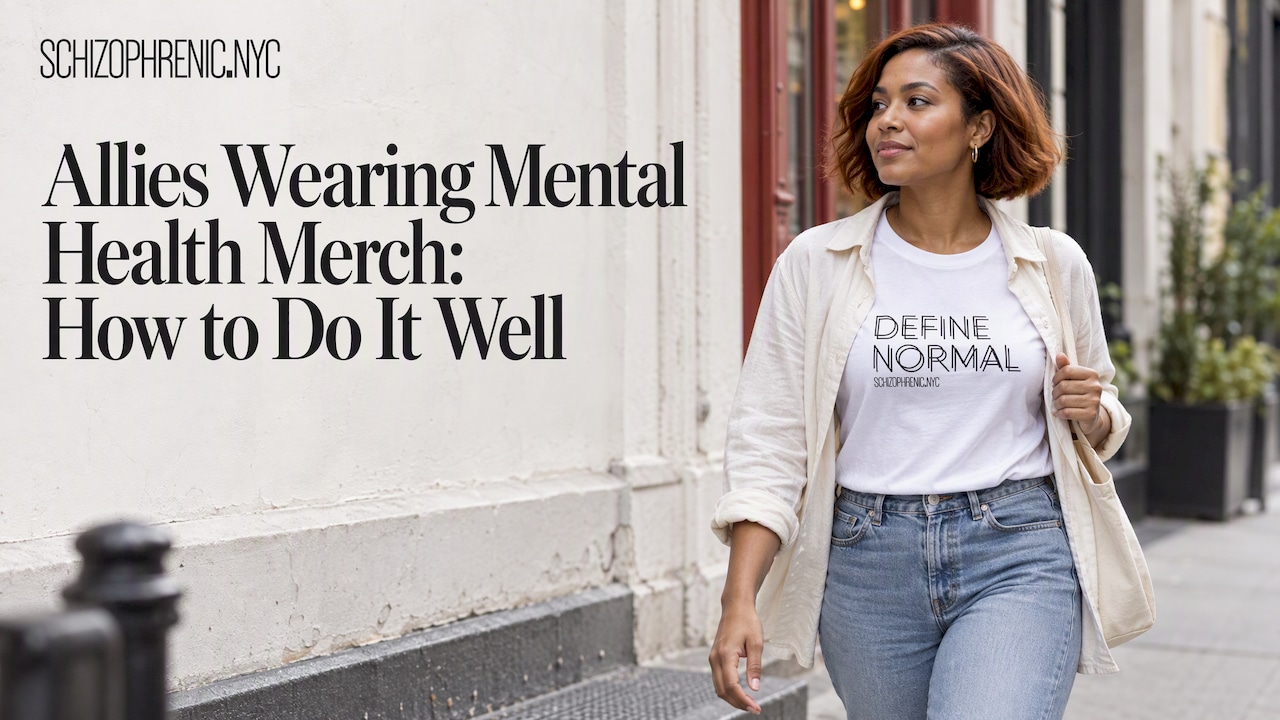
At the same time, don’t confuse blunt with disrespectful. Some of the most powerful advocacy is blunt, because it names things people are afraid to say. The test is who is speaking and who the joke is on. When a person with schizophrenia prints “Define Normal” on a tee, the joke is on the idea of normal, not on the person.
Pay attention to language
Guidance for inclusive writing, such as Australia’s government Style Manual, advises using person-first language for people with mental illness and avoiding describing a person as their illness. Note that this is an Australian style guide, not a US rule, and that many people in the US mental health community choose their own words. Some prefer “person with schizophrenia,” others say “I am schizophrenic” proudly. The ally’s rule of thumb: follow the lead of the person you are talking to, and be careful when your shirt speaks about other people rather than yourself.
That is why a design in which the wearer speaks as a supporter (“Ask me about mental health,” “Stigma fighter,” “I’ve got your back”) often fits an ally better than a design that labels the wearer with a diagnosis they do not have. If you want to wear a bolder, first-person message from an advocate, buy it knowing you are amplifying their voice, not claiming their experience.
Think about where you will wear it
A graphic tee is fine at the gym or on a weekend. At work, a smaller signal may fit better: a button on a bag, a sticker on a laptop, a pillbox on your desk. We have a few ideas for mental health stickers if you want something subtle.
Read the fine print on where the money goes
Many people buy awareness merch because they want their purchase to do some good. That is a fair expectation, and it deserves a quick check.
Reporting on the mental health apparel boom has pointed out that some brands promise to donate a “portion” of proceeds without saying how much or which charities receive it. Before you buy, look for:
- A specific number. A percentage of profit, a percentage of sales or a flat amount per item. These are very different things.
- A named recipient. Which organization, and does the brand say so?
- Who made the design. Is there a real person or community behind it?
- What the brand does besides sell. Speaking, education and community work show that the mission is more than a marketing line.
None of this requires a brand to donate. Some brands, including ours, exist because the founder is an advocate and the product is the advocacy: the shirt is the message. That is a legitimate model, as long as the brand is straightforward about it. What you should avoid is a brand that implies a charitable impact it never explains.
Wearing it without putting pressure on anyone
Here is the part that separates a thoughtful ally from a well-meaning one. Your shirt is an invitation, not a demand. It should never make someone feel they must explain themselves to you.
Mental Health America’s guidance on its bracelet says wearers may use it to signal their emotional state, and observers should respect the wearer’s boundaries and comfort level about talking. The same applies in reverse. If you wear a mental health shirt, you are not entitled to anyone’s story.
Some habits help:
- Don’t ask “What’s your diagnosis?” If someone brings up their own experience, they will tell you what they want to tell you.
- Don’t single people out. Do not point at a coworker and say that your shirt is for people like them.
- Let silence be fine. Someone who sees your shirt and says nothing may still feel better for having seen it.
- Don’t turn conversations into a performance. Your support does not need an audience.
The flip side matters too. When you wear a message, treat it as a low-pressure conversation starter. The same MHA guidance encourages people to be attentive to the message and to use it that way, rather than feeling obligated to offer solutions. You are not a therapist and you do not need to act like one.
What to say when someone asks about your shirt
At some point a person will ask. Maybe it’s curiosity, maybe a quiet test of whether you are safe to talk to. A few honest answers work well:
- “I wear it because I want people to know mental health is okay to talk about.”
- “I have people in my life who live with this, and I want to be a good ally.”
- “I’m still learning, but I think stigma gets worse when nobody talks.”
If the person opens up, the basics hold. Offer a listening ear and avoid judgmental or minimizing language. Skip “at least it’s not worse,” “everyone feels that way sometimes” and “have you tried yoga?” Say things like “That sounds really hard” and “Thank you for telling me.”
Know your limits and the next step
Support from a friend is not treatment. SAMHSA notes that a key part of supporting others is knowing how to connect them with appropriate professional help when a need arises, rather than trying to provide professional-level support yourself. In the US, that can mean encouraging someone to talk with their doctor or a mental health professional, or sharing the 988 Suicide & Crisis Lifeline if they are in crisis. If you believe someone is in immediate danger, call 911.

Beyond the shirt: other ways to show up
Merch is the easy part. The harder, more valuable work looks like this, and Mental Health America’s list of practical actions includes sharing resources, hosting awareness events, listening and helping someone find support:
- Share resources. Keep a few trustworthy links or numbers handy so you can pass them along naturally.
- Listen more than you talk. Most people want to be heard, not advised.
- Host or join an event. A small lunch-and-learn or a community walk makes the cause real.
- Help with the practical things. Rides to appointments, reminders that you’re thinking of someone, an invitation that doesn’t get withdrawn.
- Challenge stigma when you hear it. A calm “that’s not a great way to describe people” counts.
At work
If you are a manager or have influence, pair visible awareness with real support. Mental Health America recommends that employers promote resources like Employee Assistance Programs alongside broader awareness efforts so employees know what help exists. A button on your lanyard means more when your team also knows how to reach those services.
Our perspective: why we make wearable advocacy
We started Schizophrenic.NYC because I wanted to wear what I had lived. When I was diagnosed with schizophrenia, the world gave me one message: hide it. I took that message seriously for a while, and the voices in my head agreed with it. Hiding made me feel smaller. What turned things around was medication, support from people who loved me, and the decision to stop being ashamed out loud.
So I started putting it on shirts. Bold graphics, honest words, a little humor, and no apology. People stop me on the street to ask what my shirt means, and those chats have been some of the best of my life. I have met people who told me they had never said the word “schizophrenia” to anyone before that moment.
As for allies, we love you, and we want you in this. Here is what we ask:
- Wear it because you mean it, and be ready to back the shirt up with kindness.
- Let people with lived experience tell their own stories.
- Don’t use the word “crazy” lightly, even with a cool shirt on.
- Remember that confidence can get you anywhere, and that includes the confidence to say “I don’t know much, but I’m listening.”
Our work is more than shirts. We speak, share stories and keep the conversation public because stigma shrinks when ordinary people talk about mental illness as an ordinary part of life. Every ally who wears the message helps make that conversation normal for the next person who is afraid to start it.
— Michelle
Find something you’ll actually wear
If you’re ready to pick something up, start with what fits your daily life. Our mental health clothing collection brings together the apparel, and you can browse by type: mental health T-shirts, tank tops and hoodies and sweatshirts. Tees like Define Normal and Psych Meds Keep It Real are designed to get people talking about what normal even means and why medication is nothing to hide.
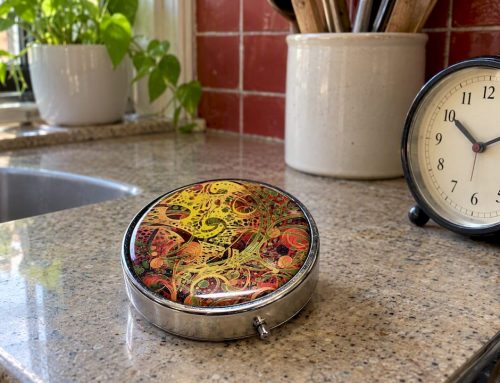
Prefer something quieter? Our pillboxes are useful and a gentle way to normalize taking medication, and the buttons and artwork are easy to pin to a bag or hang on a wall. Every design comes from an advocate with lived experience of schizophrenia.
A quick checklist before you buy
| Question | What a good answer looks like |
|---|---|
| Who designed it? | A named person or community with real connection to the cause |
| What does the message say? | Respectful, humanizing, no jokes at the expense of people with illness |
| Where does the money go? | A clear explanation, ideally with numbers and named recipients |
| Does the brand do more than sell? | Speaking, education, storytelling, community work |
| Am I ready to talk about it? | You can answer a question or point someone to help |
If you can answer all five, buy it and wear it proudly.
FAQ
Is it okay to wear mental health merch if I don’t have a mental health condition?
Yes. Allies are a big part of reducing stigma, and many people with mental illness say that visible support from others makes a real difference. Choose a message that supports rather than claims an experience that isn’t yours, and be prepared to listen if someone starts a conversation.
Does wearing awareness apparel actually reduce stigma?
A single shirt will not change attitudes on its own, but it can start conversations and make the topic feel more ordinary. Research on a community campaign in the Omaha area linked awareness of the campaign with people providing support more often. Pair what you wear with real actions like listening and sharing resources.
What should I say if someone shares their story after seeing my shirt?
Listen first. Thank them for trusting you, validate what they’ve said, and avoid minimizing comments or quick fixes. If they need more than a friend can offer, encourage them to talk to a doctor or mental health professional, and share the 988 Suicide & Crisis Lifeline if they are in crisis.
How can I tell if a brand really supports mental health causes?
Look for specifics: a stated amount, a named organization, and a real person behind the designs. Be wary of promises to donate a vague “portion.” Brands built around an advocate’s own voice and ongoing work, such as speaking and storytelling, are showing their commitment through what they do, not just what they print.
Sources
- Stigma stops when we start talking, Mental Health America
- Mental health merch: conversation-changing or commodifying?, The Guardian
- Mental Health Stigma Reduction in the Midwestern United States, PMC
- Cross-Agency Evaluation of DoD, VA, and HHS Mental Health Campaigns, RAND
- Disability and neurodiversity, Style Manual (Australian Government)
- From Sweatshirts to Baseball Caps: Unpacking the Mental Health Apparel Boom, Polyester
- How to Talk to Friends and Family Members About Mental Health, SAMHSA
- How can we promote our EAP to increase its usage?, Mental Health America
Recommended
- What Should I Wear To Support Mental Health?
- Campaign Ready Mental Health Slogans: Merch Tested and SAMHSA Aligned
- Mental Health-Themed Fashion: Style, Advocacy, and Impact
- Mental Health Tank Top Ideas for Advocates and Allies