You can fix a pilled hoodie in about ten minutes. Lay it flat, pull the fabric taut, and gently remove the pills with an electric fabric shaver, a sweater stone or a clean, dry, soft toothbrush. Test your tool on a hidden spot first, and never pick the pills off with your fingers. Then change a few laundry habits so the fuzzballs stay away.
Pilling is not a sign that you did something wrong, and it is not a reason to give up on a favorite hoodie. It is what happens when a soft, well-loved piece of clothing gets worn, rubbed and washed. This guide walks you through the fix, the tools, the prevention habits and the fabric details that explain why some hoodies pill faster than others.
TL;DR
- Remove pills with a fabric shaver, sweater stone or soft toothbrush while the hoodie lies flat and taut. Always test a hidden area first.
- Never pull pills off by hand. It can tear holes in knitwear.
- Use a fabric shaver sparingly, ideally once or twice a year on any one garment.
- Prevent new pills by washing less often, turning the hoodie inside out, not overloading the machine and air drying.
- Pilling does not automatically mean a poor-quality hoodie. Most fabrics pill with repeated wear.
Table of Contents
- What pilling is and why hoodies get it
- Three rules before you touch the fabric
- How to remove pills from a hoodie, step by step
- Which tool should you use?
- Can pilling be reversed? Does it mean the hoodie is poor quality?
- How to stop pilling from coming back
- Does the fabric make a difference?
- Our perspective
- Keep your favorite pieces looking good
- FAQ
- Sources
What pilling is and why hoodies get it
Pills are small, linty balls that form when loose fibers on the surface of a garment tangle together. Vogue describes them as the result of friction and wear, and that friction can come from rubbing, washing or dryer heat pulling fibers loose.
A hoodie is a perfect target. Think about where it gets rubbed:
- Under the arms and along the sides, where your arms move against your torso all day.
- Where a backpack or tote strap sits, which is a constant source of friction. Whirlpool specifically points to bags as a source of abrasion.
- The cuffs and the front pocket, where hands, sleeves and phones rub the same patch again and again.
- The inside of the hoodie, especially if it has a brushed or fleece lining that rubs against another layer.
The same Whirlpool guidance notes that knitted fabrics and fabrics with shorter, looser fibers are more susceptible, and that wearing fewer rubbing layers helps. UL Solutions, a textile testing organization, explains that pills form when short, broken fibers tangle into balls through abrasion. Short fibers such as cotton and loosely constructed knits are more prone to it, while tighter twists resist wear.
In plain terms: soft and cozy often means more loose fibers on the surface, and loose fibers are what pills are made of.
Three rules before you touch the fabric
Most hoodie damage during de-pilling comes from rushing. Keep these rules in mind.
- Test first. Before you treat the whole garment, try your method on an inconspicuous area, such as the inside of a hem or the underside of a cuff. Good Housekeeping advises this so you can be sure the tool does not snag or damage the specific material.
- Never pull pills off by hand. Good Housekeeping warns that pulling can tear holes in knitwear. Pills are anchored to the fabric by fibers, and tugging them can pull the surrounding fabric with them.
- Go gently. Even tools that look harmless, such as combs, can snag or roughen fibers if you press too hard. Light, even strokes beat force every time.
How to remove pills from a hoodie, step by step
This is the basic routine. It works whether you choose a shaver, a stone or a toothbrush.
- Lay the hoodie flat. Use a table, an ironing board or a clean bed. Vogue’s guidance is to keep the garment flat and taut while you work.
- Smooth out the area. Stretch the fabric gently with your free hand so the surface is tight, like a drum. Loose fabric bunches up and is much easier to nick.
- Pick a test spot. Try your tool on a hidden area and check for snags, thin patches or fuzzing.
- Work in small sections. Use light, steady strokes. With a toothbrush, brush in one direction over the pilly area to loosen and sweep the pills away.
- Do the high-wear zones last. Underarms, sides and cuffs tend to be the worst. Take your time there, since thinner fabric is easier to damage.
- Clear the debris. Wipe the surface with a lint roller or shake the hoodie out so the loosened fibers do not just resettle.
- Re-check in daylight. Pills hide in artificial light. A quick look by a window tells you whether you missed a patch.
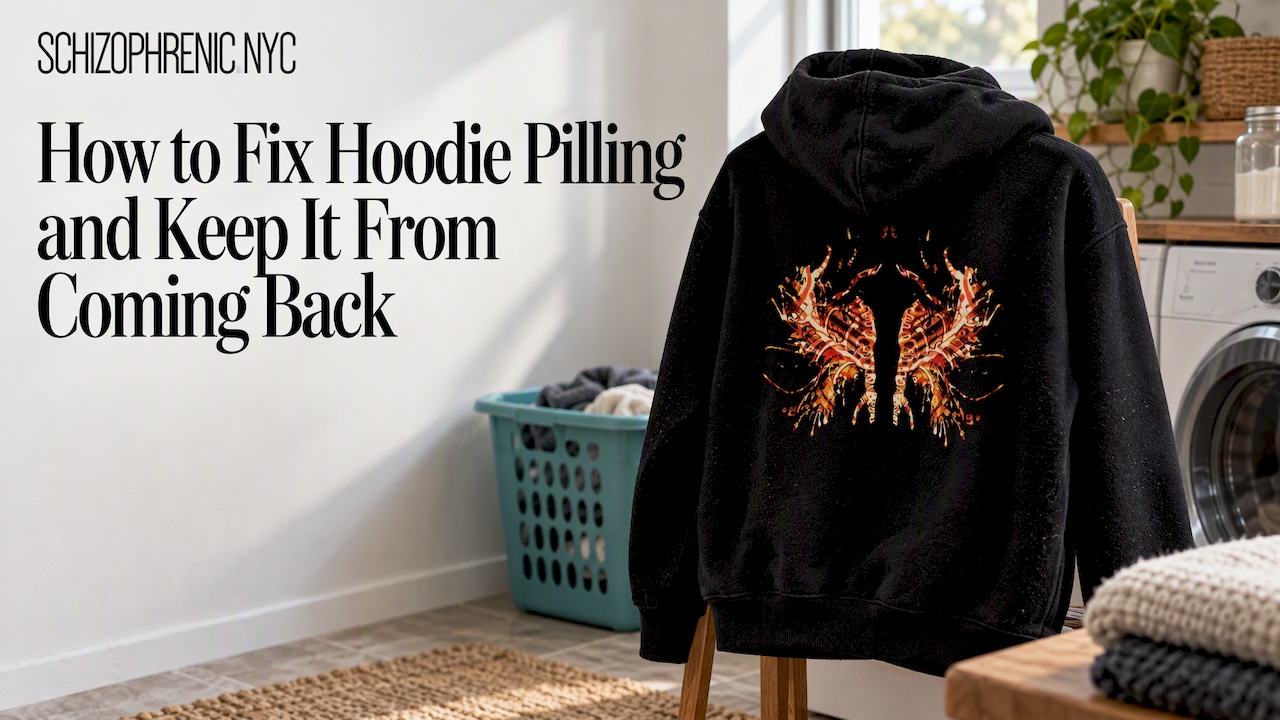
If the hoodie has a screen-printed or graphic design on the front, go slowly around it and keep the tool off the print itself. Ink sits on the fabric, and an aggressive tool can scuff it.
Which tool should you use?
There is no single best de-pilling tool, only the right one for your fabric and your comfort level. Here is how the common options compare, based on the guidance from Vogue and Wirecutter.
| Tool | Best for | Watch out for |
|---|---|---|
| Electric fabric shaver | Thick, sturdy knits and fleece-type hoodie fabric with plenty of pills | Hard on fiber integrity, so use it sparingly. Avoid on delicate fabrics. |
| Sweater stone (pumice or recycled glass) | Medium pilling on sturdy fabrics | Test on a hidden spot first. Too much pressure can roughen fibers. |
| Clean, dry, soft toothbrush | Fuzzy knits and fleece, light pilling | Slow on large areas. Use gentle strokes in one direction. |
| Sweater comb | Delicate or thin knits | Can still snag if used forcefully. |
| Lint roller | Loose, small pills that are not firmly attached | Won’t handle big or persistent pills. |
| Disposable razor | Experienced users only | Easy to cut the garment. Use extra caution, or skip it. |
A note on fabric shavers
Electric fabric shavers are fast and effective, and many people swear by them. They are also the tool most likely to cause harm. Wirecutter’s reporting notes that shaving is inherently hard on a garment’s integrity, but is often the lesser of two evils compared with throwing a pilled garment away, as long as you use it sparingly. The same piece cites FIT’s Preeti Arya, who suggests using a shaver on any one garment only once or twice a year.
Fabric shavers are also not meant for delicate materials such as lace or thin wool knits, where a manual tool like a sweater comb is safer.
When the toothbrush wins
For a fuzzy, brushed-inside hoodie, a toothbrush can be the friendliest option. Vogue recommends a toothbrush for fuzzy knits and fleece. Make sure it is clean and dry, and keep it for fabric only. It costs nothing, it gives you control, and it is very hard to cut a hoodie with it.
Can pilling be reversed? Does it mean the hoodie is poor quality?
Yes to the first, not necessarily to the second.
A fabric shaver can bring a pilled garment back to life, according to Wirecutter, though shaving carries some risk of damage. Pilling also does not always signal poor quality, because most fabrics can pill with repeated wear.
UL Solutions states that no fabric is completely pill-free. Manufacturers can assess a fabric’s resistance before production using pilling tests, and the Martindale scale runs from 5 (no or insignificant pilling) to 1 (very severe pilling). In that testing view, pilling is typically an abrasion-related surface change rather than automatically a defect. Fiber length, knit structure and yarn twist all influence how well a fabric resists it.
So if a hoodie pills after months of heavy wear, that tells you it has been lived in. If it pills after one or two wears, the fabric construction may be the cause, and that is worth remembering the next time you shop.

How to stop pilling from coming back
Removing pills is a fix. Changing how you wash and wear the hoodie is the cure. Vogue and Grove both point to the same set of habits.
Wash less often
Every wash is a round of friction. A hoodie that has been worn over a clean tee for a few hours often does not need a full wash. Hang it up to air out, and spot clean small marks when you can.
Turn it inside out
Washing a hoodie inside out keeps the outer surface from rubbing against the drum and other garments. If the inside is brushed fleece, the rubbing hits the lining instead, which is a better trade.
Do not overload the machine
A packed washer means more fabric rubbing against more fabric. Whirlpool’s guidance is to avoid overloaded washing, and to reduce abrasion from other sources too.
Separate heavy from delicate
Grove explains that separating heavy or textured items from thinner, delicate fabrics prevents the abrasion that leads to pilling. Jeans, towels and zippered items are the usual troublemakers. Wash your hoodie with similar soft knits instead.
Use a mild detergent and a gentle cycle
A delicate or gentle cycle with a mild detergent is easier on the fibers. Grove also notes that enzyme-based detergents containing cellulase can help clear loose, stray fibers that contribute to pilling, although they are not recommended for delicate fibers like silk. Check the care label on your hoodie before you try one.
Air dry or use low heat
Dryer heat and tumbling both pull fibers loose. Air drying flat or on a rack is the gentlest option. If you do use a dryer, keep the heat low and take the hoodie out while it is still slightly damp.
Watch the friction points
Backpack straps, tote bags and seat belts all rub the same patches over and over. If your shoulders always pill first, rotate which hoodie you wear on bag days.
For more on washing technique, our guide to washing hoodies without shrinkage or fading covers temperature, drying and storage in more detail.
Does the fabric make a difference?
It does. Cotton, polyester and fleece blends behave differently, and knowing what your hoodie is made of helps you choose the gentlest fix.
Vogue notes that soft, loosely held knits and cotton-polyester blends can be more susceptible, while the underlying driver is always friction. UL Solutions adds that short fibers and loosely constructed knits are more prone to it, and tighter twists resist wear.
Finishing processes matter as well. A 2021 peer-reviewed study of three-thread polyester-cotton fleece found that untreated samples scored grade 1 for pilling resistance. Heat setting improved them to grade 2, singeing to grade 3, and both treatments together to grade 4 under the study’s test method. That shows manufacturing finishes can make a real difference, though it does not predict how any one hoodie will perform.

If you are comparing garments before you buy, it helps to read up on choosing the right garment material, since fiber content shapes both comfort and how a piece ages. Weight matters too. Our guide to heavyweight versus lightweight hoodies explains how fabric weight changes the feel and the wear, and our explainer on fleece types breaks down what the different fleece grades mean for layering and daily use.
A quick fabric checklist
- Thick brushed fleece lining: use a soft toothbrush or a light pass with a shaver. Avoid hard pressure.
- Cotton-polyester blend: expect pills to appear in friction zones. A shaver or stone works, used sparingly.
- Thin or delicate knit: skip the shaver. Use a sweater comb gently, or a toothbrush.
- Anything with a printed design: keep tools off the print and work around it.
Our perspective
We make clothes to be worn out in the world, in classrooms, on subway platforms, at speaking events, in line for coffee. A hoodie that says something about mental health is only doing its job when someone has it on, which means it is going to get worn, rubbed and washed.
That is why we never see a pilled hoodie as a failure. It is a hoodie that has been out there. Some of my favorite pieces are the ones with the most history in them. Still, I know how it feels when something you love starts to look tired, and when you are wearing a message you care about, you want it to look sharp.
My advice is simple. Be gentle, be patient and do not feel guilty about it. Take ten minutes, lay the hoodie flat, and go slowly. Wash it a little less often than you think you need to. Treat it like something that matters to you, because it probably does.
Wearing a message is a way of starting a conversation, and a hoodie you feel good in gives you the confidence to have it.
— Michelle
Keep your favorite pieces looking good
If you are ready for a hoodie that is worth caring for, take a look at our mental health hoodies and sweatshirts. Each one carries original artwork and an awareness message designed to spark an honest conversation and reduce stigma around mental illness. Pieces like the Black Fire Rorschach hoodie sweatshirt or the I’m Mentally Ill And I Don’t Kill hoodie sweatshirt are made to be worn often, so the care habits above are worth building from day one.
FAQ
How do I stop my hoodie from pilling?
Wash it less often, turn it inside out, and avoid overloading the machine. Use a mild detergent on a gentle cycle and air dry when you can, since dryer heat and friction both pull fibers loose. Also cut down on rubbing from backpack straps and other layers.
Does pilling mean a hoodie is poor quality?
Not always. UL Solutions says no fabric is completely pill-free, and most fabrics will pill with enough wear. Fiber length, knit structure and yarn twist all affect resistance, so a hoodie that pills very quickly may have a construction that is more prone to it.
Can you reverse pilling on a hoodie?
Yes, you can remove existing pills with a fabric shaver, sweater stone or soft toothbrush, which makes the fabric look much smoother. The fabric may be slightly thinner afterward, so use shavers sparingly, no more than once or twice a year on a given garment.
What is the safest way to remove pills from a fleece hoodie?
A clean, dry, soft toothbrush is a gentle choice for fuzzy knits and fleece. Lay the hoodie flat, keep it taut, and brush in one direction with light strokes. Try it on a hidden spot first, and never pull pills off by hand.
Sources
- How to Remove Pilling From Clothes, Vogue
- 3 quick and easy ways to get rid of bobbles on your jumpers, Good Housekeeping UK
- Read This Before You Take a Fabric Shaver to Your Favorite Sweater, Wirecutter
- Untangling the How, What and Why of Textile Pills, UL Solutions
- What Is Fabric Pilling & How to Prevent It, Whirlpool
- How to Remove and Prevent Sweater Pilling, Grove
- An approach to improve the pilling resistance properties of polyester-cotton fleece fabric, PubMed Central
Recommended
- Stop Shrinkage and Fading When You Wash Hoodies with Fabric First Care
- Heavyweight vs Lightweight Hoodie: How to Choose
- How to Use a Hoodie Size Guide to Get a Perfect Fit