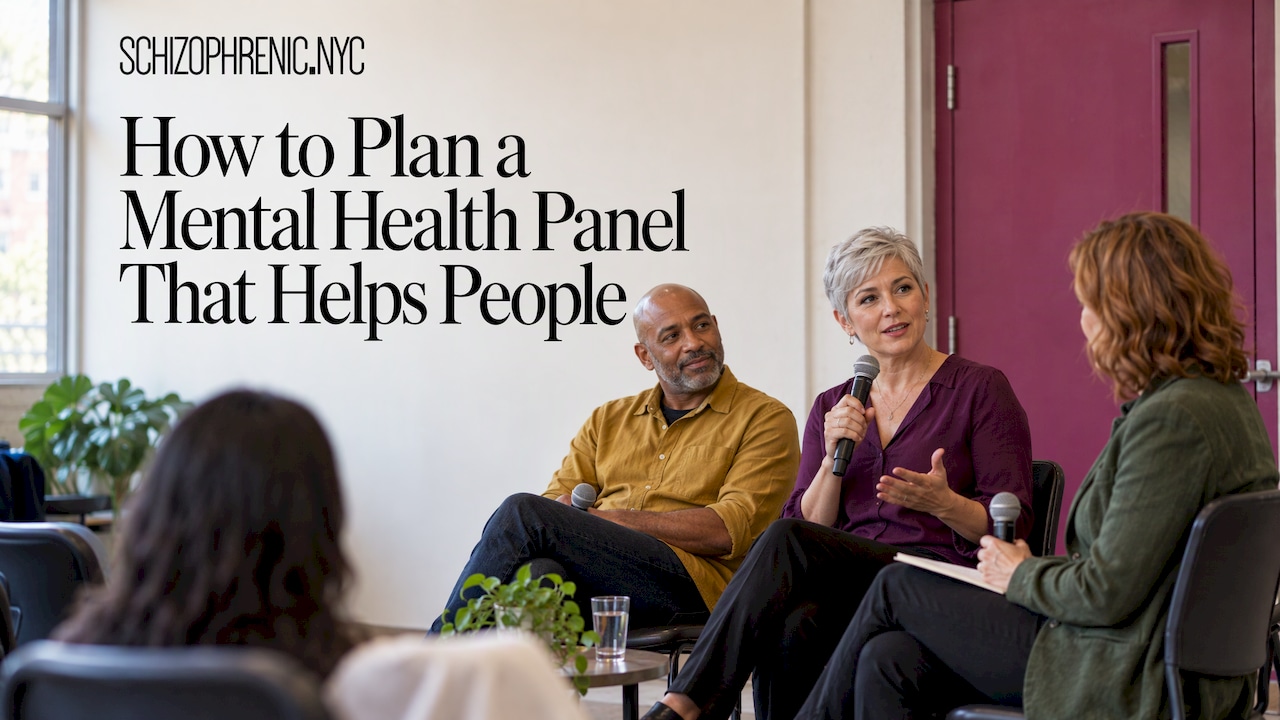
To plan a mental health panel, decide who you want to reach and what you want them to walk away with. Then recruit a small, varied group of panelists, choose a moderator who can hold a tough conversation, and put trained support in the room before anyone speaks. Everything else, from the room layout to the follow-up email, grows out of those choices.
We built Schizophrenic.NYC around open conversation about mental illness, and we have seen how much a well-run panel can change a room. We have also seen what happens when the basics get skipped. This guide walks you through the whole process, step by step, in plain language.
TL;DR
- Start with one audience and one goal, then pick a topic narrow enough to cover in about an hour.
- Aim for two to five panelists with different perspectives, plus a moderator who is trusted by the audience.
- Always have a licensed clinician or trained professional present for support. A clinician sitting on the panel does not count as that support.
- Brief panelists in advance, share the questions, and hold a practice session well before the event.
- Show crisis resources, set ground rules, and plan follow-up so the conversation doesn’t end when the lights come up.
Table of Contents
- Start with purpose and audience
- Choose a focused topic and a format
- Choose your panelists
- Pick the right moderator
- Prepare panelists and write the questions
- Set ground rules and safeguards
- Handle distress and disclosures during the event
- Promote the panel and set up the room
- Follow up after the panel
- A planning checklist
- Our perspective
- Bring the conversation home with our products and speaking
- FAQ
- Sources
Start with purpose and audience
Before you book a room or send a single invitation, answer two questions. What do you want to accomplish? Whom do you want to reach? Active Minds’ guide to panel discussions begins in exactly this place, and it is good advice because every later decision depends on it.
A panel for high school students looks nothing like a panel for HR managers. A panel meant to reduce stigma in a faith community has different needs than one meant to help clinicians understand lived experience. Write your goal as one sentence. For example:
- “Help college students recognize early warning signs and know where to get help on campus.”
- “Give employees a chance to hear how coworkers have handled mental health at work.”
- “Show neighbors that people with serious mental illness are part of the community, not outside it.”
If you can’t finish that sentence, you aren’t ready to invite panelists yet.
Build a small planning team
You don’t have to plan alone, and you shouldn’t. The American Academy of Child and Adolescent Psychiatry suggests forming a planning committee with representatives from allied groups, such as family organizations, mental health providers and advocacy organizations, so more people feel the event is theirs. Campus groups can do the same. Active Minds suggests that chapters partner with other campus organizations and spread the word through school-wide email lists and word of mouth.
Even three or four people is enough. Give one person each of these jobs: logistics, panelist outreach, promotion, and attendee support. Our mental health event planning guide goes deeper on the wider event if your panel is part of something bigger.
Choose a focused topic and a format
Broad topics produce shallow answers. “Mental health” is a category, not a topic. Better options are “Starting therapy for the first time,” “Supporting a family member who lives with psychosis,” or “Talking about mental health at work.”
A guide to creating and moderating successful panels from the Association of Food and Drug Officials puts it simply: know your audience, identify a specific topic and a clear message, and then pick a format that fits. Its examples include a roundtable or a presentation-style panel. Mental health is not their field, but the logistics of a good panel are the same everywhere.
Match the setting to the community
Context matters as much as topic. NAMI’s community programs, such as NAMI Sharing Hope, are grounded in personal stories and tailored to the setting, whether that is a faith gathering or a local event. Take the same approach. Ask people in the community what they want to hear, and in what words. Language that feels warm in one room can feel clinical or foreign in another.
A simple format that works
For a 60 to 75 minute panel, this structure gives you room to breathe:
| Segment | Time | What happens |
|---|---|---|
| Welcome and ground rules | 5 min | Moderator introduces the goal, the rules, and where support is located |
| Panelist introductions | 10 min | Each panelist shares who they are and why they care, in about two minutes |
| Guided questions | 30 to 35 min | Moderator asks prepared questions and invites follow-ups |
| Audience Q&A | 15 to 20 min | Questions come from the floor or from cards |
| Close and resources | 5 min | Moderator thanks everyone and repeats where to find support |
These timings are our own suggestion, not a standard. Adjust them to your audience’s attention span and your room.
Choose your panelists
Active Minds describes a panel as an event with two to five panelists and a moderator. Panelists should bring a broad range of perspectives and relevant experience. More than five people means everyone gets too little time to say anything meaningful.
Think in terms of the mix, not the résumé. For a community panel, AACAP suggests considering people such as state legislators, child and adolescent psychiatrists, community mental health providers, and youth with mental illness and their families. Adapt that list to your own audience. A workplace panel might include an HR leader, an employee with lived experience, and a therapist who works with employers.

Include lived experience, with care
People who live with a mental health condition are the experts on what it feels like. Their stories are often what audiences remember most. That also means they deserve support. Ask them what they are comfortable sharing, let them decide how much detail to give, and never pressure anyone to disclose. If panelists share stories about patients or clients, they should do so only with consent and in de-identified form, as one physician’s panel planning guide recommends.
SAMHSA also encourages community and faith leaders to talk openly about their own mental health and make mental wellness a priority. A respected local leader who shares honestly can make it easier for everyone else to do the same.
Pick the right moderator
The moderator carries the room. According to Active Minds, the moderator introduces the panelists, asks the questions, and opens the floor to audience Q&A.
For sensitive topics, personality counts as much as skill. The CDC’s facilitator guide for roundtables on mental health says facilitators should be emotionally intelligent, experienced at holding space for complex conversations, and trusted by the audience. Look for someone who can:
- Stay calm when a story gets heavy, and slow the room down when needed.
- Keep time without making panelists feel rushed.
- Redirect gently if someone drifts into graphic detail or gives medical advice.
- Thank people for vulnerable answers before moving on.
The moderator also manages audience questions. Good moderators direct each question to the panelist best placed to answer it, then ask the other panelists to add their perspective. That keeps one voice from dominating.
Prepare panelists and write the questions
Great panels feel spontaneous because someone did the preparation. Brief each panelist on the topic, the message, the audience, and how long they will have. Then share the questions ahead of time and hold a practice session to run through order and timing. The same guide recommends holding that rehearsal at least a month before the event, which gives you time to fix problems.
For mental health panels, that preparation does more than polish the delivery. It lets people with lived experience decide in advance what they are ready to say out loud.
Write questions that invite stories and skills
Avoid yes-or-no questions and avoid questions that ask people to relive their worst moments. Aim for questions about what helped, what they wish others knew, and what they would say to someone just starting out. A few examples:
- What is one thing that made it easier to ask for help?
- What do people often get wrong about your experience?
- What does a good day of taking care of yourself look like?
- What is one small thing a friend, coworker, or teacher did that mattered?
- What would you like the audience to do differently tomorrow?
Questions like these produce practical takeaways instead of shock. They also match what the audience came for: hope and tools, not graphic detail.
Set ground rules and safeguards
This is the part you must not skip. Mental health topics can be triggering, and Active Minds stresses that organizers should prioritize professional support personnel regardless of how safe the event seems.
Have a clinician or trained supporter present
Active Minds recommends always having at least one licensed clinician or trained professional on hand, such as counseling center staff or trained peer counselors. It also notes that a clinician who is serving as a panelist does not meet this need, because that person is busy being a panelist. Assign someone whose only job is to watch the room and help anyone who is struggling.
Pathlight Behavioral Health’s event kit suggests placing support staff at resource tables and on the post-event panel so that people who are triggered can get immediate help.
Write ground rules and read them aloud
The same Pathlight kit points to confidentiality, respect, and nonjudgmental attitudes as the heart of good ground rules. Put them on a slide and have the moderator read them out. A simple version:
- What is shared here stays here. What is learned here leaves here.
- Speak from your own experience. Don’t diagnose or advise other people.
- Listen without judgment. Everyone is at a different point.
- Take a break whenever you need one. Support staff are at the back of the room.
SAMHSA encourages organizers to build a trauma-informed environment that emphasizes nonviolence, acceptance, and compassion. In practice, that means a quiet exit that people can use without being noticed, no surprise graphic images, and a welcoming tone from the first minute.
Show crisis resources and keep detail safe
Put crisis information on screen at the start and again at the end. In the United States, that means the 988 Suicide & Crisis Lifeline, which you can reach by calling or texting 988. Dr. Harvey Castro’s panel guide also recommends displaying crisis resources at the beginning and end of a panel and asking panelists not to describe self-harm methods in slides, stories, or Q&A. Tell panelists about that rule during the briefing, not on the day.
Handle distress and disclosures during the event
People sometimes share something personal from the audience, and sometimes it is raw. Plan for it. Active Minds advises having a clinician present as a resource, making counseling staff available for difficult situations, and reminding attendees about counseling resources.
Here is a simple plan for the moderator:
- Thank the person for trusting the room. Keep your tone kind and unhurried.
- Do not probe for details or turn the moment into a debate.
- Offer a break, then have the support person quietly check in.
- Remind everyone where support is available and move on with care.
Castro’s guide also suggests planning for audience Q&A, responding kindly to personal disclosures, and making sure staff know where to guide someone for support. SAMHSA recommends training key community members to recognize signs of depression and suicide so they can refer people to local resources. If your budget allows, offer that short training to your volunteers before the event.
If anyone at your event is in immediate danger, call 911. For emotional crisis, call or text 988.
Promote the panel and set up the room
Promotion should match the audience. Campus panels do well with school-wide email lists and personal invitations, as Active Minds suggests. Workplace panels do better with a note from leadership. Community panels do best when trusted local groups spread the word. Our community engagement ideas can help you think about who else to bring in.
A few practical details make a big difference:
- Seating: Place panelists at a table or in chairs with water and name cards. Leave space for people to enter and leave quietly.
- Microphones: Test them. Audiences disengage fast when they can’t hear a soft-spoken story.
- Accessibility: Check step-free access, captioning, and printed copies of the questions.
- Resource table: Offer flyers for local services, hotline information, and support groups. If you have a table anyway, our event booth ideas show how to make it welcoming instead of clinical.
- Quiet space: Reserve a nearby room where someone can step away and talk with a support person.
Follow up after the panel
The best part of a panel is often what people do afterward. AACAP suggests offering educational materials, summarizing the forum in organizational newsletters, building an action plan with the planning committee, and considering making the event annual.
Within a week, send a thank-you to panelists and a short message to attendees with the resource list, the 988 information, and a way to give feedback. Ask two questions: what was most useful, and what would you like to hear next? Then share the key takeaways in your newsletter or on social media, with panelists’ permission. Our piece on fostering open dialogue on mental illness has ideas for keeping the conversation going between events.
A planning checklist
| When | What to do |
|---|---|
| 2 to 3 months out | Define purpose and audience, form the planning team, choose topic and date |
| 6 to 8 weeks out | Invite panelists and moderator, secure a clinician or trained support person, book the space |
| 4 to 6 weeks out | Hold the practice session, finalize questions, start promotion |
| 1 week out | Confirm all roles, print ground rules and resource lists, test equipment |
| Day of | Arrive early, brief support staff, display 988 on screen at the start and end |
| After | Thank panelists, share resources, collect feedback, plan the next one |
The timeline is our suggestion. The one-month practice session comes from the AFDO guide, and the rest depends on your event.
Our perspective
When I started speaking about schizophrenia, I learned fast that people don’t need a perfect speech. They need to see someone who looks like them, or like their sister, or like their coworker, talking about this out loud and still standing.
That is why we think panels are one of the best tools for changing minds. A room full of people hears real voices, in real time, and the stigma starts to loosen. But it only works when the people on stage feel safe and the people in the seats feel safe too. Put the support in place first. Brief your panelists kindly. Let people with lived experience say what they want to say, and nothing more than they want to.
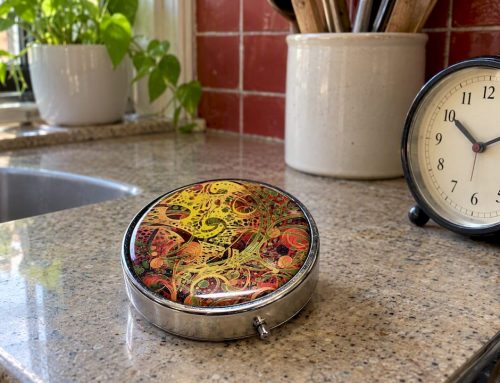
We also believe the little things carry the message. A pillbox on the resource table starts a conversation about medication that most people are afraid to start. A button on a panelist’s jacket says “you can ask me about this.” Wearable art gives the audience a way to keep talking after they leave, and that is the whole reason we make what we make.
If you plan well and lead with compassion, your panel will give someone the courage to ask for help. That is worth every hour of planning.
Michelle
Bring the conversation home with our products and speaking
If you are planning a panel, we can help in two ways. Michelle is available for public speaking and design and direction, and she can bring lived experience of schizophrenia to your stage. For your resource table or your volunteers, look at our pillboxes, our artwork button set, and our mental health tank tops. Each one is designed to start the kind of conversation your panel is trying to open.
FAQ
How many panelists should a mental health panel have?
Two to five is the usual range, along with a moderator, according to Active Minds. Fewer than that can feel thin, and more than five leaves each person too little time. Choose people with different perspectives, such as lived experience, clinical expertise, and community leadership.
Do I need a therapist or clinician at the event?
Yes. Active Minds recommends always having at least one licensed clinician or trained professional present to support participants. If a clinician is also a panelist, bring in someone else for support, because a panelist can’t watch the room while speaking.
What should I say at the start of the panel?
Welcome everyone, state the goal of the event, read the ground rules, and say where support staff are located. Show crisis information on screen, including the 988 Suicide & Crisis Lifeline, which is available by call or text. Then introduce your panelists.
When should I hold a practice session?
AFDO’s panel guide recommends holding it at least a month before the event. That gives panelists time to adjust their answers and gives you time to fix problems with order, timing, or questions. Share the questions ahead of time so people with lived experience can decide what they want to say.
Sources
- Planning a Panel Discussion, Active Minds
- Chapter FAQs, Active Minds
- Organizing Forums on Children’s Mental Health, AACAP
- Creating, Coordinating and Moderating a Successful Panel Discussion, AFDO
- NAMI Sharing Hope
- Facilitator’s Guide for Roundtable Discussions, CDC
- How to Talk to Community and Faith Leaders About Mental Health, SAMHSA
- 988 Suicide & Crisis Lifeline, SAMHSA
- Event and Resource Kit, Pathlight Behavioral Health
- Mental Health and AI Speakers: Panel Guide, Dr. Harvey Castro
Recommended
- Mental Health Themed Event Planning Guide
- Mental Health Community Engagement Ideas That Work
- The Best Mental Health Speaker Topics for Your Next Event
- Mental Health Poster Ideas for Schools, Work & Community