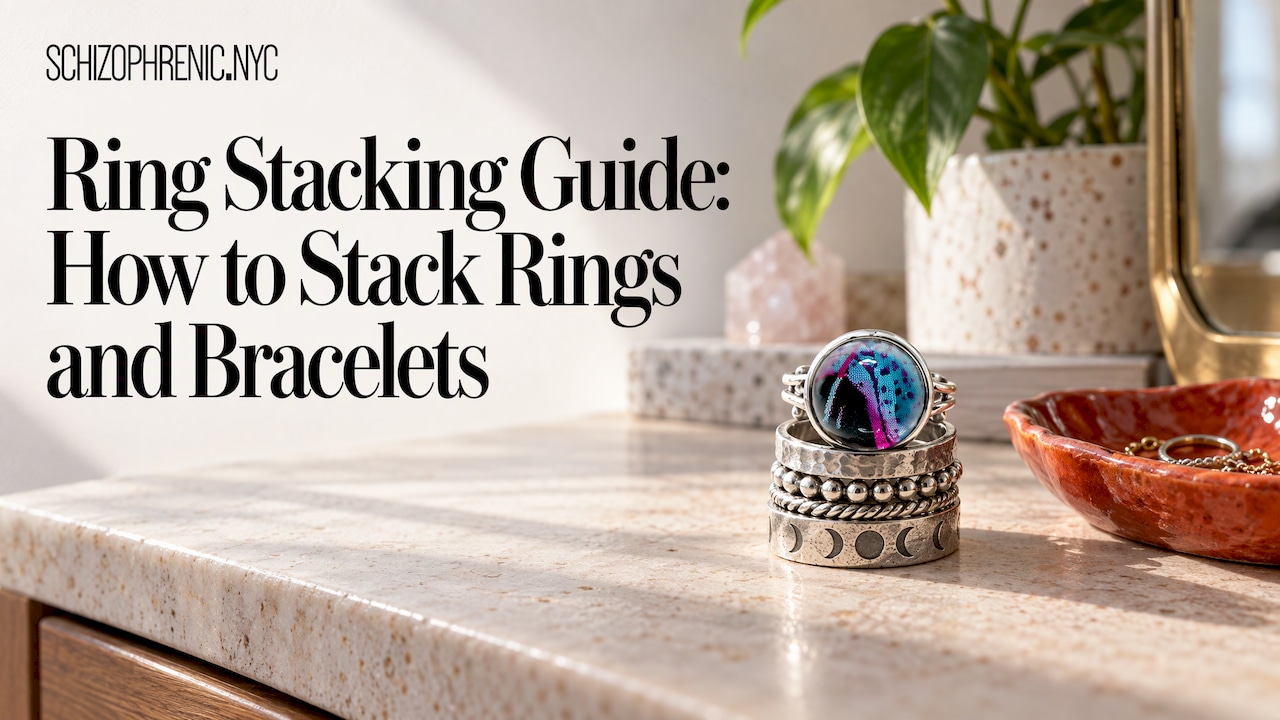
A good ring stack starts with one piece you love, then adds thinner or differently textured pieces around it until the whole hand feels balanced and comfortable. The same logic works for bracelets. If you want the stack to mean something, start with a piece that carries a message. Our mental health awareness rings are made for exactly that: jewelry you can build a stack around, and a conversation starter on your hand.
Below you will find how to choose your anchor ring, how to mix widths and metals, how to stack bracelets without tangles, and what to do when a bracelet slides around your wrist.
TL;DR
- Start with one statement ring, then add thinner bands in different textures so the stack flows instead of competing.
- Put the thickest ring at the bottom of a finger stack, leave room near the knuckle, and keep at least one finger bare.
- For bracelets, work in odd numbers, pick one focal piece, and use a buffer piece between delicate or tangle-prone ones.
- A loose bracelet can often be fixed with a built-in adjustment, a smaller setting or a gentle bend of a cuff. Fine or soldered pieces belong with a jeweler.
- Make the stack personal: one awareness piece in the mix turns style into advocacy.
Table of Contents
- What ring stacking actually is
- How to stack rings, step by step
- Ring stacking ideas worth borrowing
- Stacking wedding and engagement rings
- How to stack bracelets
- How to tighten a bracelet or make it smaller
- Build a stack that speaks
- Our point of view
- Start your stack with something that means something
- FAQ
- Sources
What ring stacking actually is
Ring stacking means wearing several rings together, either layered on one finger or spread across both hands. There is no rulebook. There are, though, a few principles that jewelers and gem educators keep returning to: contrast, balance, and comfort.
The GIA ring stacking guide (published May 12, 2025) suggests alternating band thickness so the rings visually flow from one to the next. It also suggests beginning with a statement piece and adding thinner bands in different textures around it. That is a useful frame for everyone, whether your rings are fine jewelry or everyday fashion pieces.
For many of us, a stack is also a story. People layer rings for milestones, for family, for a favorite color. Some of us layer them for a cause. That is the idea behind wearable advocacy: something small you put on in the morning that says who you are without you having to explain it first.
How to stack rings, step by step
1. Choose your anchor
Pick the ring that should be noticed first. It might be bold, graphic or oversized. Everything else supports it. If you are building a stack around advocacy, make the awareness ring the anchor. Our designs, such as the Believe design ring or the Midnight design ring, carry a word or image that people can read, which gives the rest of the stack something to frame.
Where it goes wrong: choosing three or four equally loud rings. When everything is the statement, nothing is, and the hand looks crowded.
2. Vary the widths
Alternate thick and thin. GIA advises placing the thickest ring at the bottom of a stack of bands with different widths, so the finger tapers gently toward the knuckle. If you stack several bands on one finger, leave comfortable room between the stack and the knuckle so you can bend your finger freely.
Where it goes wrong: stacking rings of identical width. The stack reads as one heavy block instead of separate pieces.
3. Add texture and shape
Once the widths work, bring in variety: a smooth band, a twisted band, a ring with a pattern, a ring with an angular profile. The goal is contrast that still feels related. If your anchor is geometric and graphic, a plain thin band is often the best partner.
4. Decide on metals
Mixing metals is common and looks intentional when you repeat each tone at least twice across your hands. Keep in mind that metals wear differently. GIA notes that softer metals like gold can wear down faster when stacked against harder metals like platinum, and it suggests a buffer ring of a different metal to unify a mixed-metal stack and reduce wear. If your rings touch each other all day, that is worth knowing.
5. Spread across fingers
A stack does not have to live on one finger. Put your anchor on one finger, a pair of thin bands on another, and a single midi or simple ring on a third. Leave at least one finger bare. Negative space is what makes the other fingers look styled instead of loaded.
6. Check the fit
Stacked rings add width, and fingers swell with heat, salt and time of day. GIA advises checking that rings sit snugly with minimal rotation and normal blood flow. Try your stack on in the evening as well as the morning. If a ring leaves a deep mark or feels tight, take that ring out of the stack.
Ring stacking ideas worth borrowing
If you are staring at a jewelry box and not sure where to begin, try one of these combinations.
- The statement and two whispers. One bold awareness ring on your ring finger, two thin plain bands on the neighboring finger. Simple and easy to wear every day.
- The matched hands. A graphic ring on the right hand and a quieter version of the same idea on the left. The symmetry feels deliberate.
- The word stack. Rings that carry words or symbols side by side. Our Silence, Night and Sharp designs have different moods, so you can choose a combination that reflects your own journey.
- The strap and the stack. The Strap design ring has a distinct look that pairs well with simple thin bands that let it stand out.
- The minimal one-finger stack. Two or three thin rings on the bottom of one finger. The thinner the ring, the more of them you can comfortably wear.
The point of all of these is the same: pick one piece that matters to you, then let everything else play a supporting role.
Stacking wedding and engagement rings
If you already wear an engagement or wedding ring, you are not starting from scratch. Many people keep those rings together on one finger and build outward on the other hand. If you want an awareness ring in the mix, put it on a different finger or the other hand so the rings you wear for sentimental reasons are not rubbing against it all day. A buffer ring of another metal between mixed-metal pieces also helps, as GIA suggests.
How to stack bracelets
Bracelets follow the same principles as rings, with a few extra considerations because they move.
Jewelers Mutual, an insurer of jewelry, suggests starting with two or three bracelets in the same metal color for a unified look, then choosing different styles. It recommends a focal point, such as a larger cuff surrounded by two smaller bracelets, and the rule of three or any odd number. Their bracelet stacking tips also cover protection: put a buffer bracelet between gemstone or pearl pieces, and place a tighter bracelet or a watch between loose ones so they do not tangle. If you wear a watch, they suggest one bracelet above and one below it.

A second set of tips from BriteCo’s bracelet stacking advice (September 24, 2024) puts comfort first: do not layer so many bracelets that your arm feels heavy. Start with naturally stackable pieces such as beaded bracelets and bangles, begin on your non-dominant arm, and avoid piling multiple charm bracelets together, since the charms make them unwieldy.
Here is how that translates into a simple routine:
- Choose a focal piece. It could be our Don’t Be Paranoid, You Look Great bracelet, which brings humor and a message to your wrist.
- Add one or two simpler bracelets in a matching tone.
- Put your watch or a snug bracelet between loose pieces.
- Move your arm, type, reach for a door handle. If something clinks, catches or pinches, take one off.
Where it goes wrong: too many loose bangles on a small wrist. They slide to your hand, bang against desks and tangle with sleeves.
How to tighten a bracelet or make it smaller
Stacking only works when each piece sits where you put it. A bracelet that spins around or slides over your hand ruins the look and can catch on things. Before you decide it is the wrong size, try these in order.
Use the built-in adjustment
Many bracelets have an adjustable closure, a sliding knot or a detachable extender chain. Use the smaller setting first, or remove the extender if there is one. If you are unsure of the size you need, our bracelet size chart lays out the 7" and 8" defaults and the adjustable fit options, so you can compare against your wrist before you stack.
Adjust a cuff gently
Cuffs are open-ended, so they are the easiest to fix. Jewelry Repair of Atlanta explains that you can press the ends slightly closer to tighten a cuff, and that over-bending can weaken or crack the metal. Small, slow movements are the rule. Bend it a little, try it on, and repeat only if you need to. Hinged bangles and closed bangles are different: a closed bangle has to pass over your hand, so a smaller one may simply not fit.
Shorten a chain only if it is simple
For a basic costume or fashion chain held by jump rings, removing a link is a reasonable at-home job. BriteCo’s guide to removing a chain link (June 22, 2026), which quotes jewelry expert Rachel Akmakjian, says home link removal makes sense only for fashion jewelry valued under $100 with jump rings. For most other bracelets, especially fine jewelry, it recommends a reputable jeweler. It also says to stop at once and see a professional if you hear cracking, see bending, or find soldered links, gem settings or soft or plated metals.

Know when to stop
A bracelet that opens on its own, a stone that moves, or a clasp that will not stay shut needs a bench jeweler before you wear it again. A bracelet worn too loose also catches on sleeves and door handles, which is how pieces get lost. If an adjustment will not hold, take the bracelet out of your stack until it is fixed.
Build a stack that speaks
Style guides tell you how a stack looks. They rarely ask what it says. For a lot of us, jewelry is a quiet way to open a conversation, whether that is about medication, diagnosis or simply being honest about our mental health. A ring with a word on it, a pillbox on the table, a bracelet with a joke about paranoia: these are small ways to make a hard subject easier to talk about.
If you are an educator, clinician or advocate, a stack can be part of how you show up. A single awareness ring among your everyday pieces signals that the subject is welcome in the room. If you live with a mental health condition yourself, it can be a reminder that you are not alone and not ashamed.
Our point of view
Every ring I design starts with the same question: what do I want people to feel when they notice it? I am a schizophrenia activist, and I know how heavy this diagnosis can feel when you carry it silently. Wearing it boldly changed things for me.
That is why we think of a stack differently. We want the awareness piece to be the anchor, not an afterthought. When it sits on your hand next to your other favorite rings, it stops being a secret and becomes part of your style.
Our rings, bracelets and the rest of our mental health jewelry were created to spark conversations and reduce stigma through bold graphic artwork. Someone asks about your ring, you answer honestly, and a stigma gets a little smaller. Confidence can get you anywhere, and sometimes it starts with something you can see on your own hand.
Michelle
Start your stack with something that means something
If you are ready to build, begin with a ring. Browse all of our mental health awareness rings and choose the design that speaks to you. Then add a bracelet, and bring the message into the rest of your wardrobe with our mental health T-shirts or pillboxes. Each purchase supports a platform built around open dialogue and destigmatization.
FAQ
How many rings should I stack on one finger?
There is no fixed number. Think about the total width of the rings and how they sit with the rest of your hand. Thin bands allow more rings, while a thick statement ring usually works best with one or two thin partners. If your finger cannot bend comfortably, remove one.
Can I mix gold, silver and other metals in a stack?
Yes. Repeat each metal at least twice across your hands so the mix looks planned. GIA also notes that softer metals such as gold can wear faster against harder metals like platinum, so a buffer ring of a different metal between them helps reduce wear.
How do I stack bracelets without them tangling?
Work with an odd number, choose one focal piece, and put a snug bracelet or a watch between loose ones. Keep delicate gemstone or pearl bracelets apart with a buffer piece, and avoid stacking several charm bracelets together.
How do I make a bracelet smaller?
Start with the built-in adjustment, a smaller setting or a removable extender. A cuff can be pressed slightly closer, gently. A fine, soldered or gem-set bracelet should be resized by a jeweler, and any bracelet that cracks, bends or will not stay closed should come off until it is repaired.
Which finger should I put my statement ring on?
Whichever feels natural. Many people choose the ring finger or index finger because they are easy to see when you talk and gesture. Choose the spot where you will notice it and enjoy it every day.
Sources
- Ring Stacking Guide: How to Style and Stack Your Rings, GIA
- How to Stack Bracelets, Jewelers Mutual
- How to Stack Bracelets, BriteCo
- Adjusting Bracelet Size, Jewelry Repair of Atlanta
- How to Remove a Link From a Chain Bracelet, BriteCo
Recommended
- 7" and 8" Defaults: Bracelet Size Chart and Adjustable Fit Options
- Strap Design Mental Health Awareness Ring
- Sharp Design Mental Health Awareness Ring
- Mental Health Don’t Be Paranoid You Look Great – Bracelet