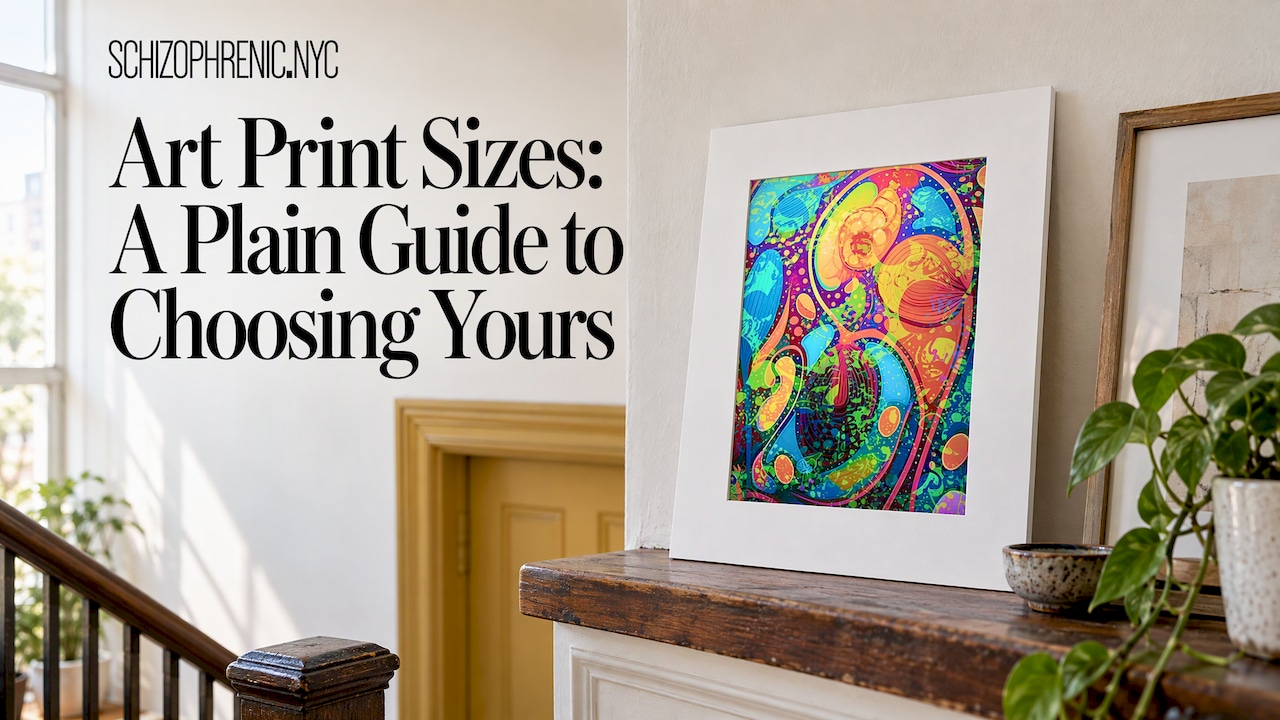
Most art prints in the United States come in a handful of sizes: 5×7, 8×10, 11×14, 16×20, 18×24 and 24×36 inches. Small sizes suit desks, shelves and gallery walls. Larger sizes carry a room. The right one depends on the wall, the frame and how much you want the piece to speak. Our own prints come in 8×10, 8.5×11 and 18×24 inches, and each size does a different job, as the sections below explain.
This guide covers the sizes you will see, how they differ from posters, how frames and mats change what you can hang, and how to match a size to a space.
TL;DR
- The common US art print sizes are 5×7, 8×10, 11×14, 16×20, 18×24 and 24×36 inches. Poster sizes lean larger, such as 11×17, 18×24, 24×36 and 27×40.
- A print and a frame share a nominal size when there is no mat. With a mat, the frame must be bigger than the print.
- 8×10 and 11×14 suit desks, shelves and small walls. 18×24 and up suits a wall that needs a focal point.
- A4 and A5 are international paper sizes and do not match US frames exactly.
- Our shop offers 8×10, 8.5×11 and 18×24 prints, plus canvas prints.
Table of Contents
- The common art print sizes, in inches
- Poster sizes and how they differ from art print sizes
- A4, A5 and other international sizes
- How frames and mats change the size you need
- Choosing a size for your space
- Which size to choose from our shop
- Why we say size is part of the message
- Where to start
- FAQ
- Sources
The common art print sizes, in inches
There is no single legal standard for art prints. The sizes that dominate are the ones that match ready-made frames, because a size that has a frame on every store shelf is a size people can actually hang. Here is the usual lineup, grouped by how you will use it.
| Size (inches) | Group | Where it works well |
|---|---|---|
| 4×6, 5×7 | Small | Desks, nightstands, cards, a tight cluster |
| 8×10 | Small to medium | Shelves, bookcases, gallery walls |
| 8.5×11 | Small to medium | US Letter paper size, easy to frame or mat |
| 11×14 | Medium | Small walls, entryways, above a desk |
| 12×16, 12×18 | Medium | Narrow walls, pairs |
| 16×20 | Medium to large | Bedrooms, offices, as the main piece on a small wall |
| 18×24 | Large | Above a dresser, beside a door, as a feature |
| 24×36 | Extra large | Over a sofa or bed, a big blank wall |
A published frame and mat size guide updated in May 2025 lists 5×7, 6×8, 8×10, 11×14, 12×12, 12×16, 14×14, 12×18, 16×16 and 16×20 inches among standard art print sizes. Those are the sizes a frame shop expects to see, and they overlap heavily with the table above.
Two ideas help here. The first is aspect ratio, which is simply the shape of the print: how wide it is compared with how tall. An 8×10 is a 4:5 shape. A 16×20 is the same shape, only bigger, so a design made for one scales cleanly to the other. An 11×14 is a slightly different shape, and an 18×24 is a 3:4 shape. When you move a design between shapes, something gets cropped or you gain white border.
The second is orientation. Every size here can hang vertically (portrait) or horizontally (landscape). A size listed as 8×10 means the same print either way.
Poster sizes and how they differ from art print sizes
When people search for common poster sizes, they are usually looking at a slightly different list. Posters tend to be sold in 11×17, 12×18, 18×24, 24×36 and 27×40 inches. The 11×17 size is also known as tabloid, one of the standard US paper sizes alongside Letter at 8.5×11 inches. You will notice that 18×24 and 24×36 appear in both lists, which is why they are the sizes people mix up most.
So what is the real difference between a poster and an art print? Size is part of it, but the bigger difference is how the piece is made and what it is. The Smithsonian Associates Art Collectors Program describes limited-edition prints as original works, made by an artist working with a fine-art printer and usually signed and numbered. Posters, in contrast, are photographic reproductions of existing works. A poster is a copy of art. A true art print is the art.
In practice, you will meet a spectrum. Some prints are open editions, meaning they are printed as demand continues rather than capped at a set number. Some are signed by the artist. The label “print” alone does not tell you which. Look at the product description for the paper, the signature and whether it is an edition.
11×14 or 11×17?
Both are 11 inches wide, but 11×17 is three inches taller. The math is easy: 11×14 covers 154 square inches and 11×17 covers 187, so the taller one is about 21% larger. They also have different shapes. 11×14 is a photo and art format that fits a standard frame. 11×17 is tabloid, a poster and paper format that often needs a specialty frame. If you are choosing for a frame you already own, 11×14 is the safer bet. If you want a tall, slim presence on a narrow wall, 11×17 gives you the height.

A4, A5 and other international sizes
If a print arrives from outside the US, or you see A4 and A5 in a listing, those are ISO A-series sizes, which are metric. A4 is 210×297 millimeters, roughly 8.27×11.69 inches, and A5 is half the area of A4, about 5.83×8.27 inches, according to a paper size guide for artists. A4 is slightly narrower and taller than US Letter, and A5 is close to 6×8 inches.
The catch is the frame. The same frame guide notes that A-series sizes do not match US frame sizes exactly. It suggests custom framing, or a near-fit frame with a mat, when you need to hold an A4 piece at about 8.3×11.7 inches. Letter-sized prints at 8.5×11 avoid that problem in a US home, which is one reason we offer our signed prints at that size.
How frames and mats change the size you need
This is where most people get tripped up. A print has a size. A frame has a size. A mat, the paper border between them, adds a third number. If you do not line them up, you end up with a print that rattles in its frame or a frame that is too small.
Without a mat, the frame and print share the same nominal size. A 16×20 print goes in a 16×20 frame.
With a mat, the frame is larger than the print. The frame guide’s own examples pair an 8×10 print with an 11×14 frame, and an 11×14 print with a 16×20 frame. The mat fills the difference and gives the piece breathing room.
Two details save frustration:
- Frame sizes name the artwork, not the outside edge. A frame sold as 16×20 is built to hold a 16×20 piece. The molding itself is wider, and a small lip overlaps the edge of the art, so the visible opening is slightly smaller than the print.
- A mat opening is not the frame size. A 16×20 frame with a mat cut for a 12×16 print shows a 12×16 piece. The mat opening has to match the artwork you are displaying, with a small overlap so the print edges are held.
That overlap is why we wrote a short guide, framing art prints at home and why a quarter inch of overlap matters. It is worth reading before you cut or order a mat.
A worked example
Say you want to hang an 8×10 print and you like a wide border. Choose an 11×14 frame with a mat whose opening is slightly smaller than 8×10, so the mat overlaps the print edges. The visible art will be a little under 8×10, and the border all around will look balanced.
Now the arithmetic for a bigger piece. If you start with a 16×20 print and want a 2-inch mat border on every side, the outer size comes to 20×24 inches. Add the border to both dimensions: 16 plus 4 is 20, and 20 plus 4 is 24. Stocked frames come in common sizes, so check that your result matches one before you buy the mat.
For long-term care, archival practice is worth knowing. The Library of Congress, which mats works on paper for storage, makes its mats to standardized sizes that include 11×14, 14×18 and 20×24 inches. Standard sizes exist for a reason: they keep framing simple.
Choosing a size for your space
The wall decides. Use these steps.
- Measure the wall space. Measure the width of the spot, not the whole wall. If you are hanging above a sofa, console or bed, the art should usually be narrower than that furniture, so it looks anchored to it.
- Decide on one piece or several. A single large piece makes a statement. A cluster of small pieces tells a story. Both work.
- Pick a size from the table. Small spaces, such as shelves, desks and nooks, suit 5×7, 8×10 and 11×14. Medium walls suit 16×20 and 18×24. Large blank walls suit 24×36.
- Add the frame and mat. The finished piece is bigger than the print. An 8×10 print in an 11×14 frame takes up an 11×14 footprint on the wall.
- Mock it up. Cut paper to the finished size and tape it up for a day. You will know right away if it feels too timid or too crowded.
A few common situations:
- A desk, shelf or bookcase: 8×10 is the classic. It is big enough to read from across the room and small enough to lean or hang.
- A gallery wall: Mix 8×10, 8.5×11 and 11×14 in matching frames. Matching frames make different sizes feel like a set.
- A bedroom or office: 16×20 or 18×24 gives a focal point without overwhelming the room.
- A waiting room, classroom or clinic wall: 18×24 is easy to see from a few steps back, which matters when the goal is to start a conversation.
Which size to choose from our shop
We make our art as wearable and hangable advocacy, and each size is meant to do a different job.
8×10 prints are the easiest way to start. Pieces like the Pop Art Print 8"x10" and the Jump Art Print 8"x10" fit a standard 8×10 frame, or an 11×14 frame with a mat. If you want a set, the 4 Art Print Pieces 8"x10" listing gives you four pieces at the same size, which makes a ready-made grid.
8.5×11 signed prints come in several colors, including the Blue Signed Print and the Orange Signed Print. The size matches US Letter, so it works for a desk, a binder, a office door or a Letter-sized frame.
18×24 prints are for walls that need a statement. The Forget Print and the Thinking Print are both 18×24 inches, a size many ready-made frames are built for.
If you prefer art without glass and a frame, our mental health canvas prints are another way to hang a piece.
Why we say size is part of the message
Size is part of how a piece speaks. When I started making art about schizophrenia, I wanted people to be able to live with it, not just look at it from across a gallery. A small print on a desk is a quiet reminder that you are not alone. A big one on a wall starts a conversation with every person who walks in.
That is why we offer prints from 8×10 up to 18×24. An 8×10 can sit in a bedroom, a therapist’s office or a dorm room. An 18×24 says out loud that mental illness is something we can talk about. Both are made to be framed and seen.
My advice is simple: choose the size where you will see it every day. Hanging it somewhere you pass often matters more than getting the biggest size. Confidence can get you anywhere, and sometimes it starts with a picture on your own wall.
Michelle
Where to start
Browse Michelle’s artwork to see every print size we offer, from 8×10 pieces to 18×24 statement prints. Each purchase supports the work of reducing stigma around mental illness, and each piece is designed to start a conversation wherever it hangs.
FAQ
What is the most common art print size?
8×10 and 11×14 are the sizes most people buy, because frames for them are easy to find. Among larger sizes, 16×20, 18×24 and 24×36 are the usual choices. If you are unsure, start with 8×10 for a small space and 18×24 for a wall that needs a focal point.
What is the difference between a poster and an art print?
A poster is generally a reproduction of an existing work, while the Smithsonian Associates Art Collectors Program describes limited-edition prints as original works made with a fine-art printer, often signed and numbered. Sizes overlap, so check the description for the paper, the signature and whether it is an edition.
Will an 8×10 print fit an 11×14 frame?
Yes, with a mat. The mat fills the extra space and its opening is cut slightly smaller than 8×10 so it overlaps the print edges. Without a mat, an 8×10 print will float in an 11×14 frame, so use the mat.
Do A4 prints fit US frames?
Not exactly. A4 is about 8.27×11.69 inches, which is narrower and taller than US Letter. A near-fit frame with a mat, or custom framing, is the usual solution. A Letter-sized 8.5×11 print avoids the issue.
How big is 18×24 compared with 24×36?
An 18×24 print covers 432 square inches, and a 24×36 covers 864, exactly twice the area. Both share the same 3:4 and 2:3 family of tall shapes, but they are not the same ratio, so a design may need cropping to move between them.
Sources
- Guide to Frame and Mat Dimensions for Common Print Sizes
- Paper Sizes Chart: US Letter, Legal, Tabloid and ISO A-Series
- Buying Good Art, Smithsonian Associates Art Collectors Program
- A-series paper sizes in inches for artists
- Matting and Hinging Works of Art on Paper, Library of Congress
Recommended
- 3 Specs That Decide Giclée vs Art Print: Ink, Substrate, Longevity
- Frame Art Prints at Home: Why a Quarter Inch of Overlap Matters
- Clarity Art Print 8"x10"
- Forget Print – 18"x24"