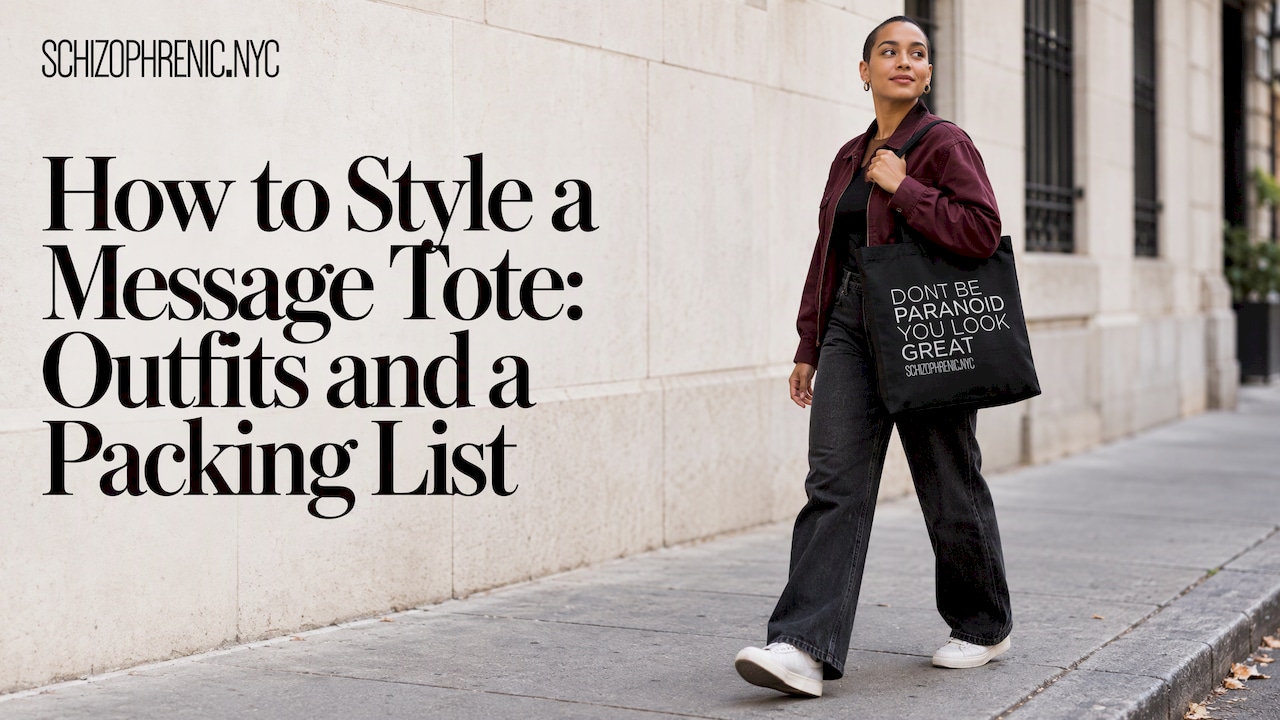
A tote bag with a message does two jobs at once. It carries your day, and it says something before you say a word. The easiest way to style one is to let it be the single loud piece: keep the rest of the outfit simple, choose a tote whose message you are proud to explain, and pack it so it actually helps you get through the day. Below you will find outfit formulas for the weekend, the office and the evening, a packing list for comfort and support, and a few notes on how a tote starts real conversations.
We make our own mental health awareness tote bags at Schizophrenic.NYC, so this is written from that side of the counter: bold graphic, plain black canvas, and a lot of thought about what it feels like to wear your story in public.
TL;DR
- Treat a message tote as the statement piece. Keep clothes neutral or tonal and skip stacking every awareness item you own.
- Casual: jeans, a plain tee, sneakers. Work: a darker, simple outfit so the message reads as confident, not chaotic. Evening: clear out the bulk and keep the essentials.
- Pick a message that is positive, readable at a glance and true to you.
- A tote makes a good home for a self-soothe kit: something for each of the five senses, a few contact numbers and 988 saved in your phone.
- If you carry prescribed medication, keep it in its original labeled container or a pillbox you trust, and call ahead before any facility stay.
Table of Contents
- Why a message tote is different from any other tote
- Three outfit formulas that work
- Choosing a message that advocates without reinforcing stigma
- Turn your tote into a mental health packing list
- Carrying prescribed medication in your tote
- Starting conversations with your tote
- Don’t overdo it
- Find your tote
- FAQ
- Sources
Why a message tote is different from any other tote
Most style guides treat a tote as a practical bag you coordinate with shoes. A message tote adds a second layer. People read it. Some smile, some ask what it means, and some tell you about their own brother, their own diagnosis, their own hard year.
That is the point of wearable advocacy, and it is how our founder, Michelle Hammer, built the brand. The Good Trade reported that at her NYC pop-up shop she talks with people about mental illness all day, and that once she explains she is schizophrenic and made the line for that reason, most people open up about how mental illness has touched their lives. A tote is a small, daily version of that pop-up.
So styling it is not only about looking good. It is about deciding how much attention you want, and making sure the outfit supports the message instead of fighting it.

Three outfit formulas that work
The formulas below share one rule: the bag speaks, everything else supports. A bold tote with a calm outfit reads as intentional. A bold tote with five competing graphics reads as noise, and the message gets lost.
Weekend and errands
This is where a message tote lives most naturally.
- Straight or relaxed jeans, a plain white or black tee, and clean sneakers.
- A denim jacket or an oversized cardigan if it is cool.
- One small extra, such as a ring or a pair of earrings, in a single metal tone.
If you wear a graphic tee as well, let it be the same quiet color family as the tote. Black on black with one white-lettered message is hard to get wrong. Our Define Normal black tote is a good example of a design that works over almost anything, because the bag does the talking and your outfit can stay easy.
Work and the office
A message tote can go to work, and plenty of people carry one daily. A few things make it feel polished.
- Choose a dark, simple outfit: trousers or dark jeans if your workplace allows them, a plain shirt or knit, and a blazer if you like one.
- Keep colors to about three across clothes, shoes and bag. Black canvas makes that easy.
- Carry it on the shoulder, not stuffed to the point of sagging. A tote that holds its shape looks deliberate.
- Choose a message with a warm, confident tone. “Don’t be paranoid, you look great” is the kind of line coworkers laugh at and then remember.
Only you know your workplace culture and how much you want to share there. A message tote is a choice, never an obligation. If you would rather keep it for weekends and advocacy events, that is a perfectly good way to wear it.
Evenings and events
For dinner, a talk or an awareness event, the tote has to change gears.
- Empty the bulky items. Keep wallet, phone, keys, and one comfort item.
- Pair it with a dressier base: black jeans or a simple dress, a fitted top, boots or clean white sneakers.
- Add one piece of jewelry that echoes the tote’s theme, such as our rings or earrings, rather than layering several.
If you are speaking, volunteering or tabling at an event, comfort matters more than anything. You may carry the bag for hours, so pack light and choose shoes you can stand in.
Choosing a message that advocates without reinforcing stigma
Not all awareness messaging lands the same way. The best lines are readable at a glance, positive in tone and personal enough that you can stand behind them in a conversation.
A few guidelines drawn from mental health communication practice:
- Use respectful language. The 2024 Mental Health Toolkit from The Wellbeing Partners recommends person-first phrasing, such as “a person living with” a condition, and avoiding words like “crazy” or “insane” as insults.
- Reclaim with care. Humor and reclaimed words can break tension when they come from someone with lived experience. That is the spirit behind lines like “I’m Mentally Ill And I Don’t Kill,” which confronts a harmful stereotype head on. Our black tote with that message is designed to open exactly that conversation.
- Pick conversation starters, not conclusions. Michelle’s Rorschach-style artwork works because, as she told The Good Trade, everyone who looks at it sees something different. It invites a question instead of handing someone a label. You can browse the same idea on our artwork totes.
- Know your answer. If someone asks about your bag, you do not owe them your medical history. Decide ahead of time how much you want to share. A short line works: “It’s about ending stigma. Mental health is health.”
Turn your tote into a mental health packing list
A tote is roomy, washable and easy to grab, which makes it an ideal home for a comfort or self-soothe kit. Clinicians describe these as a kind of first aid kit for your emotions. CBT Center NJ frames it that way, built on the five-senses self-soothe skill from dialectical behavior therapy (DBT), and suggests keeping one at home or work plus a traveling version in a bag. The reasoning is simple: emotions are unpredictable, so a kit that is already packed saves you from hunting around the house in a hard moment.
The five-senses packing list
Mental Health America recommends a coping toolbox that covers all five senses, plus basic needs. Here is a tote-sized version.
| Sense | What to pack | Why it helps |
|---|---|---|
| Touch | Stress ball, smooth stone, small fidget, soft scarf | Gives your hands something steady to do |
| Hearing | Earbuds and a saved calming playlist | Replaces noise with something you chose |
| Sight | A photo, an affirmation card, a note to yourself | A reminder of who and what matters |
| Taste | Mints, sour candy or tea bags | Strong flavors pull attention to the present |
| Smell | Scented hand lotion or a small essential oil roller | A quick, calming cue |
| Basics | Water bottle, a snack, a charger | Hunger and thirst make everything harder |
Crisis Connections adds a notebook or art supplies, and suggests keeping the numbers for 988, the Recovery Help Line and the Warm Line close by. 988 is the Suicide and Crisis Lifeline, which you can call or text. Save it in your phone and write it on a card inside the tote, so you do not need your phone unlocked to find it.
If compact, easy-to-carry items interest you, there are good care package ideas for a portable self-soothe kit that show what fits in a small bag.
Add the people, not only the things
The Sacred Heart University Counseling Center coping skills box includes a list of three people to call, alongside items like a journal, affirmation cards and a coloring book with pencils. Write your three names on a card. On a bad day, deciding who to call is the hardest part, so decide in advance.

Keep it small, keep it yours
Delaware Psychological Services suggests starting with just three to five tools that truly help, labeling the kit clearly and updating it as your needs change. Bradley REACH adds that a kit is not a cure or permanent solution but a way to find relief in the moment, and recommends keeping the building process simple and fun so it does not become one more stressful task.
Crisis Connections also suggests decorating a self-care bag with stickers, patches or drawings. A message tote is already halfway there. Add a sticker or button from our artwork collection and the bag becomes unmistakably yours.
Carrying prescribed medication in your tote
Medication is the item where a little planning matters most, and it is part of a mental health packing list for many of us. Medication adherence, meaning taking your medicine as prescribed, is a real part of staying well, and a bag you carry every day can support that routine.
For daily carry, a 7-day pillbox from our shop sits easily in a tote and keeps the week’s doses organized. Keep your pharmacy-labeled bottle or your current medication list available too, in case anyone needs to confirm what you take.
For a hospital or residential stay, rules are set by the facility, so follow them exactly:
- Bring medications in their original pharmacy-labeled bottles. Dr. Sanjai Thankachen of Socal Empowered advises no loose pills, no unlabeled containers and nobody else’s prescriptions, so staff can document, store and dispense them on schedule.
- Expect that your medication will be stored by staff. Skyland Trail keeps all medications in a locked room at the nurses station, and asks for a minimum seven-day supply in original packaging. It also asks for clear plastic or vinyl totes labeled with your name, a good reminder that a bag you carry into a program may need to be a specific kind.
- Bring a full list of prescriptions, over-the-counter drugs and supplements, with doses, prescriber names and pharmacies. U.S. News quotes pharmacist Patricia Weiser, PharmD, saying you should ask whether to bring the actual medications, because policies differ from one facility to the next.
- Call ahead. The same article lists items commonly restricted on psychiatric units, including sharp objects, glass containers, belts, cords, shoelaces and drawstring clothing, lighters, alcohol, large amounts of cash and, depending on the unit, electronics. A canvas tote with a drawstring or long cord may fall into that category, so ask the unit before you pack.
If you have questions about your medication, how to carry it or whether to change anything, talk to your prescriber or pharmacist. A tote cannot answer those, and nothing in a packing list replaces your care team.
Starting conversations with your tote
Wearing a message in public invites people in. Some reactions will be a nod, and some will be a story. A few ways to get comfortable with that:
- Decide your boundary first. You can say as much or as little as you want. “It’s a cause I care about” is a complete answer.
- Lead with curiosity. The Wellbeing Partners toolkit suggests openers like “How are you, really?” and “What can I do to support you?” They work just as well when a stranger starts talking about their own experience.
- Keep confidences. The same toolkit advises keeping what people share confidential unless someone is at risk of harm. If a person seems to be in danger, point them to 988.
- Remember what talking does. The toolkit notes that open conversation normalizes mental health, helps break down barriers and empowers people to get help. It also points to NAMI as a place to learn more.
- Give yourself breaks. Being an ambassador is tiring. A tote can go in a closet for a day, and the cause will still be there.
Don’t overdo it
It is tempting, once you care about a cause, to wear all of it at once: the shirt, the pin, the necklace, the tote, the sticker on your laptop. Fewer pieces read more clearly. A good rule for the awareness wardrobe is one statement item per outfit. If your tote is the statement, wear plain clothes. If you want a graphic hoodie or tank top, carry a plain bag.
When you want an outfit with a quieter second signal, a button or a ring is enough. Our mental health T-shirts, tank tops and hoodies and sweatshirts are made for days when you want the message on you, not in your hand.
Our perspective
We started this brand because the clothes we wanted did not exist. I am schizophrenic, and I wanted to walk down a New York street wearing something that said so with a sense of humor and with pride, not whispered in a waiting room.
A tote is the friendliest way in. It is not as intense as a T-shirt, and it goes everywhere you do: the subway, the pharmacy, the office, the stage. People read it, they smile, and then they talk. I have watched strangers tell me things they have never told their families, because a bag gave them permission.
That is why our totes carry lines like “Define Normal” and “Don’t Be Paranoid. You Look Great.” We design them to start a conversation that ends with someone feeling a little less alone. Wear one with whatever you like. Fill it with what keeps you steady. And let it do the talking on the days you do not feel like it.
Michelle
Find your tote
If you are ready to carry the message, start with our mental health awareness tote bags, including the Don’t Be Paranoid. You Look Great black tote and our artwork totes featuring Michelle’s original designs. Pair one with a 7-day pillbox and you have a bag that carries both your routine and your voice.
FAQ
What should I wear with a graphic message tote?
Keep the outfit simple. Jeans or black trousers, a plain tee or knit and clean sneakers let the message stand out. Limit colors to about three across clothes, shoes and bag, and let the tote be the only loud piece.
Can I use a mental health tote as a self-care kit bag?
Yes. Clinicians describe kits as portable first aid for emotions, and a tote is a suitable container. Pack something for each of the five senses, a few contact numbers and the 988 Lifeline, and start with only three to five items that you know help you.
How should I carry prescription medication in a tote?
For daily use, a pillbox keeps doses organized, and keeping the pharmacy label or a medication list nearby is wise. For any hospital or residential stay, bring medication in original pharmacy-labeled bottles and call the facility first, since each one has its own rules. Your prescriber or pharmacist is the right person for medication questions.
Is it okay to wear an awareness tote at work?
It is your choice, and many people do. Pair it with a simple outfit, choose a message with a warm, positive tone, and decide in advance how much you want to share if a coworker asks about it.
What message works best on an awareness tote?
Choose one that is readable at a glance, positive and honest to your experience. Lines that use humor or confront a stereotype head on, written by someone with lived experience, tend to invite conversation rather than judgment.
Sources
- What Disabled People Are Actually Looking For When Shopping, The Good Trade
- 2024 Mental Health Toolkit, The Wellbeing Partners
- Self-Soothe Starter Kit, CBT Center NJ
- Building your coping toolbox, Mental Health America
- Wellness in a Bag, Crisis Connections
- Coping Skills Box, Sacred Heart University Counseling Center
- How to Build a Mental Health First Aid Kit, Delaware Psychological Services
- How To Prep A Mental Health First Aid Kit, Bradley REACH
- What to Pack for Inpatient Mental Health Treatment, Socal Empowered
- What to Bring, Skyland Trail
- How to Prepare for a Mental Health Hospital Stay, U.S. News
Recommended
- How to Organize a Tote Bag So You Can Find Everything
- 10 to 12 oz Canvas: Tote Bag Materials to Keep Your Advocacy Visible
- Tote Bag Weight Limit: How Much a Tote Can Really Carry
- 8 Steps to Waterproof a Canvas Tote and Protect Its Print