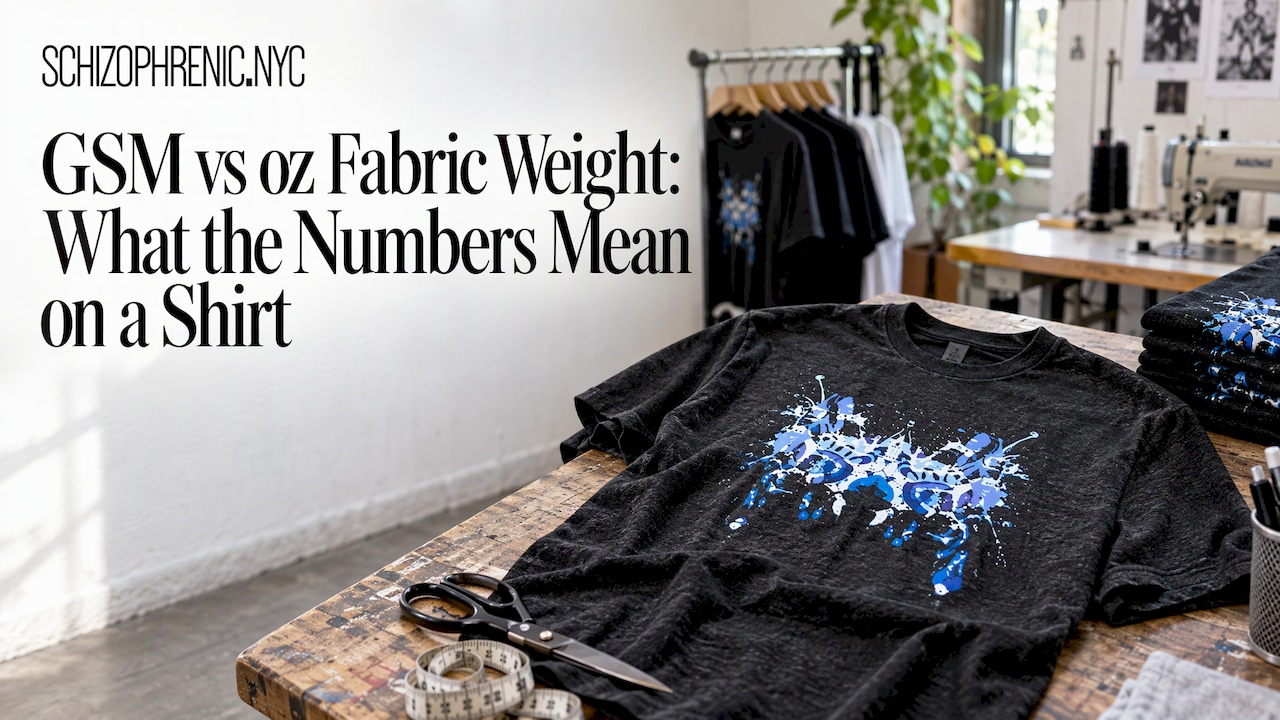
GSM and ounces describe the same thing: how much a fixed piece of fabric weighs. GSM is grams per square meter. The US number, oz/yd², is ounces per square yard. One oz/yd² equals about 33.9 GSM, so a 5.3 oz tee is a 180 GSM tee. Once you can move between the two, you can read any label, compare any shirt, and pick a tee, tank or sweatshirt that feels the way you want it to.
This matters to people who wear their message. An advocacy tee gets worn to panels, classrooms, clinics, rallies and ordinary Tuesdays. The weight of the cloth decides whether it hangs well, whether it shows through, and whether it still looks good after many washes. At Schizophrenic.NYC we make mental health T-shirts, tank tops and sweatshirts to be worn out loud, so the fabric language is worth learning.
TL;DR
- GSM means grams per square meter. Oz/yd² means ounces per square yard. Divide GSM by 33.906 to get ounces, or multiply ounces by 33.906 to get GSM.
- A 180 GSM T-shirt is about 5.3 oz/yd², the everyday midweight: opaque enough, comfortable, and structured without feeling heavy.
- The figure describes the cloth, not the finished garment, and it is not a quality score. Fiber, yarn and knit decide softness and durability too.
- Watch for “oz” that really means ounces per linear yard. It is a different measure and can make a fabric look about 40 to 50% heavier than it is.
Table of Contents
- What GSM and oz/yd² actually measure
- How to convert GSM to oz/yd² (and back)
- What GSM means in shirts
- What a 180 GSM T-shirt means
- Why weight is not the whole story
- The oz trap: square yard vs linear yard
- Reading weight on things besides tees
- How to read a label in under a minute
- Our perspective on fabric weight
- Wear the message you choose
- FAQ
- Sources
What GSM and oz/yd² actually measure
Both units answer one question: if you cut a standard patch of this fabric and weighed it, how heavy would it be? GSM uses a patch of one square meter and weighs it in grams. The US system uses a patch of one square yard and weighs it in ounces. Standard test practice is even simpler in the lab: cut a 100 cm² circle, which is one hundredth of a square meter, weigh it on a sensitive scale and multiply by 100.
Two things follow from that.
- It is weight per area, not weight per garment. A 180 GSM fabric tells you how dense the cloth is. A small tee and a 3XL cut from the same fabric have the same GSM and very different total weights.
- Heavier means denser, not automatically better. More fabric in each square means more thickness, more warmth and more opacity. It does not tell you how soft the shirt is, or how long it will last.
You will see GSM on most international listings, because the metric system is the standard almost everywhere. Ounces show up on US labels and in US denim and canvas descriptions. If you shop for apparel in the United States, you will meet both, sometimes on the same page.
How to convert GSM to oz/yd² (and back)
The conversion factor comes straight from the unit definitions: one ounce is 28.3495 grams, and one square yard is about 0.8361 square meters. Divide the first by the second and you get 33.906 grams per square meter for each ounce per square yard, as 3DMockups’ converter lays out.
- GSM to oz/yd²: divide by 33.906. Example: 180 ÷ 33.906 = 5.31 oz/yd².
- oz/yd² to GSM: multiply by 33.906. Example: 8 × 33.906 = about 271 GSM.
- Shortcut: multiply GSM by 0.0295. It gives the same answer to two decimals.
Using a rounded factor of 34 is fine for shopping. For a written specification with tight tolerances, TextileNotes points out that rounding to 34 overstates GSM by about 0.3%, which is why precise documents use 33.906.
A quick conversion table
| GSM | oz/yd² | Where you typically meet it |
|---|---|---|
| 120 | 3.5 | Very light blouse, lining |
| 150 | 4.4 | Lightweight tee or tank |
| 180 | 5.3 | Classic everyday tee |
| 200 | 5.9 | Sturdy tee, upper end of midweight |
| 240 | 7.1 | Heavyweight tee |
| 271 | 8.0 | Light sweatshirt or tote fabric |
| 339 | 10.0 | Heavy canvas, denim |
| 407 | 12.0 | Heavy canvas, mid-heavy denim |
The 271, 339 and 407 figures match the conversions on 3DMockups’ chart for 8, 10 and 12 oz. The rows for 120 to 240 GSM are the same division, rounded to one decimal.
The PAA-style questions people type all resolve with the same two steps. How many GSM is 1 oz? About 34. What is 8 oz fabric in GSM? About 271. What GSM is 10 oz fabric? About 339. How many GSM is 12 oz cotton? About 407.

What GSM means in shirts
On a T-shirt listing, GSM is the weight of the jersey knit the shirt is sewn from. Here is a practical way to read it, with ounces alongside.
| Class | GSM | oz/yd² | What it usually feels like |
|---|---|---|---|
| Lightweight | under about 150 | under about 4.4 | Airy, drapey, best in heat, may show through in light colors |
| Midweight | about 150 to 200 | about 4.4 to 5.9 | Balanced everyday tee |
| Heavyweight | 200 and up | 5.9 and up | Dense, structured, holds its shape |
These bands are a rule of thumb rather than a standard. Threads magazine’s fabric-weight guide puts lightweight to midweight tops and dresses at roughly 4 to 7 oz (about 120 to 200 GSM), pants, jackets and totes at 7.5 to 10 oz (about 200 to 300 GSM), and heavy jeans, workwear and winter coats at 10 to 13 oz (about 300 to 450 GSM). So the same number can be “heavy” for a tee and “light” for a coat. Always read weight against the type of garment.
What a 180 GSM T-shirt means
A 180 GSM tee is made from fabric where one square meter weighs 180 grams, which is 5.31 oz/yd². In cotton jersey, that is the standard everyday T-shirt weight. 3DMockups describes it as a midweight tee that is thick enough not to look see-through in light colors, holds a print well and stays comfortable in summer, with most everyday blanks falling between 140 and 200 GSM.
On the body, that translates to:
- Opacity. A white or light heather tee at this weight generally does not show what is underneath. Hold a lighter tee up to a window and you will see the difference.
- Drape. It falls from the shoulders instead of clinging, but it is not stiff.
- Season. It works in warm weather and under a jacket in cold weather.
- Print. Graphics sit flat on a midweight cloth, which matters when the artwork is the point of the shirt.
If you are choosing between 160, 180 and 200 GSM, think about where you will wear it. Hot climates and layering favor the lighter end. A shirt that will be worn alone, washed often and expected to hold its collar favors 180 and up.
Why weight is not the whole story
A number on a label is a starting point. Three shirts at 180 GSM can feel completely different, because weight says nothing about the fiber or how the cloth is made.
Fibers of Earth’s glossary notes that mass per unit area correlates with opacity, warmth and durability but does not determine them. What does the rest of the work?
- Fiber and staple length. Longer cotton fibers make smoother, stronger yarn. Our guide to Supima cotton versus regular cotton explains what changes.
- Fiber blend. Cotton, polyester and rayon blends drape and wear differently at the same weight. See how tri-blend compares with cotton over repeated washes.
- Knit structure. A single jersey and a terry knit at the same GSM are different animals.
- Finishing and shrinkage. Weight is measured on the fabric before it is sewn and can change after washing. Our explainer on pre-shrunk cotton covers what residual shrinkage means.
The practical takeaway: use GSM to narrow the field, then judge by fiber, feel and how a shirt holds up when you wear it.
The oz trap: square yard vs linear yard
This is the mistake that causes real confusion when you convert. Ounces per square yard measures a fixed area. Ounces per linear yard measures a one-yard length cut from the roll at its full width, so the result depends on how wide the roll is.
Mekan Textile’s guide shows the correction. To convert, multiply the ounces per linear yard by 36 and divide by the width in inches. A fabric quoted as 10 oz per linear yard on a 58-inch roll is only about 6.2 oz/yd², around 210 GSM. If you multiplied 10 by 33.906 you would get 339 GSM and think it was far heavier than it is.
The same fabric also changes its linear-yard weight with width. A fabric weight chart shows that a 200 GSM fabric weighs 5.899 oz per linear yard at 36 inches wide but 11.797 oz at 72 inches wide. Square-yard weight compares fabrics fairly. Linear-yard weight does not.

This most often turns up with denim and canvas. When a listing says only “12 oz” and the garment is a tote or jeans, check which kind of ounce it means before converting.
Reading weight on things besides tees
Tank tops. These usually sit in the lighter to midweight range, since the point is airflow. A tank in the 150 to 180 GSM range gives you coverage without bulk.
Sweatshirts and hoodies. Fleece and terry are heavier by nature, so their numbers run higher than tee numbers. A 300 GSM sweatshirt is about 8.8 oz/yd². Our hoodie weight guide explains what heavyweight means for these pieces, and how to choose between heavyweight and lightweight hoodies walks through the decision by season and use.
Totes. Canvas is almost always quoted in ounces, and the range is much heavier than a tee. Our page on tote bag materials shows how 10 to 12 oz canvas works for a bag you carry every day.
How to read a label in under a minute
- Find the unit. GSM, g/m², oz/yd² or plain “oz”? If it is plain “oz”, look for “per linear yard” or a roll width.
- Convert to one unit. Pick the one you think in and use the factor of 33.906.
- Place it by garment type. 180 GSM is midweight for a tee, light for a sweatshirt, and very light for a tote.
- Check fiber and knit. Cotton jersey, a blend or a fleece all behave differently at the same weight.
- Match it to use. Hot climate, layering, daily wear, printing or something you will wash weekly all push the number in different directions.
One caution for denim: weights are usually stated for the rigid, unwashed fabric, so compare before-wash with before-wash and after-wash with after-wash.
Our perspective on fabric weight
Fabric weight is not a spec for us, it is part of how a message feels when you put it on. I started this brand because I wanted people to be able to talk about schizophrenia and mental illness without whispering, and clothing turned out to be a good way to start that conversation.
A shirt that hangs well, sits comfortably and stays opaque is a shirt that someone wears again. When someone wears it again, the message goes out again: on the subway, in a classroom, in a waiting room. That is why we think about weight at all.
Our approach is to make bold, original designs and put them on pieces people actually want to live in: T-shirts, tank tops, sweatshirts, totes and more. Learn the numbers, enjoy the nerdy side of the label, and then pick the piece that feels right to you.
Michelle
Wear the message you choose
Once you know that 180 GSM is about 5.3 oz and that midweight is the sweet spot for an everyday tee, you can browse with confidence. Our mental health T-shirts, tank tops and hoodies and sweatshirts carry original artwork by Michelle Hammer, a schizophrenia activist with lived experience, designed to start honest conversations and reduce stigma. If you want the full range, from pillboxes to prints, start at the Schizophrenic.NYC shop.
FAQ
What is GSM in shirts?
GSM stands for grams per square meter. It is the weight of one square meter of the fabric the shirt is made from, which tells you how dense and thick the cloth is. It describes the fabric, not the weight of the finished shirt.
How do I convert fabric weight from GSM to oz?
Divide the GSM by 33.906 to get ounces per square yard. For example, 180 GSM is 5.31 oz/yd². To go the other way, multiply ounces by 33.906, so 10 oz/yd² is about 339 GSM.
What does a 180 GSM T-shirt mean?
It means the cotton jersey weighs 180 grams per square meter, or about 5.3 oz/yd². That is a midweight everyday tee: opaque, comfortable in warm weather and structured enough to drape instead of cling.
Is a higher GSM always better?
No. Higher GSM means a thicker, denser fabric, which suits cooler weather and a structured look. Softness, durability and feel also depend on the fiber, the yarn and the knit, so choose the weight that fits how and where you will wear the piece.
Is oz the same as oz per linear yard?
No. Ounces per square yard measures a fixed area, while ounces per linear yard depends on the width of the roll. A 10 oz per linear yard fabric on a 58-inch roll is only about 6.2 oz/yd², roughly 210 GSM.
Sources
- A Matter of Fabric Weights, Threads magazine
- GSM to oz Converter and Fabric Weight Chart, 3DMockups
- GSM to oz/yd² Conversion: Formula, Table and Examples, TextileNotes
- GSM and oz/yd²: how fabric weight is measured and converted, Mekan Textile
- Fabric Weight Chart: GSM to oz/yd², Fabric Formula
- Fabric weight (GSM): definition, examples and textile uses, Fibers of Earth
Recommended
- Hoodie Weight Guide: GSM, Ounces and What Heavyweight Means
- When 400 GSM Beats a Hood: Crewneck vs Hoodie for Style Shoppers
- Heavyweight vs Lightweight Hoodie: How to Choose