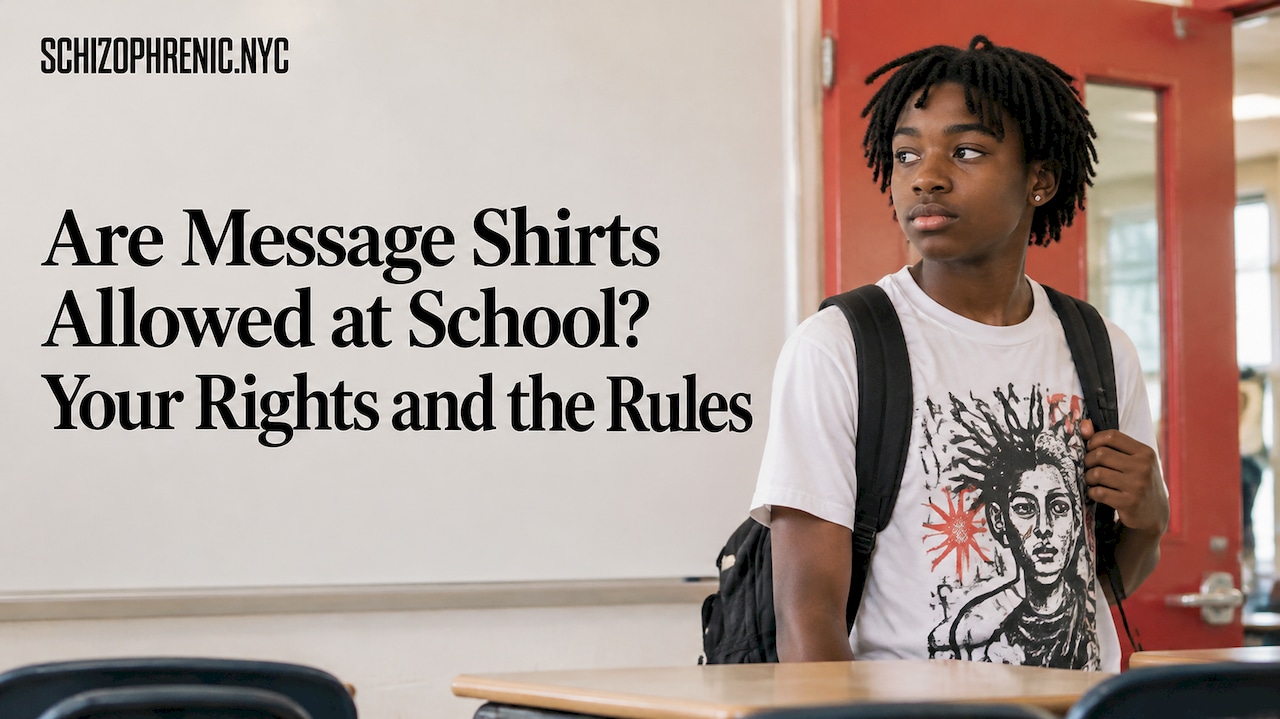
In most US public schools, yes: students can wear shirts with messages, including mental health awareness shirts, as long as the message isn’t lewd, threatening, tied to illegal drug use, or likely to seriously disrupt class. The exceptions are real, though. A school’s dress code, a uniform policy, a private school’s own rules and your state’s law can all change the answer. This guide walks through what protects your shirt, what limits it, and how to pick a design that will do its job in the hallway.
We built our brand on wearable messages that start honest conversations about mental illness, so we get this question from students, parents and teachers. We’re not lawyers, and nothing here replaces advice about your own situation. But the rules are clearer than most people expect, and knowing them is empowering.
TL;DR
- Public school students keep their free speech rights at school, and a message shirt is speech. Schools can restrict only specific kinds of messages.
- Schools can limit shirts that are lewd, school-sponsored, promote illegal drugs, or materially disrupt class. A school disliking a message isn’t enough.
- A neutral dress code or uniform can limit message shirts across the board, so read your handbook first.
- Private school students have fewer protections, and state laws and district policies vary.
- Mental health awareness messages that are respectful and aimed at understanding are the kind of speech the law was written to protect.
Table of Contents
- The short answer: usually yes, with limits
- The case behind it all: Tinker
- Four situations where a school can say no
- Dress codes and uniforms: the rule that can override your message
- Hate speech provisions: a newer limit
- Religious shirts get the same treatment as other messages
- Public schools, private schools and your state
- Where mental health awareness shirts fit
- A checklist before you wear it
- If a school asks you to change
- Choosing a message shirt for school
- Our perspective
- Find a shirt that starts the conversation
- FAQ
- Sources
The short answer: usually yes, with limits
The ACLU’s guide to speaking out with your T-shirt says wearing a shirt with a message is First Amendment speech. It also says schools may ban obscene, threatening, lewd or vulgar speech, and speech that significantly disrupts classes or interferes with other people’s rights (ACLU, Know Your Rights). That one sentence covers most real-life cases.
The ACLU of Texas puts it in similar terms: students may wear expressive clothing as long as they don’t disrupt the school’s functioning or violate its content-neutral policies. A school can’t restrict the message unless it is lewd or offensive, causes substantial disruption, or promotes drug use (ACLU of Texas).
So the default is permission. The burden sits with the school to show a legitimate reason, not with the student to prove the shirt is acceptable.
The case behind it all: Tinker
The foundation is Tinker v. Des Moines Independent Community School District (1969). The Supreme Court ruled 7-2 that students do not “shed their constitutional rights” at the schoolhouse gate. Schools may restrict student speech only when it materially disrupts classwork or involves substantial disorder or invasion of the rights of others (Freedom Forum).
The students in that case wore black armbands to protest a war. Fifty-plus years later, the same logic covers a graphic tee.
The ACLU of Texas adds an important point: a school disagreeing with your position, or thinking it’s controversial or in bad taste, is not enough to make it disruptive. Courts have upheld an anti-war armband, an armband opposing abortion rights, and a shirt supporting the LGBTQ community (ACLU of Texas).
The ACLU also stresses that when administrators claim a shirt will cause disruption, that fear must be backed by facts, not vague apprehension (ACLU, Know Your Rights). Courts look closely to make sure the real motive isn’t censoring an unpopular opinion.
Four situations where a school can say no
The Fifth Circuit’s opinion in Palmer v. Waxahachie ISD summarizes four categories of student speech schools can regulate (Fifth Circuit opinion). They give you a practical checklist.
Speech that materially disrupts school
This is the Tinker standard from 1969. A shirt that provokes fights or makes teaching impossible can be restricted. A quiet shirt that someone simply finds uncomfortable usually can’t.
Lewd or vulgar speech
Bethel School District No. 403 v. Fraser (1986) allows schools to restrict sexually explicit or lewd speech. Profanity and sexual innuendo are the usual triggers on shirts.
School-sponsored speech
Hazelwood School District v. Kuhlmeier (1988) covers speech that looks like it carries the school’s stamp, such as a team uniform or a club shirt. Your own shirt bought elsewhere isn’t school-sponsored.
Speech promoting illegal drugs
Morse v. Frederick (2007) lets schools restrict speech advocating illegal drug use. A message about taking prescribed medication as part of treatment is a different thing from promoting illegal drugs, but vague or joking drug imagery can invite questions, so choose wording that is plainly about health and support.
Dress codes and uniforms: the rule that can override your message
Here is where many students get surprised. A school can have a viewpoint-neutral dress code that limits message shirts for everyone. The Fifth Circuit held that content-neutral codes are reviewed under intermediate scrutiny. In Palmer, the court upheld a code that barred T-shirt messages unless they were connected to a school club, sports team, university or school spirit. It reasoned that the code didn’t restrict dress outside school and left other ways to communicate during the school day (Fifth Circuit opinion).
Courts have generally accepted content-neutral codes when the school gives a reason that matters to its educational mission and isn’t aimed at suppressing expression. Reasons that have worked include minimizing distractions, keeping the learning environment orderly, reducing socioeconomic differences and teaching respect for authority (Lawyers.com).
Uniform policies get a bit more nuance. The Department of Education’s Manual on School Uniforms says a uniform policy may not prohibit students from wearing or displaying expressive items, such as a button supporting a political candidate, so long as those items don’t independently disrupt discipline or others’ rights (U.S. Department of Education manual). That manual dates from 1996, so treat it as guidance on the principle and check what your district does today.
What this means for you: read the handbook. If it bans all graphic shirts, the rule applies to everyone equally and may be enforceable. If it allows some message shirts but not yours, that’s the situation worth questioning. In Webb City, Missouri, the ACLU sued after a 15-year-old was punished twice for gay-rights shirts while administrators let other students wear shirts about presidential campaigns and abortion. The case settled when the school promised to stop censoring the student (ACLU, Know Your Rights).

Hate speech provisions: a newer limit
Many handbooks now ban clothing that states or implies hate speech. In L.M. v. Town of Middleborough, a Massachusetts student was allowed to wear shirts with messages such as “First Amendment Rights” and “Don’t Tread on Me,” but not a shirt reading “There Are Only Two Genders,” under a district provision banning clothing that states, implies or depicts hate speech targeting groups by race, ethnicity, gender, sexual orientation, gender identity, religion or another classification (NASSP Legal Matters).
The First Circuit upheld the school’s decision. It adopted a test from an earlier Seventh Circuit case: schools may bar passive, silent messages aimed at no specific student if they are reasonably read as demeaning an “unalterable or deeply rooted” aspect of identity and are reasonably forecast to poison the educational atmosphere (First Circuit opinion). The Supreme Court declined to hear the case on May 27, 2025 (Education Week), so that ruling stands in its region and carries weight elsewhere.
The takeaway for awareness shirts is encouraging. Messages that build understanding and push back against stigma sit on the opposite side of that test from messages that demean a group.
Religious shirts get the same treatment as other messages
Students ask whether religious shirts are allowed. The Department of Education manual says religious messages may be displayed to the same extent as comparable messages and may not be singled out for suppression (U.S. Department of Education manual). Some states spell it out. Arizona law lets public school students wear clothing, accessories and jewelry that display religious messages or symbols the same way other message clothing is permitted (Arizona Revised Statutes § 15-110). Florida’s statute says the same and bars districts from discriminating on religious viewpoint (Florida Statutes § 1002.206). So does Alabama’s code (Alabama Code § 16-1-20.5).
The principle is consistency: a school can’t permit secular message shirts and then single out one viewpoint.
Public schools, private schools and your state
The protections above apply to public schools. The ACLU notes that private school students have fewer rights (ACLU, Know Your Rights). A private school can set a stricter dress code, and the handbook you signed usually governs.
States add their own layers. Massachusetts law says students’ freedom of expression in public schools shall not be abridged, provided it doesn’t cause disruption or disorder. In Pyle v. South Hadley School Committee (1996), the court held that students could wear a shirt reasonably considered vulgar, as long as it caused no disruption (Mass.gov). That’s more protective than the federal baseline, and it only applies in Massachusetts.
NASSP also notes that school authority can depend on a district’s history and needs and varies by jurisdiction, so the question is always a balance between the district’s educational mission and students’ constitutional rights (NASSP Legal Matters). Your district’s handbook and your state’s student-rights law are the two documents to check.
| Situation | Usual answer | What to check |
|---|---|---|
| Public school, no uniform, respectful message | Generally allowed | Handbook wording on graphics |
| Public school with a neutral “no messages” code | May be enforceable | Exceptions for clubs or spirit wear |
| Public school uniform policy | Expressive items may still be protected if they aren’t disruptive | District’s current policy |
| Lewd, vulgar or drug-promoting message | Can be restricted | Wording and imagery |
| Message demeaning a group | Can be restricted in some courts | Hate-speech provision |
| Private school | Handbook usually controls | What you agreed to when enrolling |
Where mental health awareness shirts fit
A shirt that says something like “Define Normal” or “It’s Not A Delusion You Are Incredible” is a message of support and anti-stigma. It doesn’t target a person, isn’t sexual, and doesn’t promote illegal drugs. Under the categories above, that’s the kind of expression schools have the least legal ground to restrict, though your district’s handbook still applies.

Students who live with a mental health condition often tell us the shirt does something a conversation can’t: it starts one on the wearer’s terms. Our mental health T-shirts and tank tops are designed for exactly that. If your school has sleeve or strap rules, check them before choosing a tank, or look at our hoodies and sweatshirts, which many students find easier to fit into a handbook.
For more on wearing a message with intention, see our guides on mental health merch etiquette and how bold graphic tees get read. If you’re curious about the long tradition behind slogan clothing, our fashion activism history is a good place to start.
A checklist before you wear it
- Read the handbook’s dress code section. Look for words like “graphics,” “slogans,” “messages,” “uniform” and “hate speech.”
- Check whether the rule is neutral. Does it apply to every message shirt, or just certain viewpoints?
- Look for exceptions. Many codes allow club, team and school-spirit shirts. Those exceptions can matter in a neutral code.
- Scan your shirt for the four triggers. Is anything lewd, vulgar, drug-related or aimed at a person or group?
- Think about context. A big event or a tense week can change how adults react, even if your shirt is within the rules.
- Ask first if you’re unsure. A quick, friendly question to an assistant principal or counselor often settles it before the day starts.
If a school asks you to change
Stay calm and respectful. A teacher or administrator reacting in the moment isn’t always the final word.
- Ask which rule applies, and ask to see it in writing.
- Ask what the specific concern is. Because fear of disruption must be backed by facts, a specific answer matters.
- Note whether other message shirts are allowed. Uneven enforcement is what drove the Webb City case.
- Bring in a parent or guardian, then contact your state’s ACLU affiliate or another student-rights organization if you think the response is unfair.
- Keep your own record: dates, names, what was said, and a photo of the shirt.
If you’re facing discipline, speak with a parent or guardian and a lawyer or student-rights group in your state. The rules differ by place, and they can advise you on yours.
Choosing a message shirt for school
A few choices make a shirt easier to wear every day:
- Pick a clear, positive message. Words about support, understanding and dignity read well to teachers and classmates alike.
- Mind the fit rules. Strap width, length and coverage are the most common dress code issues, and they have nothing to do with your message.
- Think about legibility. Large, high-contrast type gets noticed and starts conversations.
- Consider layers. A hoodie or sweatshirt gives flexibility if a code or a classroom temperature changes your plans.
- Want your own wording? Custom-printed pieces such as personalized college hoodies let a club or class put its own message on a shared garment.
If you’re an educator, a club shirt for a mental health awareness group is also one of the clearest cases of school-connected messaging.
Our perspective
We started this brand because I wanted people to see schizophrenia without flinching. A shirt can do that. It says something out loud that a lot of us were taught to hide.
I want students to know their rights, and I also want them to know how to use them with grace. The goal isn’t to win an argument with a vice principal. The goal is to let someone across the cafeteria see “I’m Mentally ill And I Don’t Kill” and realize their assumptions might be wrong.
That’s why our designs are bold, clear and made to start a conversation, not a fight. Read your handbook, pick the message that feels like you, and wear it with confidence. Confidence can get you anywhere.
Michelle
Find a shirt that starts the conversation
We design mental health awareness clothing around lived experience: T-shirts, tank tops, hoodies, pillboxes, totes and more. If you’re looking for a first piece, try our I’m Mentally ill And I Don’t Kill tee or the Define Normal tee. You can browse everything at Schizophrenic.NYC.
FAQ
Can my school ban graphic T-shirts completely?
Possibly. A viewpoint-neutral dress code that bars most shirt messages has been upheld by courts, including in Palmer v. Waxahachie ISD, where messages were allowed only if tied to clubs, teams, universities or school spirit (Fifth Circuit opinion). A school can’t, however, single out one viewpoint while allowing others. Check your handbook and your state’s student-rights law.
Is wearing a message shirt considered free speech?
Yes. The ACLU treats a message T-shirt as First Amendment speech, and Tinker set the standard that public schools may restrict it only for things like material disruption or invasion of others’ rights (ACLU, Know Your Rights). Private schools aren’t bound the same way.
Can kids wear religious shirts to school?
In public schools, generally yes. Federal guidance says religious messages must be treated like comparable messages, and states such as Arizona, Florida and Alabama have statutes saying so (U.S. Department of Education manual). Dress code rules that apply equally to all message shirts can still apply.
Can a school stop a shirt because someone disagrees with it?
Not on that basis alone. The ACLU of Texas explains that a controversial message or one in bad taste isn’t automatically disruptive (ACLU of Texas). Messages that demean a protected group are treated differently in some courts, as in the Middleborough case.
Do private schools have to allow message shirts?
No. Private school students have fewer rights, and the dress code in the enrollment agreement usually controls (ACLU, Know Your Rights). If you attend one, ask the administration what’s allowed before you buy.
Sources
- ACLU, Know Your Rights: Speaking Out With Your T-Shirt
- ACLU of Texas, Political and Free Speech in Schools
- Freedom Forum, School Dress Codes: A First Amendment Breakdown
- Fifth Circuit opinion, Palmer v. Waxahachie ISD
- Lawyers.com, When Does the First Amendment Protect What Students Wear to School
- U.S. Department of Education, Manual on School Uniforms
- NASSP, Legal Matters: April 2025
- First Circuit, L.M. v. Town of Middleborough
- Education Week, Supreme Court Won’t Hear ‘Two Genders’ Student T-Shirt Case
- Arizona Revised Statutes § 15-110
- Florida Statutes § 1002.206
- Alabama Code § 16-1-20.5
- Mass.gov, Massachusetts law about student dress codes and freedom of expression
Recommended
- How to Wear Statement Shirts at Work With Confidence
- Mental Health Merch Etiquette: What to Wear and Say
- 10 Advocacy Apparel Ideas That Fund Causes and Keep Wearers Safe