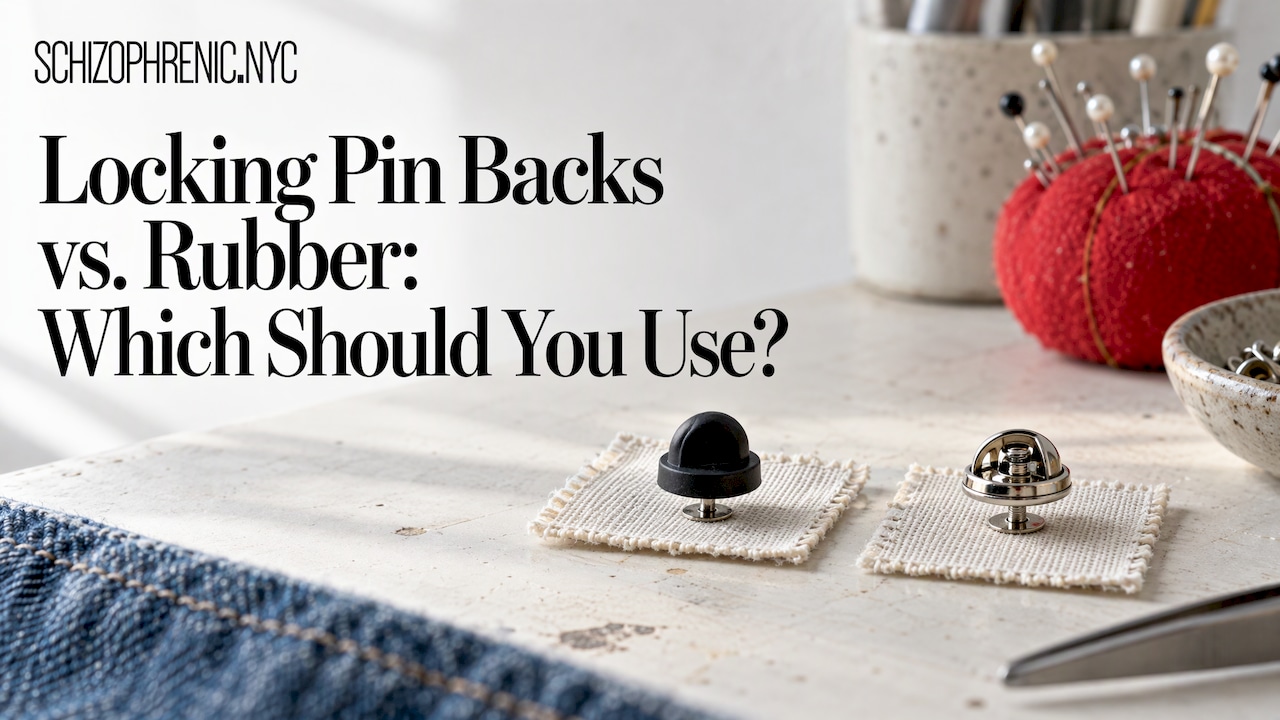
Choose a locking back when losing the pin would hurt, or when the pin rides on a bag, a jacket or a lanyard. Choose rubber when the pin is light, the fabric is thin, or you swap pins often. Locking backs hold harder. Rubber backs are softer, cheaper and quicker to take off. Neither is “better” in general. Each fits a different kind of day.
We care about this because wearing a message you believe in only works if it stays on your chest or your bag. Below you’ll find how each back works, how they compare, and a simple way to match the back to what you’re wearing.
TL;DR
- Locking backs use a ball-and-spring clasp that clicks onto the post and needs deliberate release. They are the safer pick for bags, denim, leather and pins you’d hate to lose.
- Rubber backs hold by friction alone. They are comfortable, light and fast to remove, and they suit tees, thin fabric and casual wear.
- One guide puts rubber at roughly 1 to 3 years before it dries out, versus 5+ years for metal locking clasps.
- Match the back to the job: rubber for light pins and changing layouts, locking for daily wear, movement and valuable pieces.
- Always give the pin a gentle tug after attaching it, and replace rubber backs once they feel stiff instead of springy.
Table of Contents
- How each back actually works
- Security: which one stays on?
- Comfort, lifespan and fit side by side
- Which one for what you’re wearing
- How to attach and remove each type
- Small checks that save pins
- Do you need locking backs for pin-back buttons?
- Wear your message with us
- FAQ
- Sources
How each back actually works
Rubber backs: friction and nothing else
A rubber (PVC) pin back has no moving parts. The hole in the center of the molded cap is a little smaller than the pin post, so when you push it on, the rubber stretches and grips. According to KST Enamel Pins, you push it down until it seats and pull it straight off with light pressure to remove it.
Because the grip depends on that snug hole, size matters. Amazon’s listing for one common pack of PVC backs states they fit posts 1 to 1.2 mm thick and won’t fasten onto a post that is too slim. If a rubber back spins freely or slides off with no effort, the post is probably too thin for it or the rubber has worn out.
Locking backs: a clasp that has to be released
A locking back (often called a deluxe clutch or flathead clutch) works with a ball and a spring inside a small metal housing. When you press it onto the post, the ball slides along and settles into an indentation, producing a click and a firm hold. KST Enamel Pins describes the same mechanism: you press until it clicks, and to remove it you pull the top disc while gripping the lower lip.
There is also a tool-based style. It is a small cylinder with a screw set into the side. You slide the post through, then tighten the screw with a small Allen wrench so it presses against the post. Custom Pins Now explains this type and how to release the spring style, which means pushing the center part away from the flat top so the mechanism lets go. The screw type is the hardest to lose, but it is slow, so it suits pins you plan to leave in place.

Security: which one stays on?
Locking backs win on security, and by a clear margin. One comparison rates rubber clutch security as light to moderate, since rubber can loosen with movement, and rates locking clasps as high, because they won’t release without a deliberate action. A separate guide to pin backs places rubber at medium security and locking at high.
Potter USA’s guide to pin backs says the locking style leads on security thanks to its spring mechanism, though it is somewhat bulky and costs a bit more. It recommends locking backs for securing decorative pins to thick textiles such as denim or leather.
A story from The Inventory shows what that hold means in practice. A pin was ripped off a bag on a plane, yet the locking back stayed attached. The pin body broke at the stud instead. The back did its job.

Rubber’s weakness is that it can tear or let go if the pin is caught with enough force. It can also stretch over time, a bit like a rubber band losing its snap.
Comfort, lifespan and fit side by side
| Rubber back | Locking back | |
|---|---|---|
| How it holds | Friction on the post | Ball and spring clicks into a groove |
| Security | Light to moderate | High |
| Putting on and off | Fast, no technique | Needs a firm press and a deliberate release |
| Feel against skin or thin fabric | Soft and light | Heavier, can be tight on very thin fabric |
| Typical lifespan | About 1 to 3 years before the rubber dries out | About 5+ years |
| Best for | Tees, light blouses, display, swapping layouts | Bags, denim, leather, lanyards, valued pins |
The lifespan and fabric figures come from ProudZebra’s comparison guide, which describes rubber as gentle on most fabrics and locking clasps as slightly heavier and sometimes too tight on very thin material. Treat the years as a rough guide. Heat, sun and how often you take the back on and off will move them.
Which one for what you’re wearing
A tee, tank top or light blouse
Rubber is a good fit here. It is soft, it won’t drag a thin knit down, and it is easy to remove when you wash the shirt. If the pin is small and you could replace it, the trade-off is easy to accept.
A tote, backpack or messenger bag
Bags move constantly. They brush doors, seat backs and other people. This is where rubber most often fails, and where we would reach for a locking back. If you carry an advocacy tote every day, a pin that stays put means the message goes everywhere with you. Our own mental health awareness tote bags are a good canvas for pins, and the heavier canvas holds them well. We wrote about tote bag materials and canvas weight if you want to know what fabric suits a pin.
A denim jacket, leather jacket or thick fabric
Thick material pairs well with a locking back. The post has to pass through a lot of fabric, and the back needs to bite down hard on it. Potter USA specifically points to denim and leather for this reason.
Lanyards, badge holders and work wear
If you wear it every day, choose locking. Daily wear means daily knocks, and a pin that falls on a hospital floor or a classroom floor is easy to lose. Rubber is fine for a special-occasion pin that only comes out once in a while.
Pins you swap often
If you like to rearrange your collection, rubber is practical. It goes on and off quickly, so you can test spacing before you commit to a layout. One sensible approach is a mix: rubber on light pins and changing layouts, locking on rare, heavy or important pieces.
A pin with sentimental meaning
If a pin was a gift, marks a milestone or stands for your own story, use a locking back. A replacement pin is easy to buy. A moment you can’t recreate is not.
How to attach and remove each type
Rubber
- Slide the post through the fabric from the front.
- Push the rubber cap onto the post until it sits flat against the fabric.
- Give the pin a gentle tug to confirm it won’t slide.
- To remove, pull the cap straight off with light pressure.
Spring-style locking
- Line the back up over the post.
- Press firmly until you hear or feel the click.
- Tug gently on the pin to be sure it isn’t wobbling.
- To remove, hold the flat top between your thumb and finger, then push or pull the center part away from the top to release the mechanism.
If the click doesn’t come, the post may not be fully through the fabric, or the post may be bent. Don’t force it. Take it off and check.
Small checks that save pins
These habits come from Hesank’s guide to pin backs, and they work for both types.
- Look at the post before storing or wearing. A bent post makes any back grip badly.
- Replace rubber backs when they go stiff or brittle. A healthy one feels springy.
- Make sure a locking back is fully seated. You should feel or hear the click.
- Fasten both posts on a two-post pin. This stops the pin from rotating and shares the load.
- Use two locking backs on a heavy pin that rides on a bag, or look for a design with a second post, if the pin spins or feels loose.
- Tug gently after you attach it. It takes a second.
One more habit: keep rubber backs out of hot places. Rubber loses strength with heat, so a pin left on a sunny dashboard is more likely to loosen. Keep spares in a small pouch so you always have a fresh one on hand.
One safety note. Pin posts are sharp. Keep loose pins and backs away from small children, and think twice about pins on a child’s clothing. Rubber is the usual choice for kids’ pins because there are no sharp metal parts on the back.
Do you need locking backs for pin-back buttons?
Flat pin-back buttons are a different animal from enamel pins. They fasten with a pin that runs through a metal shell, not a post and clutch. If you’re making your own, our guide to 57.15mm vs 58mm button sizes will save you a costly reprint. If you want to wear pins on clothing without harming the fabric, read how to wear enamel pins for activism.
Our take
When I started wearing my message on my clothes, I learned fast that wearable advocacy has to survive real life. A bus, a crowded train, a bag thrown over a shoulder. If something I’m wearing keeps falling off, the conversation never starts.
That’s why we think about this the way we think about everything: use what fits the moment. A soft rubber back is lovely on a light tee when you want something easy and comfortable. A locking back is what you want when the piece matters to you, or when you’re on the move. Pick for the day you’re having, not for a rule.
What matters most is that you wear it, proudly, and that it stays where you put it. Confidence can get you anywhere, and a secure pin helps you get there with your message intact.
Michelle
Wear your message with us
If you want something to carry your message every day, start with a mental health tote bag, a Don’t Be Paranoid carabiner or our artwork button set. Browse everything at Schizophrenic.NYC. Each piece is designed to start a conversation and chip away at stigma around mental illness.
FAQ
Are locking pin backs better than rubber?
For holding power, yes. Locking backs use a spring-loaded clasp that requires deliberate release, while rubber relies on friction. Rubber is better when comfort, low cost and quick removal matter more than maximum hold.
How long do rubber pin backs last?
One comparison guide gives a typical range of about 1 to 3 years before the rubber dries out, with metal locking clasps lasting 5+ years. Heat, sun and frequent removal shorten that. Swap in a fresh rubber back once yours feels stiff or loose.
How do I take off a locking pin back?
Hold the flat top disc between your thumb and finger, then push or pull the center part away from the top so the internal mechanism lets go. The back then slides off easily. If it sticks, don’t pry at it. Check that you are pulling the right part of the clasp.
Which back is best for a backpack or tote?
A locking back. Bags take constant knocks and movement, which is where rubber is most likely to slip off. Check that the back clicks fully into place and give the pin a gentle tug.
Can I use rubber backs on a heavy pin?
It’s better not to. Rubber can stretch and let go under weight or when the pin snags, so heavy or valuable pins do better with a locking back. If you want to keep rubber, use it on light pins on thin fabric.
Sources
- How Do Locking Pin Backs Work (KST Enamel Pins)
- eBoot PVC Rubber Pin Backs (Amazon)
- How To Get A Locking Pin Back Off (Custom Pins Now)
- Rubber Clutch vs Locking Clasp (ProudZebra)
- A Guide to Pin Backs (Potter USA)
- Protect Your Pin Collection (The Inventory)
- Understanding Pin Backs (Hesank)