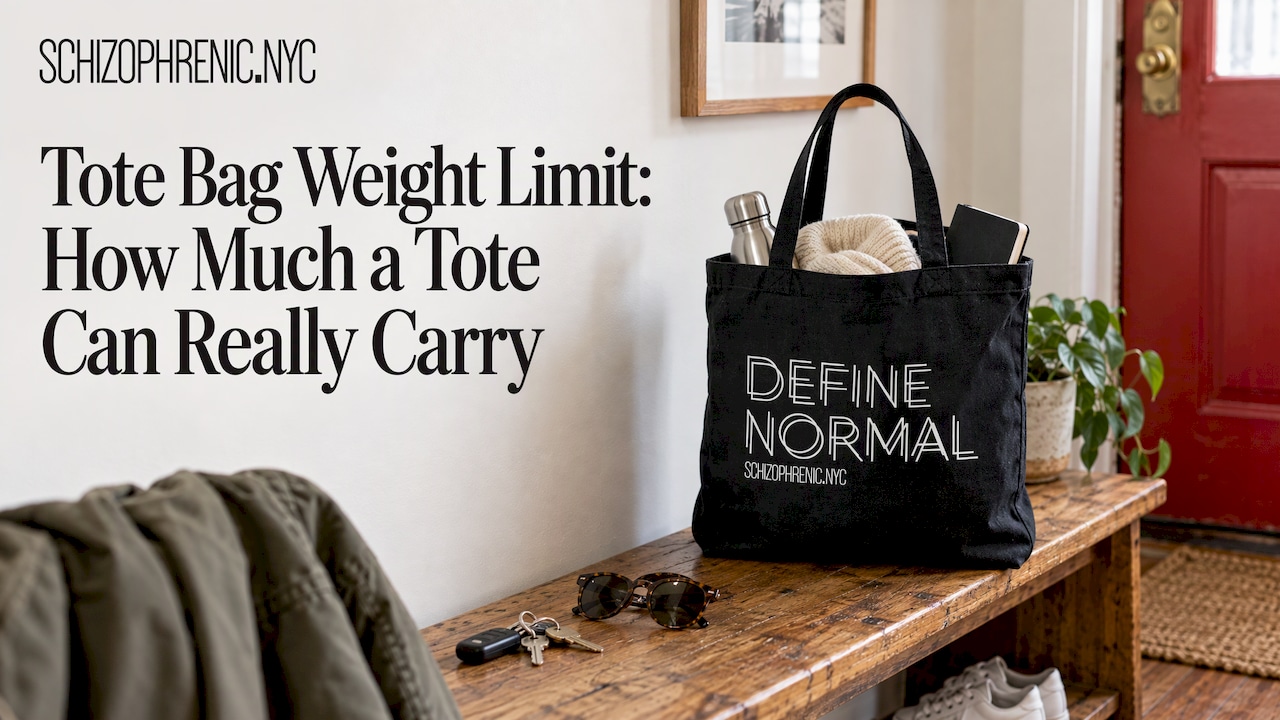
There is no single weight limit for tote bags. How much a tote can hold depends on its fabric, its stitching, its handles and how you carry it. Your body also sets a limit, and it is usually lower than the bag’s. For everyday use, a well-made canvas tote is comfortable with a modest load, and the weight that feels good on your shoulder is often less than the weight the bag can survive.
We sell mental health awareness totes, so we think about this a lot. People carry our bags to work, to the farmers market, to appointments and to advocacy events. Here is how to figure out what a tote can hold, what you should hold, and how to make a bag last.
TL;DR
- No universal tote bag weight limit exists. Fabric weight, seams, handle attachments and bag shape all decide what a tote can hold.
- The weak point is usually the handle joint or the bottom seam, not the fabric.
- For comfort, many experts suggest keeping a bag to about 10% of your body weight. Some research points to shoulder strain starting even lower.
- Totes work as a carry-on or personal item if they fit the airline’s size rules. Weight rules differ by airline, so check yours.
- Choose a heavier canvas, a reinforced handle and a bag sized to your heaviest regular load.
Table of Contents
- Why a tote has no fixed weight limit
- What canvas weight tells you
- The real weak points: handles and seams
- The limit that matters most: your body
- What to carry, and what it weighs
- Choosing a tote for your usual load
- Keeping a tote strong over time
- Can a tote bag be your carry-on?
- Our perspective
- Ready for a tote that keeps up with you
- FAQ
- Sources
Why a tote has no fixed weight limit
A backpack or a suitcase often comes with a rated load. A tote is simpler: a piece of fabric, a bottom, two handles. That simplicity is why it is so easy to carry, and also why makers rarely publish a number.
Four things decide how much a tote can hold:
- Fabric weight. Heavier canvas resists tearing and stretching. It is measured in ounces per square yard or in GSM (grams per square meter).
- Stitching. The seams carry the load. Double stitching and reinforced boxes or crosses at the handle joints spread the strain.
- Handle design. Length, width and how the handle attaches to the body matter more than the handle’s material.
- Bag structure. A gusseted or boxed bottom spreads weight across the base. A flat bag concentrates it on the bottom seam.
These work together. A carefully sewn bag in lighter fabric can outlast a sloppy bag in heavy fabric, because the weakest part sets the practical limit. Fabric weight is a good starting clue, but it never tells the whole story.
What canvas weight tells you
Canvas weight is the number most shoppers can actually find on a product page, so it is worth knowing how to read it.
| Canvas weight | Typical feel | Best for |
|---|---|---|
| Around 6 oz | Thin, light, drapes easily | Light daily items, a book and a water bottle |
| 8 oz | Light but sturdy | Occasional carrying, light errands |
| 10 to 12 oz | Substantial, holds shape | Everyday carrying, groceries, work gear |
| 14 to 16 oz and up | Stiff, heavy duty | Frequent heavy loads, market hauls, tools |
These bands are general guidance, not a promise for any single bag. Every maker builds differently, so treat them as a rough scale. If you want to see how fabric weight changes the look and feel of a printed tote, our guide to 10 to 12 oz canvas tote bag materials walks through it.
For a sense of the heavy end of the scale, a 24-ounce cotton canvas tote was tested by a reviewer carrying a 50-pound kettlebell with no signs of strain. That is an extreme case. It shows what thick canvas and good construction can do, not what a typical lightweight tote is built for.
The real weak points: handles and seams
When a tote fails, it rarely fails in the middle of the fabric. It fails where forces gather.
- The handle attachment. When you hang a tote from one shoulder or one hand, the whole load pulls on a small patch of stitching. One handle letting go is enough to drop the bag.
- The bottom seam. Heavy, dense items such as books, cans or jars press down on the base. A single seam with no reinforcement can split.
- The corners. Hard-edged objects push into the corners and wear through the fabric over time.
So when you judge a tote, look at the handle joints first. A square or cross-shaped stitched patch is a good sign. Handles that are simply folded over and stitched in a single line are fine for light loads and will tire sooner under heavy ones.
A few habits protect the weak points:
- Pack heavy items low and centered, not piled against one side.
- Carry with both handles in your hand or on the same shoulder when the load is heavy, rather than hanging the bag by one handle.
- Put hard or pointy objects in a pouch or box so they do not press into the corners.
- Empty the bag at the end of the day instead of leaving it loaded on a hook.
The limit that matters most: your body
The bag may survive far more than you should carry. Comfort sets the limit for most people.
According to orthopedic spine surgeon Dr. Steven Girdler, quoted by Yahoo Health, a bag shouldn’t exceed about 10% of your body weight. For a 150-pound person, that is roughly 10 to 15 pounds. The same article notes that some research suggests shoulder pain can start at about 4% of body weight, which is around six pounds for a 150-pound person.

He also explains that carrying a bag on one shoulder makes the muscles across the shoulders and the back of the neck work nearly three times as hard as wearing the same bag crossbody. For longer walks, he recommends switching shoulders every 30 minutes.
Here is what that looks like in practice:
| Body weight | About 10% of body weight | About 4% of body weight |
|---|---|---|
| 120 lb | 12 lb | 4.8 lb |
| 150 lb | 15 lb | 6 lb |
| 180 lb | 18 lb | 7.2 lb |
| 200 lb | 20 lb | 8 lb |
The 10% and 4% figures come from the sources above. The rows are simple arithmetic. If you already live with shoulder, neck or back pain, or you have a condition that affects how you carry weight, talk with your doctor or a physical therapist about what load is right for you.
A few ways to make a loaded tote easier on your body:
- Go crossbody or switch sides. Changing shoulders often spreads the work.
- Choose longer handles if you like carrying on your shoulder, so the bag sits against your hip instead of pulling on your neck.
- Lighten the load. Take out what you did not use yesterday.
- Use two bags for heavy trips, one on each side, instead of one overloaded bag.
- Hold it in your hand for short distances and take breaks on long ones.
What to carry, and what it weighs
It helps to know what your usual load adds up to. Weigh your own bag on a bathroom scale once. Many people are surprised.
Rough guide to common items (weigh yours for an exact number):
- A paperback book: under a pound, a hardcover can be two or more
- A 16 oz water bottle full: a little over a pound
- A laptop: often three to five pounds with its charger
- A gallon of milk: about eight pounds
- A bag of groceries: five to fifteen pounds, depending on the trip
- A 7-day pillbox with a full week of pills: very light, an ounce or two for the box itself
If your heaviest regular item is a laptop and a book or two, a medium tote in mid-weight canvas is plenty. If you shop for groceries on foot, pick a heavier canvas with reinforced handles, and shop in two lighter trips rather than one heavy one.
Choosing a tote for your usual load
Match the bag to your heaviest regular item, not the prettiest design on the shelf. Then use this checklist.
- Check the fabric weight. Look for ounces or GSM on the product page. For everyday use, mid-weight canvas is a sensible target.
- Look at the handle joints. Reinforced stitching at the attachment points is worth more than an extra ounce of fabric.
- Check the bottom. A boxed or gusseted base spreads weight. A flat sewn bottom suits lighter loads.
- Look at handle length. Short handles suit hand carrying. Longer handles suit the shoulder.
- Think about the inside. An inner pocket keeps small things from sinking to the bottom and shifting your load.
- Size for the load. A bag that is too big invites overpacking. A bag that is too small bulges and strains its seams.
If you want a tote that carries a message as well as your things, browse our mental health awareness tote bags. Each one is designed to start conversations about mental illness wherever you take it.
Keeping a tote strong over time
A bag lasts longer when you look after the places that take the strain.
- Rotate how you carry it. Switch hands and shoulders so one handle joint is not always doing the work.
- Mend small problems early. A loose thread at a handle joint is easy to fix. A torn handle is not.
- Wash gently. Follow the care label, and let the bag dry fully.
- Protect the print. If you want your tote to stay crisp in rain and spills, our guide on how to waterproof a canvas tote covers eight steps that protect the print too.
Wet canvas can feel heavier and can stress the fabric, so dry out a soaked bag before you load it again.
Can a tote bag be your carry-on?
Often yes. A tote can serve as a personal item or a carry-on bag as long as it fits the airline’s size rules. The Federal Aviation Administration says the maximum size carry-on for most U.S. airlines is 45 linear inches, the total of height, width and depth, and it advises travelers to check with their airline for rules on the number of items and maximum size.
Size is only half of it. Weight limits are set by each airline, not by one national rule. The FAA’s guidance for airlines says a carry-on program should not compromise the airline’s weight and balance program, and that flight attendants should not place items in overhead bins that exceed bin weight limits. In plain terms, some carriers publish a carry-on weight limit and others rely on whether the bag fits and can be lifted safely. Look at your airline’s baggage page shortly before you fly, because policies change.
A few tote-specific travel tips:
- Pick a tote with a zipper or a snap closure so items do not spill under the seat.
- Pack the heaviest things in your main bag and keep the tote for what you want at your seat.
- Remember you may have to lift it overhead. If you cannot do that comfortably, it is too heavy.
- Keep medications in your carry-on tote, where you can reach them. Our guide to traveling with pills and the TSA explains what to know.
Our perspective
We think a tote bag is one of the most honest pieces of advocacy you can own. It goes everywhere with you. It sits on a train seat, it hangs on a chair at a clinic waiting room, it rides on your shoulder past hundreds of people a day. A message on a tote gets seen all day.
That is why we care that it holds up. When you carry a bag with words like “Define Normal” on it, you are saying something out loud. The last thing you need is a handle that gives out in the middle of a crosswalk. So we design our totes to be everyday companions, and we encourage you to think about what you really carry before you pick one.
Here is what I would tell a friend. Carry less than you think you need. Switch shoulders. Put your pillbox and your essentials in a spot you can reach. And pick a bag that makes you feel confident, because confidence can get you anywhere. Carrying your story on your shoulder is a strong thing to do, and you deserve a bag that keeps up with you.
Michelle
Ready for a tote that keeps up with you
If you are looking for a bag that carries your essentials and your message, start with our mental health awareness tote bags. If you want a design to start with, try the Define Normal black tote. It pairs well with a 7-day pillbox, a sticker or a button from the rest of the shop at Schizophrenic.NYC.
FAQ
Do tote bags have a weight limit?
There is no standard limit. Each bag’s capacity depends on its fabric weight, stitching, handles and shape, so two totes that look alike can carry very different loads. Plan your load around the bag’s construction and around what feels comfortable on your shoulder.
How much weight can a canvas tote bag hold?
It varies widely with the canvas weight and construction. Light canvas suits light errands, mid-weight canvas suits everyday loads, and heavy canvas with reinforced handles suits frequent heavy carrying. Even a very sturdy bag should be loaded with your body in mind, since one expert suggests keeping a bag near 10% of your body weight.
How heavy is too heavy for a tote bag on my shoulder?
About 10% of your body weight is a common ceiling, so roughly 15 pounds for a 150-pound person. Some research suggests strain can start closer to 4%. Switch shoulders, go crossbody when you can, and see a doctor or physical therapist if you have ongoing shoulder, neck or back pain.
Can I use a tote bag as a carry-on?
Usually, yes, if it fits your airline’s size limits for a personal item or a carry-on bag. The FAA notes that most U.S. airlines cap carry-on size at 45 linear inches and tells travelers to check with their airline. Confirm both the size and any weight rule on your airline’s website before you fly.
What breaks first on a tote bag?
Usually the handle attachment or the bottom seam, not the fabric. Reinforced stitching at the handle joints, a boxed base and even packing all help. Carrying with both handles together on heavy days also takes strain off a single seam.
Sources
- That tote bag could be wrecking your shoulders, Yahoo Health
- Carry-On Baggage Tips, Federal Aviation Administration
- FAA Advisory Circular 121-29B
- The 7 Best Canvas Totes, Business Insider
Recommended
- 10 to 12 oz Canvas: Tote Bag Materials to Keep Your Advocacy Visible
- 8 Steps to Waterproof a Canvas Tote and Protect Its Print
- It’s Not A Delusion. You Are Incredible – Black Tote
- Dont Be Paranoid Tote Bag!