
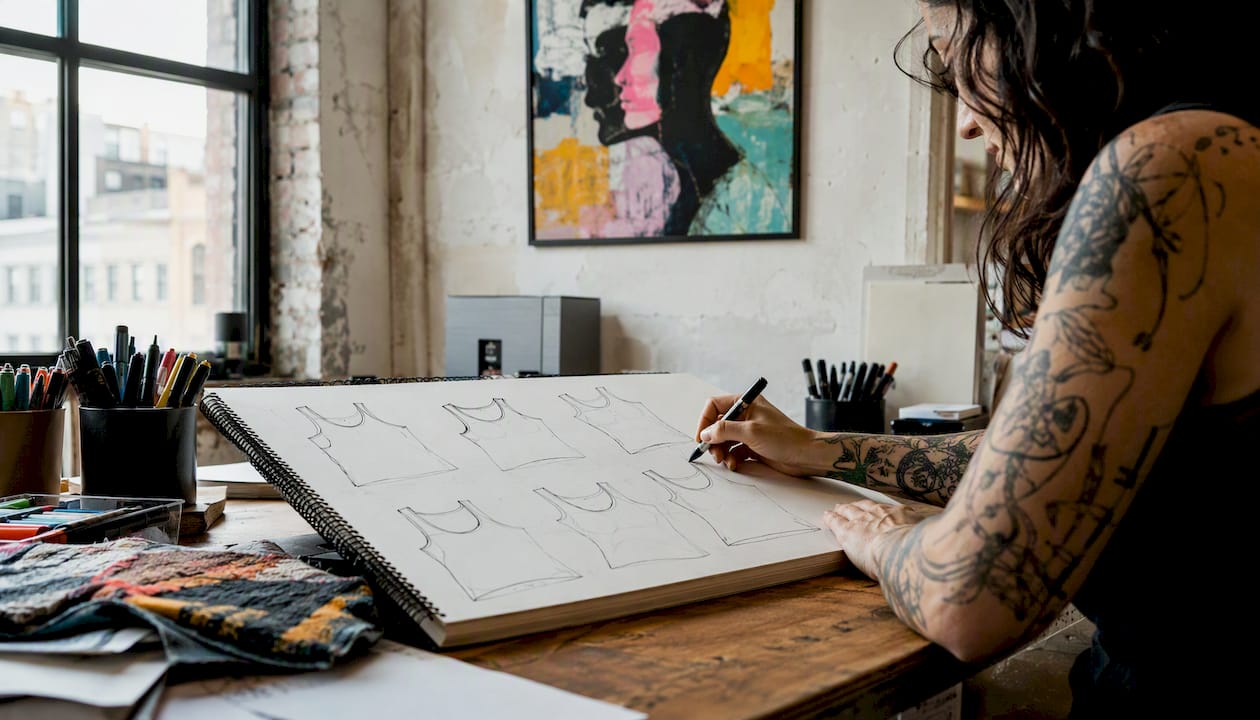
Want mental health tank top ideas you can wear, gift, or sell? Start with advocacy-forward slogans on a soft cotton blend. Buy ready-made at Schizophrenic for designs rooted in lived experience, or build your own using print-on-demand services connected to Shopify. Use Pinterest for slogan inspiration and Shutterstock for licensed vectors when you need print-ready art.
- Fastest ready-made option: Schizophrenic’s mental health tank top collection, designed by Michelle Hammer with advocacy messaging built in
- Fastest custom option: A Shopify-connected POD platform where you upload art and fulfill orders on demand
- Best for advocacy and education: Schizophrenic, where every purchase supports stigma-reduction work grounded in real lived experience
Pro Tip: Before you browse or design anything, write down the one feeling or message you want someone to walk away with after reading your shirt. That single sentence becomes your creative brief.
Key Takeaways
The most effective mental health tank tops pair an honest, person-first slogan with a soft cotton fabric, a legible layout, and a print method matched to your order size.
| Point | Details |
|---|---|
| Buy vs. make decision | Buy from Schizophrenic for advocacy-aligned designs; use POD for custom slogans with no minimums. |
| Design fundamentals | Limit front copy to ten words or fewer and choose one focal element per design. |
| Print method match | DTG suits small runs; screen print delivers better durability and lower cost at 24-plus units. |
| Respectful wording | Use person-first language, avoid sensational phrasing, and test slogans with people who have lived experience. |
| Schizophrenic collection | Ready-made mental health tank tops designed by Michelle Hammer, rooted in lived experience and stigma-reduction advocacy. |
Useful resources for inspiration, mockups, and sourcing
These resources cover the main steps from idea to finished shirt.
| Resource | What it’s useful for |
|---|---|
| Pinterest mental health shirt boards | Visual inspiration, slogan discovery, and mood-board building for non-designers |
| Shutterstock mental health vectors | Licensed icons and art for mockups and commercial print runs |
| Shopify POD integrations | Storefront setup and on-demand fulfillment for selling custom tanks without inventory |
| Marketplace review platforms (Trustpilot, BBB) | Quality and trust checks before ordering from unfamiliar POD sellers |
When ordering from any marketplace, check product photos from real buyers and read recent reviews before placing a bulk order. Mockup images rarely show how ink actually sits on fabric.
Table of Contents
- What are the best mental health tank top ideas for advocates?
- How do you design a mental health tank top that actually communicates?
- Which printing method and fabric work best for tank tops?
- Where can you buy or customize mental health tank tops?
- How do you write slogans that support awareness without stigmatizing?
- How do you create a print-ready file for your tank top design?
- What copyright and licensing rules apply to mental health designs?
- What does a mental health tank top actually cost?
- Why clothing works as advocacy, and why lived experience matters
- Schizophrenic: advocacy-forward tanks made from lived experience
- Sources
What are the best mental health tank top ideas for advocates?
The strongest mental health tank top ideas pair an honest message with a visual treatment that lets the words breathe. Below are 25 slogan prompts grouped by tone, followed by layout and typography notes you can hand directly to a designer or printer.
Slogan ideas by tone
Supportive and gentle
- Healing is not linear
- You are not your diagnosis
- Rest is productive
- Be kind to your mind
- Mental health matters every day
Candid and honest
6. Some days are harder than others
7. Medicated and doing great
8. My brain works differently
9. Therapy changed my life
10. I live with schizophrenia. Ask me anything.
Advocacy and awareness
11. Mental health is health
12. End the stigma
13. 1 in 5 people. Maybe you know one.
14. Schizophrenia has a face. This is mine.
15. Speak up. Show up. Show out.
Humor and reclaiming
16. Professionally anxious
17. My therapist says I’m doing great
18. Mood: medicated
19. Certified overthinker in recovery
20. Brains are weird. That’s okay.
Recovery-focused
21. Still here. Still fighting.
22. Progress, not perfection
23. One good day at a time
24. Surviving and occasionally thriving
25. Recovery looks different for everyone
Trending category-level phrases like “Mental Health Matters” and “Be Kind to Your Mind” appear consistently across mental health tank top listings, which confirms they resonate with buyers. That said, the most memorable designs tend to go one step further, adding a specific, personal edge that generic slogans skip.
Layout variants
- Centered large text: Works for short, punchy slogans (three to five words). The message reads from across a room, which makes it ideal for events and marches.
- Small chest emblem + back graphic: A small icon or logo on the left chest pairs with a longer statement across the back. Good for everyday wear where you want subtlety up front and impact from behind.
- Vertical left-chest text + simple icon: A single word or short phrase running vertically beside a minimal icon. Feels editorial and modern, suits a mindfulness apparel aesthetic.
Typography pairings
A serif headline paired with a clean sans-serif subline reads as confident and grounded. All-caps condensed block type suits bold advocacy statements. Script accents work for softer, recovery-focused phrases but should stay legible at small sizes. For accessibility, keep chest copy at least 18pt equivalent in the final print file and maintain a contrast ratio that passes WCAG AA standards.
Pro Tip: Run your slogan past at least one person with lived experience before you print. What feels empowering to a designer can land differently for someone who lives with the condition every day.
How do you design a mental health tank top that actually communicates?
Good design is mostly restraint. A tank top has limited real estate, and a cluttered message defeats itself.
- Limit word count. Aim for ten words or fewer on the front. Longer statements belong on the back where the reader has time to absorb them.
- Choose one focal element. Either a strong graphic or a strong phrase, not both competing at the same scale.
- Use supportive language, not clinical labels. “Mental health matters” centers the person. “Mentally ill” as an identity label centers the diagnosis.
- High-contrast palettes for events: Black on white, white on navy, or white on forest green all read clearly outdoors in sunlight.
- Muted palettes for everyday wear: Sage, dusty rose, slate blue, and oatmeal feel wearable without looking like a protest sign. They suit a self-care tank top or mindfulness apparel aesthetic.
For typography, chest copy typically prints well at 1.5–3 inches tall. Back copy can run 3–5 inches for the headline and 1–1.5 inches for a subline. Pair no more than two font families per design.
Pro Tip: Test your color choices by photographing a printed proof in both indoor and outdoor light. Colors that look great on screen often shift significantly on fabric.
Which printing method and fabric work best for tank tops?
The print method and fabric you choose shape how the finished tank feels, how long the design lasts, and what it costs per unit.
Fabric options
It holds DTG ink well and feels comfortable against skin during workouts, which matters for mental health workout shirts. Tri-blend (cotton, polyester, rayon) drapes softly, has a slight vintage look, and resists shrinkage, but DTG ink can appear slightly faded on the heathered surface. Polyester blends wick moisture and suit athletic wear, though they require sublimation printing rather than standard DTG or screen print.

Printing methods compared
| Method | Best for small runs | Color fidelity | Cost per unit | Wash durability |
|---|---|---|---|---|
| Direct-to-garment (DTG) | Yes | High on cotton | Medium | Good with proper care |
| Screen print | No (minimums apply) | Very high | Low at volume | Excellent |
| Heat transfer / DTF | Yes | Medium-high | Low-medium | Moderate |
DTG suits one-off or small-batch orders and handles photographic detail well. Screen print delivers the sharpest, most durable result at volume but usually requires a minimum order of 12–24 pieces per color. Heat transfer and direct-to-film (DTF) methods work for short runs and complex designs but can crack over time if washed in hot water.
Vendors who sell through marketplaces typically document product-safety specifications, so it is worth reviewing any vendor’s compliance documentation before placing a bulk order.
Where can you buy or customize mental health tank tops?
You have four main sourcing routes, and each suits a different goal.
- Direct brand shop (Schizophrenic): The strongest choice when advocacy alignment matters. Designs are created by Michelle Hammer, a schizophrenia activist with lived experience, and every purchase supports the brand’s stigma-reduction mission. Browse the mental health tank top collection to see current styles.
- POD marketplaces: Platforms like Shopify-connected POD services let you upload your own art and sell or order on demand with no inventory risk. Shopify supports POD integrations that many small apparel creators use to test slogans before committing to a screen-print run. Quality varies by fulfillment partner, so always order a sample before listing publicly.
- Local screen printers: Best for bulk orders (events, fundraisers, group campaigns). You get hands-on quality control and can negotiate on fabric and ink. Turnaround is typically one to two weeks after art approval.
- Print shops integrated with Shopify: If you want to sell your own mental wellness clothing line, a Shopify storefront connected to a POD fulfillment partner keeps upfront costs low and lets you test which slogans resonate before scaling.
When ordering from any marketplace, check Trustpilot and BBB reviews for the specific seller or platform, and look at product photos from real buyers rather than mockups alone.
Pro Tip: Always request a physical proof or digital color swatch before a full run. Ink colors shift between screen and fabric, and a $15 proof can save you from 50 unusable shirts.
Running out of a size mid-event is a missed advocacy moment.*
How do you write slogans that support awareness without stigmatizing?
Words on a shirt carry weight. The goal is to spark a conversation, not close one down with language that reduces a person to their diagnosis.
- Avoid identity-as-diagnosis framing. “A person living with depression” centers the person. “A depressive” does not.
- Skip sensational or pity-based phrasing. Phrases like “suffering from” or “battling” can imply the person is losing. Many people prefer “living with” or “managing.”
- Be careful with reclaiming language. Words like “crazy” or “psycho” can be reclaimed powerfully by people with lived experience, but the same words on a shirt made by someone without that experience can feel dismissive. Know your audience and your own position.
- Avoid copying trademarked phrases or licensed artwork. Use original wording or properly licensed assets. If a phrase is closely associated with a specific organization’s campaign, write your own version rather than lifting it verbatim.
Language swap examples:
| Instead of | Try |
|---|---|
| Crazy | Experiencing mental health challenges |
| Mentally ill person | Person living with a mental health condition |
| Suffering from schizophrenia | Living with schizophrenia |
| Battling depression | Managing depression |
Subtle, everyday messaging can communicate solidarity without performative language. A design that says “Check on the strong ones” lands gently and opens a door without demanding anything from the reader.
Clothing that comes from lived experience carries something that a generic slogan cannot replicate. When I design for Schizophrenic, I am not guessing what it feels like to live with schizophrenia. I know. That specificity is what makes the message land differently. If you are writing slogans for a community you are not part of, bring people from that community into the process before you print a single shirt.
Sizing, fit, and care for mental health tank tops
Fit and sizing
Unisex tank tops typically run wide through the shoulders and straight through the body. Women’s or fitted cuts taper at the waist and sit closer to the body, which affects how a printed graphic sits on the torso. A centered chest graphic on a unisex tank may shift lower on a shorter torso, so check placement on the actual garment size before finalizing art.
A simple fit-check before ordering:
- Measure shoulder width and compare to the size chart, not just chest circumference
- For printed designs, confirm graphic placement (distance from collar) matches across sizes
- Order a sample in the smallest and largest sizes you plan to carry
Care by fabric and print method
- DTG on cotton: Wash inside out in cold water, tumble dry low or hang dry. High heat degrades the ink.
- Screen print: More durable. Cold or warm wash, inside out. Avoid bleach.
- Heat transfer / DTF: Cold wash only, inside out, hang dry when possible. High-heat drying is the fastest way to crack a transfer.
Pro Tip: Add a short care card to every order. Buyers who follow the right wash instructions keep their shirts looking good longer, which means your message stays visible longer.
How do you create a print-ready file for your tank top design?
Getting the file right before you send it to a printer saves time and money.
File preparation checklist:
- Create artwork at 300 DPI at the actual print size (not scaled up later)
- Convert all text to outlines so fonts do not shift between computers
- Use a transparent PNG for DTG orders or a vector PDF/EPS for screen print
- Include bleed (typically 0.125 inches) if your printer requests it
- Confirm color mode: DTG uses RGB; screen print uses spot colors (Pantone references preferred)
Steps for ordering a proof:
- Export your file in the format your printer specifies
- Request a digital proof (soft proof) and review it on a calibrated monitor
- If the order is large, request a physical strike-off or printed sample before the full run
- Compare the sample to your original art under both indoor and natural light
- Approve in writing before production begins
For mockups and templates, Shutterstock offers licensed vectors and art you can legally use in printed runs. For visual inspiration and slogan discovery, Pinterest boards collect hundreds of mental health shirt designs that help non-designers assemble mood boards quickly.
What copyright and licensing rules apply to mental health designs?
Original artwork and slogans you create yourself are protected by copyright from the moment of creation in the United States, with no registration required, though registering with the U.S. Copyright Office strengthens your legal position if you ever need to enforce rights.
A few rules that apply specifically to mental health apparel:
- Do not copy campaign slogans verbatim. Phrases tied to specific nonprofit campaigns (like certain awareness-month taglines) may be trademarked. Write your own version.
- Do not use licensed characters or artwork without permission. Even if an image appears in a Google search, it is almost certainly protected.
- Stock art from licensed libraries is safe when used within the license terms. Shutterstock licenses, for example, specify whether an asset can be used on physical products sold commercially. Read the license before you print.
- If you commission a designer, get a written work-for-hire agreement that transfers copyright to you. Without it, the designer may retain rights to the art.
- Parody is a limited defense, not a blanket one. If your design comments on a recognizable brand or phrase, consult an intellectual property attorney before printing at scale.
What does a mental health tank top actually cost?
Pricing depends on whether you are buying a single ready-made piece or producing a custom run.
Ready-made advocacy tanks from brands like Schizophrenic typically fall in the $25–$45 range for a single piece, reflecting the cost of quality fabric, ethical production, and the advocacy mission behind the design.
POD single units usually run $20–$35 before shipping, with no minimum order. The trade-off is that per-unit cost stays high because there is no volume discount.
Screen-print bulk orders drop significantly in cost per unit as quantity rises. A run of 24 shirts on a quality blank might cost $15–$22 per unit all-in (blank plus print), while 100 units can bring that closer to $10–$14 per unit. These are qualitative ranges; get quotes from at least two local printers before committing.
Budget planning tips:
- Add 10–15% to your estimated quantity for spoilage, size exchanges, and last-minute additions
- Factor in shipping both ways if you are sending blanks to a printer
- For fundraising campaigns, price the shirt at roughly 2.5 times your cost per unit to cover platform fees, shipping, and a margin for the cause
- If you are testing a new slogan, start with a DTG POD run of five to ten units before investing in a screen-print minimum
Why clothing works as advocacy, and why lived experience matters
I started Schizophrenic because I needed a way to talk about schizophrenia that did not make people shut down. A shirt does something a pamphlet cannot. It starts a conversation without anyone having to say the first word. Someone reads what is on your chest, and suddenly you are talking about something that most people spend their whole lives avoiding.

Living with schizophrenia taught me that the stigma is often worse than the symptoms. People assume the worst. Clothing that says something honest and human chips away at that assumption, one conversation at a time. That is the whole point of what a mental health clothing line can do when it is built around real experience rather than a trend.
If you have a story, I want to hear it. Reach out, share what you are wearing, and tell me what conversations your shirt started.
Schizophrenic: advocacy-forward tanks made from lived experience
Schizophrenic offers something that a generic POD marketplace cannot: designs created by Michelle Hammer, a New York City schizophrenia activist who has lived with the condition and built a brand specifically to reduce stigma. Every tank top in the collection carries a message that comes from real experience, not a trend report.
If you want a mental wellness clothing piece that does more than look good, the mental health tank top collection is the place to start. You can also explore the mental health t-shirt line for related styles. Each purchase directly supports the advocacy work behind the brand. Browse the collection and find the design that says what you have been wanting to say.
Sources
- Discover 180 Mental Health Shirts and tshirt design …
- Mental Health Awareness Shirt Design royalty-free images
- Shopify
Recommended
- What Should I Wear To Support Mental Health? | Schizophrenic.NYC Mental Health Clothing Brand
- Mental Health Don’t Be Paranoid, You Look Great Tank Top
- Schizophrenia Support Mental Health T-Shirts | Schizophrenic.NYC


[…] Mental Health Tank Top Ideas for Advocates and Allies […]
[…] T-shirts and tank tops designed to prompt questions rather than hide a […]