Wearable art activism is the practice of designing clothing or wearable objects with deliberate intent to advance social or environmental change through material, message, movement, or embedded technology. It is not fashion in the commercial sense. The goal is not to sell a look. The goal is to shift a conversation, build a community, or protect a person.
Three things make it work as an activist tactic:
- Visibility: A body wearing a message moves through space, enters rooms, and reaches people no flyer or social post can.
- Material rhetoric: The choice of fabric, construction method, or found material communicates values before a word is read.
- Community signal: Matching garments or shared symbols create instant solidarity, from the Pussyhat Project to Katharine Hamnett’s oversized slogan tees.
If you are a creator, organizer, or brand activist trying to figure out how clothing can carry your cause, this article is built for you.
Key Takeaways
Wearable art activism works when the tactic, material, and community are aligned from the start, not assembled after the design is done.
| Point | Details |
|---|---|
| Match tactic to goal | Slogan tees build awareness; e-textiles support organizing; anonymity features protect participants at risk. |
| Community co-design is non-negotiable | Projects designed without the affected community tend to miss the mark or cause harm. |
| Material choice is a message | Deadstock and natural fibers communicate values; mass-produced synthetics can undercut activist credibility. |
| Plan deployment before production | A garment worn in the right room at the right moment reaches more people than a large unplanned run. |
| Schizophrenic as a model | Schizophrenic.NYC shows how mental health slogan apparel and community events can reduce stigma and spark real conversations. |
Table of Contents
- What wearable art activism is and where it came from
- How wearable art converts attention into real change
- 8 projects and practitioners worth studying closely
- How to design, produce, and deploy your own wearable activism
- Ethical pitfalls and safety considerations to take seriously
- How Schizophrenic.NYC uses wearable art for mental health advocacy
- What I’ve learned from wearing the cause
- Schizophrenic supports wearable advocacy with products you can wear today
- Sources
What wearable art activism is and where it came from
Wearable art is made to be worn, but its purpose is expression, not commerce. Where fashion responds to market cycles and consumer demand, wearable art responds to a moment, a community, or a political condition. The intent is performative. The production is often one-of-a-kind or small-batch. The context is a march, a gallery, a protest, or a street corner.
The history of dress as protest runs long. In the 1850s, the bloomer costume challenged Victorian gender norms by giving women freedom of movement. The mini skirt of the 1960s was read as a political statement about bodily autonomy. In 1984, Katharine Hamnett walked into a Downing Street reception wearing a T-shirt reading “58% DON’T WANT PERSHING,” turning a handshake photo opportunity into an anti-nuclear statement seen around the world. The Pussyhat Project in 2017 produced a large number of pink hats worn at Women’s Marches across the United States, creating one of the most recognizable acts of collective wearable solidarity in recent history. Today, the Art Institute of Chicago and other major institutions include wearable and activist art in their curatorial programming, confirming that the practice has earned both street credibility and museum walls.
How wearable art converts attention into real change
The Center for Artistic Activism argues that art-based tactics can “effect power” when deployed with strategic intent, not just symbolic presence. That distinction matters for anyone planning a wearable project. Here is how the mechanisms actually work:
- Visibility and disruption: A garment worn in public interrupts the visual field. It forces a reaction, even a small one, from every person who sees it.
- Material rhetoric: Upcycled denim signals anti-consumption. Indigenous textiles signal solidarity. Mass-produced polyester can undercut the message entirely, as noted in Refashioning Resistance.
- Performative activation: Some pieces reveal messages only through movement, or trigger audio when touched. Interaction converts passive observers into participants.
- Community identity formation: Shared garments create belonging. When a crowd wears the same symbol, individuals feel less alone and more willing to act.
- Embedded technology: E-textiles add a functional layer. The Resistive Threads project embedded community audio into a denim jacket via conductive patches, then studied its use with housing organizers to assess how electronic streetwear could support real organizing work.
- Privacy and protection: The Signal Lost vest by Liza Stark demonstrates the opposite end of the spectrum: a garment designed to block signals and protect the wearer’s anonymity rather than amplify their visibility.
Matching mechanism to goal is the practical skill. Awareness campaigns need visibility. Recruitment needs community signaling. Protecting protesters at high-risk events may need anonymity features instead of spectacle.
Peer-reviewed research frames this work as transformative leadership: activist art raises awareness, generates dialogue, and builds communities of practice rather than functioning only as symbolic protest.
8 projects and practitioners worth studying closely
| Project / Practitioner | Primary tactic | Why it mattered |
|---|---|---|
| Katharine Hamnett | Slogan T-shirt | Turned a political handshake into a global anti-nuclear image |
| Pussyhat Project | Collective knitted symbol | Unified Women’s March participants across all 50 states |
| Slow Factory (Céline Semaan) | Educational wearables + supply chain transparency | Connected climate science to garment production in NYC |
| Vivienne Westwood | Political runway gestures | Brought environmental and anti-war messaging to fashion weeks |
| Trashion / Trashion Fashion | Upcycled garments from waste | Made environmental critique wearable and visually striking |
| Resistive Threads | E-textile denim jacket with embedded audio | Documented in ACM proceedings as a tool for housing organizing |
| Nöl Collective (Yasmeen Mjalli) | Craft and cultural solidarity | Used embroidery and traditional Palestinian craft as resistance |
| Schizophrenic.NYC | Mental health slogan apparel and accessories | Sparks public conversation about schizophrenia and reduces stigma |
Slow Factory, founded by Céline Semaan in New York City, uses garments and open-source education to connect climate data to fashion’s supply chain. The work is research-backed and community-centered, which is exactly the combination the Center for Artistic Activism points to as effective.
Katharine Hamnett’s slogan tees remain the canonical example of body-worn text as unavoidable public speech. The message was large enough to read in a press photo, simple enough to understand in a second, and worn on a body that was physically present in the room with power.
Vivienne Westwood used runway shows as political stages, wearing protest symbols and incorporating anti-war and environmental messaging into collections that reached audiences far beyond activist circles.
The Pussyhat Project showed how a replicable, low-skill pattern distributed freely online could produce mass visual solidarity at scale, with no central production budget required.
Trashion Fashion projects, practiced by artists and educators across the U.S., turn discarded materials into wearable critique of overconsumption. The garments are the argument.
Resistive Threads is the most technically documented example in this list. The ACM-published study examined how an interactive denim jacket playing community audio could support housing organizers, making it a model for anyone interested in e-textiles with a real community partner.

Nöl Collective, founded by Yasmeen Mjalli, centers Palestinian craft traditions as a form of cultural resistance, showing how material heritage and activist intent can fuse into something that is both beautiful and politically clear.
Schizophrenic.NYC uses mental health clothing and accessories to challenge stigma around schizophrenia, demonstrating that wearable advocacy does not require a runway or a gallery to reach people who need it.
How to design, produce, and deploy your own wearable activism
- Clarify your objective and audience. Are you raising awareness, recruiting allies, or protecting participants? Your answer shapes every decision that follows.
- Choose your tactic. Slogan garments are low-cost and replicable. Upcycled trashion makes an environmental argument through its materials. E-textiles require technical skill and a community co-design process. Performance-based pieces need a planned context for activation.
- Select materials with care. Deadstock fabric, natural fibers, and secondhand garments reduce environmental harm and communicate values before anyone reads a word. Mass-produced synthetic blanks can undercut your credibility if your cause is environmental.
- Prototype and test with your community. Show early samples to the people the project is for. Their feedback will catch problems you cannot see from the inside.
- Produce in small batches. A run of 50 well-made pieces distributed strategically will outlast 500 cheap ones. Local makers and print shops keep dollars in your community and allow quality control.
- Deploy at events with intention. A garment worn at a march, a town hall, or a gallery opening reaches different audiences. Plan where and how pieces will be seen.
- Measure what you can. Track social media reach when pieces are photographed, count media mentions, and ask community partners for feedback. The PMC research on art activism recommends planning for learning outcomes from the start.
Pro Tip: Partner with a local screen printer or embroiderer who shares your values. They can advise on minimum runs, help you source deadstock blanks, and often become genuine collaborators rather than just vendors.
Budget reality: a DIY slogan tee project can start under $5 per piece using deadstock blanks and a screen-printing kit. A small-batch maker run of 50 pieces typically costs $15–$40 per piece depending on complexity. A gallery-commissioned wearable art piece can run into hundreds or thousands of dollars depending on materials and labor.
Ethical pitfalls and safety considerations to take seriously
Getting this wrong can harm the communities you intend to serve. Here are the clearest lines:
- Do not appropriate. Using cultural symbols, textiles, or craft traditions that belong to a community you are not part of, without meaningful collaboration and consent, causes harm regardless of intent. Meaningful collaboration means co-design, credit, and revenue-sharing.
- Do not exploit trauma for spectacle. Garments that display graphic imagery of suffering without the consent of affected people treat pain as aesthetic material.
- Do not tokenize. Including one community member in a project to signal diversity, while keeping creative and financial control elsewhere, is tokenism.
- Do share revenue and credit. If a project generates income, the community it represents should benefit. Document who made what and compensate accordingly.
- Protect participants at high-risk events. If your project involves embedding audio, GPS, or other tracking-capable technology, consider Faraday-lined pockets or removable media storage so participants can control their own data exposure.
- Secure consent for community imagery. If you photograph or record community members wearing your pieces, obtain written consent before publishing.
- Prefer sustainable materials. Fast-fashion production runs for activist campaigns create the same environmental harm your cause may be fighting. Deadstock, natural fibers, and repairability are the more consistent choice.
This section provides general guidance only and is not legal advice. Consult a qualified attorney for questions about intellectual property, consent, or protest law in your jurisdiction.
How Schizophrenic.NYC uses wearable art for mental health advocacy
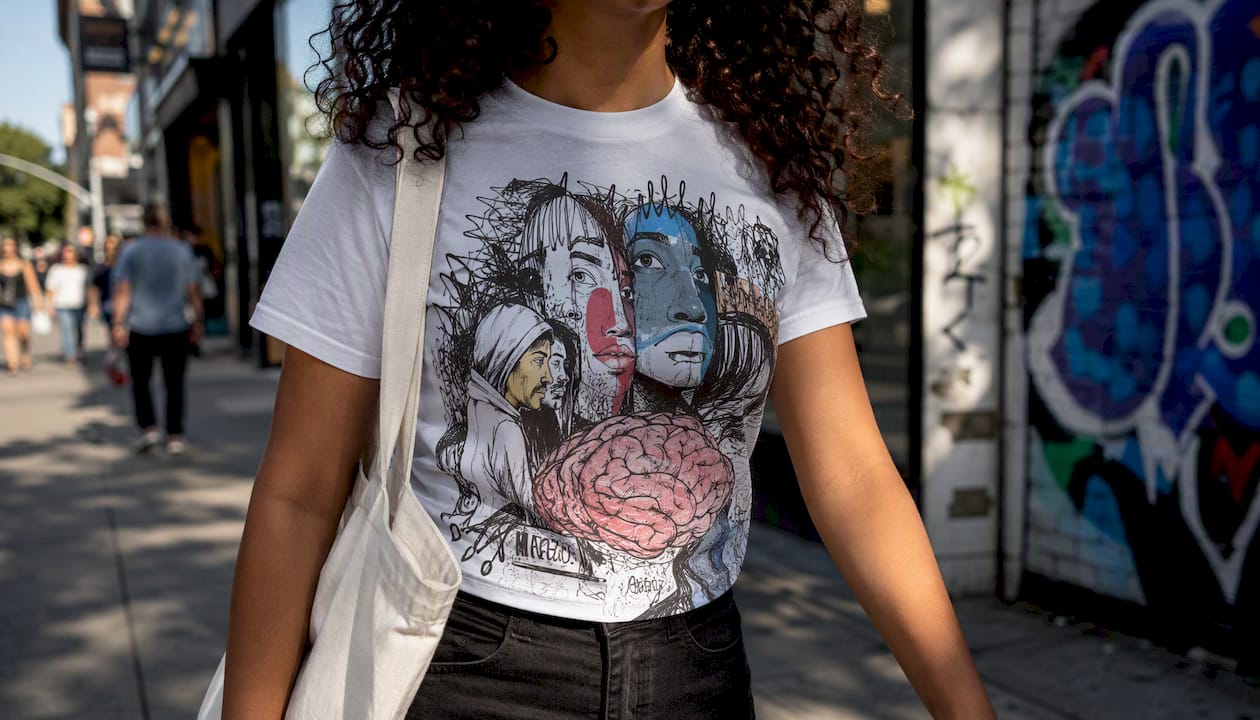
Schizophrenic.NYC is a working example of wearable art activism applied to mental health. Founded by Michelle Hammer, a New York City schizophrenia activist, the brand produces mental health-themed clothing including T-shirts, tank tops, hoodies, and tote bags, alongside accessories like buttons, pillboxes, and jewelry. Every piece is designed to spark a conversation about schizophrenia and reduce the stigma that keeps people from seeking help or speaking openly.

The model is straightforward: bold graphic artwork on wearable objects, distributed through an e-commerce platform and deployed at public speaking engagements, community events, and gallery appearances. The Schizophrenia Collective brings together fashion, art, and advocacy in a way that makes the cause visible in everyday spaces, not just clinical ones.
Pro Tip: When building a wearable advocacy project around a stigmatized condition, involve people with lived experience at every stage of design. Their perspective catches messaging that might inadvertently reinforce stereotypes, and their presence in the project gives it authenticity that no amount of research can replicate.
The community engagement side of the work matters as much as the products. Public speaking, media appearances, and community engagement programming extend the reach of each garment far beyond the person wearing it.
What I’ve learned from wearing the cause
Living with schizophrenia taught me that silence is the real enemy. When I started putting that truth on T-shirts, something shifted. People would stop me on the street, not to argue, but to say “me too” or “my sister has that.” A garment can open a door that a pamphlet never could. The practical steps in this article matter, but the most important one is the first: know exactly what you want the person looking at your piece to feel. If you can answer that clearly, the rest follows. If you want to connect, share your project, come to an event, or just tell us what you are working on.
Schizophrenic supports wearable advocacy with products you can wear today
Wearable advocacy does not have to start from scratch. Schizophrenic offers ready-made mental health apparel designed to do exactly what this article describes: start conversations, signal solidarity, and reduce stigma in everyday spaces. The mental health tank tops and slogan tees are built for visibility, the buttons and pins work as low-cost community distribution tools, and the tote bags carry the message into grocery stores, subway cars, and waiting rooms.
Organizations looking to partner for campaigns or events can connect through the ambassador program, where Schizophrenic works with allies on co-branded initiatives and speaking engagements. Browse the shop and find the piece that fits your cause.
Sources
- Center for Artistic Activism
- Creating Change: Art Activism and Leadership Development — PMC
- Resistive Threads (ACM proceedings)
- Katharine Hamnett — BBC Culture
Recommended
- The Role of Clothing in Advocacy: A 2026 Guide
- Protest Fashion Show at Rethink Gala with Schizophrenic.NYC | Schizophrenic.NYC Mental Health Clothing Brand
- The Schizophrenia Collective: Reducing Stigma Through Fashion and Art | Schizophrenic.NYC Mental Health Clothing Brand