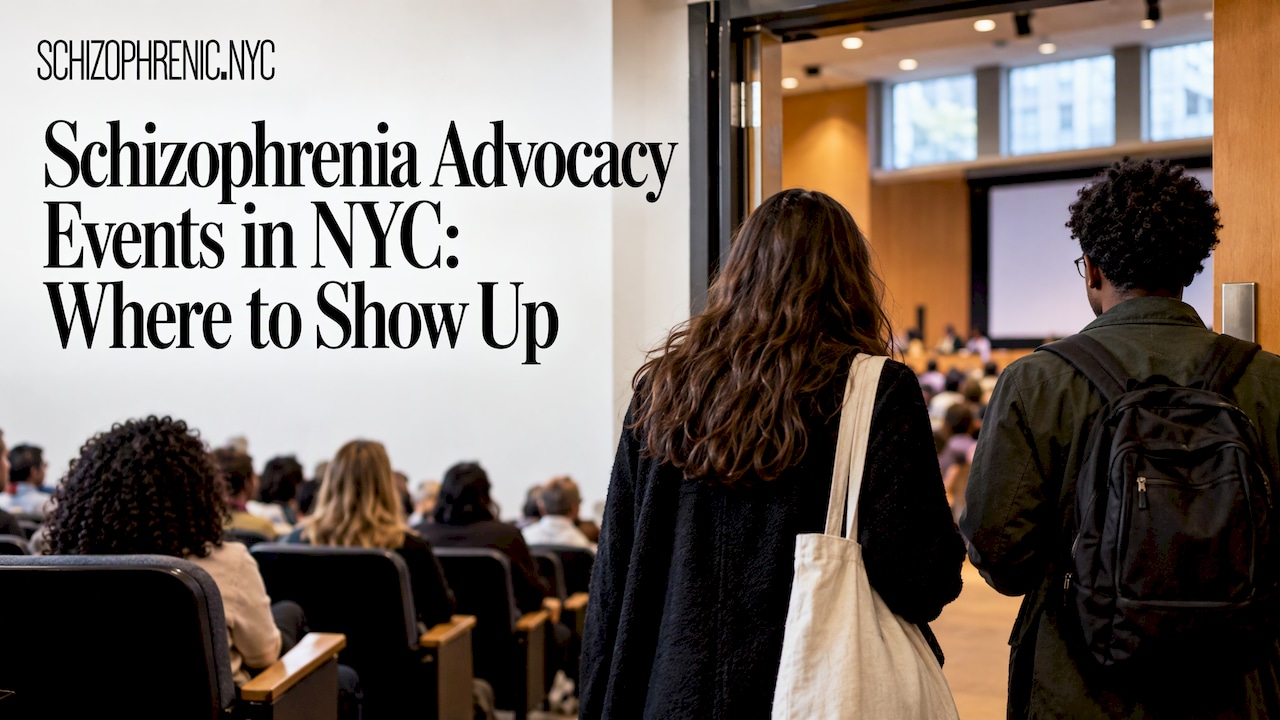
New York City has a steady calendar of schizophrenia advocacy and awareness events: a national psychosis conference, free peer-led groups, family sessions, a spring walk and street fest, and statewide education work. Most of it comes from a handful of organizations, so once you know who they are, you can plan a whole year of showing up. This guide covers where to go, who each event suits and how to take part. It also covers how to carry the message with you once you leave the room.
I’m Michelle Hammer. I live with schizophrenia, and I started Schizophrenic.NYC to get people talking about it. Events are where the talking starts. Wearable art is how it keeps going afterward.
TL;DR
- NYC’s most reliable schizophrenia-related events come from NAMI-NYC, the Foundation for Community Psychoanalysis, ISPS-US, Team Daniel Running for Recovery and Columbia’s psychiatry department.
- NAMI-NYC’s peer-led support groups are free, online and in person, and generally need no registration. Hearing Voices is open to voice hearers with or without a diagnosis.
- The big public moments recur: NAMIWalks NYC and Mental Health Street Fest each May, an October gala and a November NYC Marathon team.
- Dates change every season, so use each organizer’s own calendar before you go.
- Wear your support. A tee, tank, hoodie or pillbox from our shop turns any event into a conversation.
Table of Contents
- The Events at a Glance
- Conferences and Public Programs
- Support Groups and Family Sessions
- The Big Public Moments Each Year
- Statewide Work You Can Plug Into
- How to Pick the Right Event
- Beyond the Event: Keep the Conversation Going
- Perspective
- Wear Your Support to the Next Event
- FAQ
- Sources
The Events at a Glance
| Event or group | Host | Format | Rhythm | Best for |
|---|---|---|---|---|
| Annual conference on psychosis | ISPS-US | In person at John Jay College plus Zoom | Annual, early November in 2026 | Advocates, families, clinicians, people with lived experience |
| In Connection: Relating to Psychosis and Extreme States | Foundation for Community Psychoanalysis | In person, Brooklyn | Weekly, Thursday evenings in fall 2026 | Loved ones of people experiencing psychosis |
| Hearing Voices | NAMI-NYC | Virtual | Second and fourth Fridays | Voice hearers, diagnosed or not |
| Living with Bipolar I/Schizoaffective | NAMI-NYC | Virtual | Second and fourth Thursdays | People with those diagnoses |
| Family support sessions | Team Daniel Running for Recovery | Zoom | Listed monthly sessions | Families and friends |
| NAMIWalks NYC and Mental Health Street Fest | NAMI-NYC | In person, Seaport | Each May | Everyone |
| Schizophrenia Comprehensive Care Initiative | NAMI New York State | Workshops, webinars, online hub | Ongoing from February 2026 | Anyone wanting education |
Conferences and Public Programs
ISPS-US: psychosis, community and lived experience
The International Society for Psychological and Social Approaches to Psychosis held its 25th annual U.S. conference, “Psychosis and the Social Link,” on November 6–8, 2026, at John Jay College of Criminal Justice in Manhattan, with hybrid access by Zoom. It brought together clinicians, researchers, people with lived experience, family members, students and advocates.
The program covered peer support, trauma, social justice, housing, race, policy, hearing voices, community alternatives and early intervention. It frames psychosis through relationships, exclusion and belonging, and it deliberately puts lived-experience and family voices next to professional ones. If you’re an advocate, that mix is the draw. You sit in the same room as the people who write the research and the people it’s about.
The conference is annual, and the organizer advised attendees to register early for in-person or online participation. Check the ISPS-US site in the summer for the next schedule.

Columbia psychiatry events
Columbia’s Department of Psychiatry keeps a public events calendar. Its fall 2026 listings included an online talk on reducing the impact of cannabis on the development of psychosis and an Office of Mental Health statewide town hall. Calendars like this are worth a look every month, because talks on psychosis, early intervention and recovery show up there without much fanfare.
Clinician-focused conferences
Some events are built for professionals. A virtual Psychiatry Update conference on November 10–11, 2026, for example, included a schizophrenia-care presentation, but its organizer describes the audience as psychiatrists, nurse practitioners, nurses, physician assistants, pharmacists and other healthcare professionals. If you’re a clinician or educator, that’s your lane. Advocates and families will usually find more at the community events below.
Support Groups and Family Sessions
Support groups aren’t rallies, but they are the backbone of advocacy. People who feel less alone speak up more.
NAMI-NYC peer-led groups
NAMI-NYC says its peer-led support groups are free, offered online and in person, and generally need no registration. For diagnosis-specific groups you don’t have to show proof of diagnosis, as long as your lived experience fits the topic. Most groups meet twice a month and run about 90 minutes. If you don’t have a computer or don’t like Zoom, you can join a virtual group by phone. The model leans on trained peer facilitators, mutual respect and shared coping strategies rather than clinical treatment.
Two groups matter most for this topic:
- Hearing Voices. It meets virtually on the second and fourth Fridays, 3:30 to 5 p.m. Eastern. It’s open to anyone who identifies as a voice hearer, with or without a diagnosis, and it offers closed captioning. NAMI-NYC describes it as the only open voice-hearer group in NYC. Participants may have schizophrenia, schizoaffective disorder or psychosis. Observers aren’t permitted.
- Living with Bipolar I/Schizoaffective. It meets virtually on the second and fourth Thursdays, 6:30 to 8 p.m. Eastern, with Zoom and phone access and closed captioning. Join about five minutes early. People arriving by 6:35 p.m. are admitted subject to capacity, and no one may be admitted after 7 p.m.
NAMI-NYC’s November calendar also lists NAMI Connection, Family & Friends, Black Minds Matter, AAPI groups and sibling and adult-child groups. Its helpline is 212-684-3264, and the office is at 307 West 38th Street, 8th Floor, New York, NY 10018.
A group for loved ones in Brooklyn
The Foundation for Community Psychoanalysis listed “In Connection: Relating to Psychosis and Extreme States”, an in-person group for loved ones of people experiencing psychosis or extreme states. In fall 2026 it met Thursdays from 6:30 to 7:30 p.m. at 81 Court Street, Floor 3, Brooklyn, from September 24 through December 17. To join, email the contact named on the listing. The listing states no price and no specific accessibility arrangements, so ask when you write. Cycles like this tend to repeat, so look for the next one on the foundation’s events page.
Family sessions on Zoom
Team Daniel Running for Recovery is a nonprofit 501©(3) that advocates for people living with mental illness. It organizes social-support and exercise events for people, families and friends. Its November 2026 family-support Zoom sessions ran on four Saturdays from 11 a.m. to 2 p.m. Eastern, with registration by email. Its in-person home gatherings in Bedford, New York, require vaccination, boosters and flu shots, and were planned to resume in spring 2027. Read the current requirements on its page before you plan a trip.
The Big Public Moments Each Year
NAMI-NYC’s signature events follow a yearly pattern:
- May: NAMIWalks NYC and Mental Health Street Fest at the Seaport.
- Spring: a Young Professionals Night Out.
- October: a gala.
- November: a team for the NYC Marathon.
- Any time: community-led DIY fundraisers.
If you want visibility, the May walk and street fest are the ones. Thousands of people in one place makes it easy to start conversations. The DIY fundraisers are an option if you’d rather build your own event. A bake sale, a trivia night or a small gathering with friends all count.
For a past example, a third-party listing described a Schizophrenia Day hosted by NAMI-NYC and Mount Sinai’s Blau Center on October 22, 2026, with expert talks, family and community connection and free admission. It has ended, but it shows what to watch for around the same time next fall. Confirm details with the organizers.
Statewide Work You Can Plug Into
In February 2026, NAMI New York State launched a Schizophrenia Comprehensive Care Initiative. It covers education, outreach, public-awareness efforts, workshops, webinars, a digital resource hub and local NAMI affiliates. For an advocate, this is a good thing to follow. It means more workshops and webinars that you can attend from home, and more local affiliates looking for people with something to say.

How to Pick the Right Event
Not every event is meant for you. Here’s how I’d choose.
- Start with your reason. Want peers who get it? Pick a NAMI-NYC group. Supporting someone you love? Look at the Brooklyn loved-ones group or the family sessions. Want to be seen and heard? Choose the May walk or a conference. Want research and policy? Go to ISPS-US or the Columbia calendar.
- Check eligibility. Some groups are for a specific diagnosis, and observers aren’t allowed. Others are for professionals only. Read the listing first.
- Plan for access. Virtual groups can be joined by phone, and captioning is listed for several NAMI-NYC groups. Ask about anything the listing doesn’t say.
- Register early where it’s asked. Conferences and email-registration groups fill, and late arrival can mean not getting in.
- Go with a plan for the day after. The best events leave you with a contact, a next step or a story. Write it down before you leave.
If you’re in a hard stretch, don’t wait for an event. NAMI-NYC’s helpline is 212-684-3264. In a crisis, call or text 988, the Suicide & Crisis Lifeline, or call 911 in an emergency.
Beyond the Event: Keep the Conversation Going
Peer connection is also what pushes people to keep talking after the event ends. A community support benefits guide makes the same point about peer-led support in New York City: connection is what people go back for.
What do you do with that feeling on a Tuesday afternoon, on the subway, at work? That’s where what you wear comes in. Our page on what schizophrenia awareness apparel is explains the idea, and our piece on why to wear it covers what happens when someone asks about your shirt. A question from a stranger is a small piece of advocacy you didn’t have to schedule.
Perspective
When I started, I wasn’t looking to build a brand. I was looking for a way to talk about schizophrenia without whispering.
Events give you that room for a few hours. Then everyone goes home, back to a world that still gets a lot wrong about schizophrenia. We make wearable art so the conversation doesn’t stop at the door. A bold design on a tee, a tank or a hoodie says you’re not hiding, and it invites a question.
Our designs come from lived experience. I’m a schizophrenia activist, and the art is mine. That’s why I think a pillbox can be a statement and not something to tuck away, and why a tote bag can be a small speech.
Go to the walk. Join the group. Ask the question. Then wear your support to the next place you go, and see who starts talking.
Michelle
Wear Your Support to the Next Event
If you’re heading to a walk, a conference or a group, our shop has things you can bring along. Our mental health T-shirts, awareness tank tops and hoodies and sweatshirts carry the designs. Our pillboxes make a daily routine part of the message, and buttons, prints and original artwork are good for tables and walls. Looking for a present for someone who’s doing this work? Our gift guide for schizophrenia gifts that give back is a place to start. You can also book me for public speaking or design and direction through our home page.
FAQ
Are schizophrenia support groups in NYC free?
NAMI-NYC says its peer-led support groups are free. They run online and in person and generally don’t require registration. For diagnosis-specific groups, you don’t need proof of diagnosis if your lived experience matches the topic.
Can I join a Hearing Voices group without a diagnosis?
Yes. NAMI-NYC’s virtual Hearing Voices group is open to people who identify as voice hearers, whether or not they have a diagnosis. It meets on the second and fourth Fridays, and observers aren’t permitted.
Where can families go for support in NYC?
Families and friends have several options. NAMI-NYC lists Family & Friends and sibling and adult-child groups on its calendar. The Foundation for Community Psychoanalysis ran a Brooklyn group for loved ones of people experiencing psychosis. Team Daniel Running for Recovery holds family-support Zoom sessions.
How do I find out about upcoming events?
Start with the NAMI-NYC calendar, which you can reach by phone at 212-684-3264. Then check the ISPS-US newsroom, Columbia psychiatry’s events page and the NAMI New York State initiative page. Organizers update schedules each season, so confirm dates with them directly.
How can I take part if I can’t attend in person?
Many options are virtual. NAMI-NYC offers online groups with phone access and closed captioning, ISPS-US offers Zoom access to its conference, and NAMI New York State runs webinars. You can also build your own event, such as a DIY fundraiser.
Sources
- ISPS-US 2026 conference program
- Columbia University Department of Psychiatry events
- Psychiatry Update virtual conference
- NAMI-NYC support groups
- NAMI-NYC Hearing Voices group
- NAMI-NYC Living with Bipolar I/Schizoaffective group
- NAMI-NYC events calendar
- NAMI-NYC signature events
- Foundation for Community Psychoanalysis group listing
- Team Daniel Running for Recovery
- NAMI New York State Schizophrenia Comprehensive Care Initiative
- Community support benefits guide