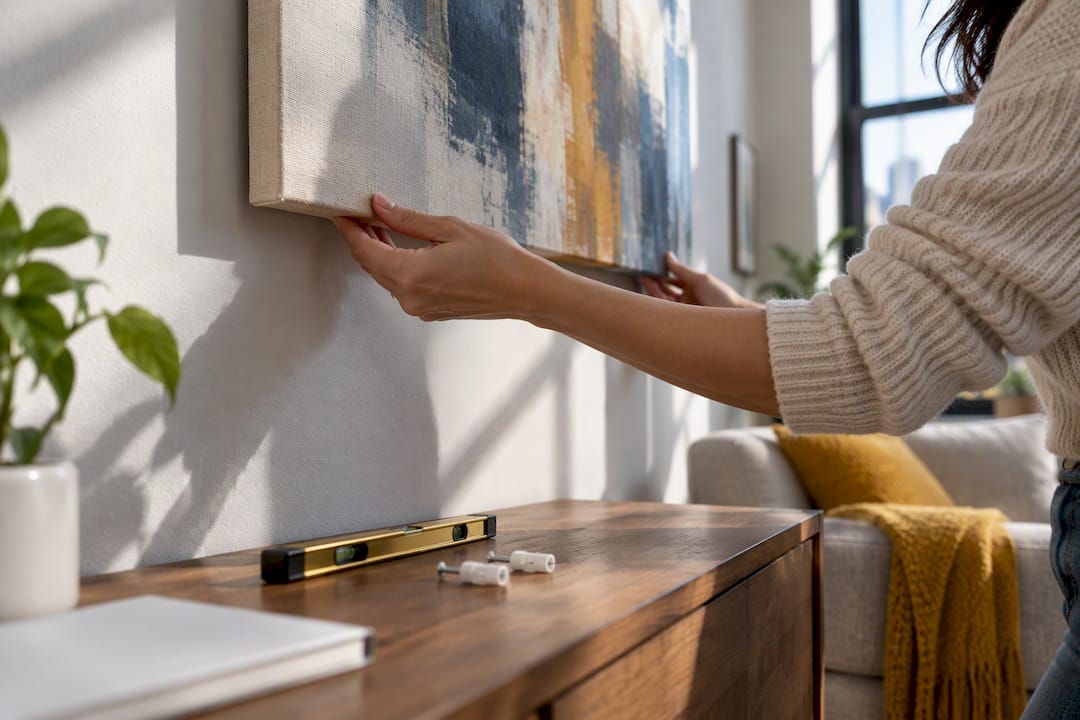
Center your canvas at 57 to 60 inches from the floor, measured to the middle of the piece, and choose your hardware based on weight, not looks. Light canvases under about 16 by 20 inches do fine with a single hook or adhesive strips. Medium pieces need D-rings and wire anchored into drywall. Anything over 24 by 36 inches wants studs, heavy-duty anchors, or a French cleat.
TL;DR:
- Canvases over 24 by 36 inches weigh enough to require studs, heavy-duty anchors, or French cleats for safe installation.
- Adhesive strips and hooks are suitable only for light canvases and smooth, clean walls; they are unreliable on textured or newly painted surfaces.
- Mounting heavier canvases into wall studs provides a more secure hold, especially for pieces over 30 pounds, reducing the risk of damage or falls.
- Proper measurement places the center of the canvas at 57 to 60 inches from the floor, with adjustments made for artwork hung above furniture or grouped displays.
- Using the correct hardware based on canvas size and weight ensures long-term stability and preserves the artwork’s visual impact.
Table of Contents
- How to Hang Canvas Art: Tools and Wall Prep
- Step-by-Step Canvas Hanging Methods
- Can You Hang Canvas Art Without Nails?
- Where Should You Measure and Mark Canvas Art?
- Which Hardware Fits Your Canvas Size?
- Common Canvas Hanging Mistakes and Fixes
- Why How You Hang Art Actually Matters
- Ready to Hang Something With a Message
- Sources
- FAQ
How to Hang Canvas Art: Tools and Wall Prep
Getting this right starts before you touch the wall. A tape measure, a level, a pencil, a stud finder (or the old-fashioned knock test), a hammer or drill, and a screwdriver will cover almost every job.
For hardware, you’ll typically pick from sawtooth hangers, D-rings with wire, single eye hooks, a French cleat, or felt bumpers for the corners. Which one you need depends entirely on what you’re hanging.
- Weigh the canvas before you decide on hardware; a stretched canvas over 24 by 36 inches often runs heavier than it looks.
- Wipe the wall with rubbing alcohol wherever adhesive will touch it. Dust and oil are the top reason adhesive strips fail.
- If the wall was painted in the last few weeks, wait for the paint to fully cure before using any adhesive product. Fresh paint doesn’t bond the way cured paint does.
- Locate studs now, even if you’re leaning toward adhesive. Plans change once you see how the piece actually sits on the wall.
Skipping the weigh-in is the single most common reason a canvas ends up on the floor. A 30 by 40 inch gallery-wrapped canvas can weigh several pounds more than a similarly sized print on paper, and that difference decides whether a sawtooth hanger will hold or slowly bend.
Step-by-Step Canvas Hanging Methods
Each hardware type has its own installation logic. Here’s how to handle the four you’ll run into most.
Single hook or nail (small canvases, up to roughly 16 by 20 inches):
- Mark the wall at your calculated hook height (more on that math below).
- Drive the nail or hook at a slight upward angle, about 45 degrees, so the canvas’s own weight seats it into place.
- Hang the canvas and check it’s centered left to right.
D-rings and wire (medium canvases):
- Screw a D-ring into each side of the frame, positioned in the upper third of the canvas rather than dead center.
- Thread hanging wire through both rings and twist it tight, leaving enough slack that the wire forms a shallow triangle when pulled up.
- Mark and install your wall hardware, then hang the wire over it and center the canvas.
Sawtooth hangers: These work fine for lightweight canvases under a few pounds, but they’re a poor match for anything larger. A sawtooth has one small contact point, which makes it prone to slipping under real weight.
French cleat (large or oversized canvases): Mount one half of the cleat to the canvas back and the matching half to the wall, using screws into at least two studs spaced according to the cleat’s width. This spreads weight across a wide surface instead of one hook, which is why framers use cleats for anything gallery-sized.
Pro Tip: For canvases over 30 pounds, always mount into studs rather than anchors alone. Anchors add holding power, but studs remove the guesswork entirely.
Can You Hang Canvas Art Without Nails?
Yes, and for a lot of homeowners and renters, it’s the better first option to try. Adhesive strips, adhesive hooks, ledges, and simple leaning all avoid putting a hole in the wall, though each has real limits worth knowing before you commit a piece to them.
Adhesive picture hanging strips need a clean, smooth wall to bond properly. Press each strip firmly for about 30 seconds, then wait the manufacturer’s recommended cure time, often up to an hour or longer after painting, before hanging anything on it. Adhesive hooks work similarly for wire-backed canvases, but check the weight rating printed on the package. Going over it invites a fall.
- Use a ledge or simple leaning setup for anything you plan to swap out often, like seasonal decor or rotating art.
- Avoid adhesives entirely on wallpaper, heavily textured or orange-peel walls, and freshly painted surfaces, since these strips are unreliable on textured walls and can pull paint or paper off when removed.
- For heavier canvases, specialized no-drill anchors and hooks can support significant weight without hitting a stud, though they still have a stated limit.
Pro Tip: When it’s time to take a strip down, pull the tab straight down and away from the wall instead of yanking it outward. It releases the adhesive cleanly and rarely takes paint with it.
Where Should You Measure and Mark Canvas Art?
Every good hang starts with the same number: the gallery-standard centerline sits at 57 to 60 inches from the floor, measured to the middle of the canvas. That’s the eye-level height museums have used for decades, and it works in a living room just as well as a gallery.
- Measure the centerline height on the wall and mark it lightly with a pencil.
- If the canvas hangs above furniture, adjust so the bottom edge sits 6 to 12 inches above the furniture rather than following the strict centerline rule.
- Calculate hanger drop: measure from the top edge of the canvas down to the highest point of the wire or hardware when pulled taut, then subtract that number from your centerline mark to find where the hook actually goes.
- For wide canvases needing two hooks, place each one roughly a third of the way in from either side, then level across the top edge once it’s hanging.
- For a gallery wall, keep 2 to 3 inches between adjacent canvases so the grouping reads as one piece rather than a scattered collection.
- Before you drill or nail anything, run through it once more: center mark set, hanger drop transferred, line leveled, anchors or studs located.
Which Hardware Fits Your Canvas Size?
Matching hardware to weight isn’t a style choice. It’s the difference between a canvas that stays put for years and one you’re rehanging every few months.
| Canvas size | Typical hardware | Wall type needed |
|---|---|---|
| Up to 16" x 20" | Sawtooth hanger or single hook | Drywall, usually no anchor needed |
| 16" x 20" to 24" x 36" | D-rings and wire, one or two hooks | Drywall with anchors |
| 24" x 36" and larger | Two hooks or a French cleat | Studs or heavy-duty anchors |
Textured walls change this table. Brick, stucco, or heavily textured drywall can defeat adhesive products outright, and in those cases ledges, brick clips, or masonry anchors become the more reliable choice regardless of how light the canvas is.
Common Canvas Hanging Mistakes and Fixes
A canvas that’s slightly off level after a few weeks isn’t a hanging failure. It’s just physics settling in, and it’s fixable in under a minute.
- Add felt or rubber bumpers to the bottom two corners; they resist shifting and keep the canvas from scuffing the wall over time.
- To re-level a hung piece, hold the top edge steady and gently rotate the bottom until a level reads flat. No need to remove it from the wall.
- Check periodically for humidity or direct sunlight exposure near the piece, since both can warp canvas material and fade ink over time.
- The two mistakes that cause the most damage: underestimating a canvas’s real weight, and using adhesive strips on a wall surface they were never designed for.
Pro Tip: If a canvas keeps drifting to one side, the wire tension is probably uneven. Take it down, retwist the wire, and rehang rather than fighting it in place.
Why How You Hang Art Actually Matters

How a piece gets hung changes how it’s experienced, and that’s not a small thing. A canvas centered properly at eye level reads as intentional. One drooping six inches off level reads as an afterthought, no matter how strong the image is.
There’s also a case for not hanging everything permanently. Events, pop-up shows, and rotating displays call for leaning pieces or removable mounts instead of a hole in the wall. Canvas prints made on sturdy material can hold up to real display use, suitable for permanent or mobile display locations. Good art deserves a mount that matches its purpose, not just whatever hardware happens to be in the drawer. You can browse Michelle’s original pieces on Michelle’s artwork page to see what durable, advocacy-driven canvas work looks like in practice.
— Michelle
Ready to Hang Something With a Message
Every step above works whether you’re hanging a family photo or a statement piece, but for art that conveys a message, canvas prints built around mental health advocacy are available. Original designs are made to hang using standard gallery-quality canvas methods, with D-rings, wire, or French cleat hardware as described. If you want to skip the framing and jump straight to a piece that starts conversations instead of just filling wall space, browse the Mental Health Canvas Prints collection and pick a size that fits your wall.
Sources
FAQ
What Height Should I Hang Canvas Art At?
Center the canvas at 57 to 60 inches from the floor, measuring to the middle of the piece. Adjust downward when hanging above furniture so the bottom edge stays 6 to 12 inches above it.
Can Adhesive Strips Really Hold a Canvas?
Yes, up to their stated weight rating, but only on smooth, clean walls. They’re unreliable on textured surfaces, wallpaper, and fresh paint, so heavier or oversized canvases usually need traditional hardware instead.
How Do I Hang a Heavy Canvas Without a Stud?
Specialized no-drill hooks and heavy-duty anchors can support significant weight without a stud, though every product has a printed limit worth checking first. For the largest canvases, locating a stud still gives the most reliable hold.
How Far Apart Should Two Canvases Be Hung?
Leave 2 to 3 inches between adjacent canvases in a grouped display so the pieces read as one arrangement rather than looking scattered.
Does Schizophrenic Sell Ready-to-Hang Canvas Art?
Yes, Schizophrenic offers mental health canvas prints featuring original advocacy-focused artwork, designed to hang using standard D-ring, wire, or cleat methods. Pricing for individual pieces is listed on the product page.