Yes, you can travel with pills. TSA allows medications in both carry-on and checked bags, and original prescription bottles are not required for screening, though labels and documentation help things move faster. Liquid and injectable medications follow different rules and need to be declared. If you’re flying back into the U.S. from abroad, Customs has its own expectations about labeling and quantity.
TL;DR:
- Solid pills have no TSA quantity limit, but keep daily doses in your carry on because checked bags can be delayed or lost.
- Medically necessary liquids, gels, and aerosols are exempt from the limit of 3.4 ounces, but declare them before screening and present them separately.
- Check destination rules before international travel; carry English prescription documentation, labeled original containers, and only a personal use supply of medication.
- To request a visual inspection instead of machine screening, tell the officer before your bag enters the scanner and expect additional screening steps.
Table of Contents
- What TSA allows for pills and solid medications
- Medically necessary liquids, injectables, and special supplies
- Do you need original prescription containers?
- What happens at the screening checkpoint
- Flying internationally and returning through U.S. Customs
- Your step-by-step packing checklist
- Carrying mental health medications through security
- How to declare medications without slowing yourself down
- TSA accommodations for disabilities and medical conditions
- If your medication is lost or confiscated
- Carrying medication with dignity, not apology
- A discreet way to organize pills for travel
- FAQ
- Sources
What TSA allows for pills and solid medications
We get asked this constantly, and the answer is reassuring: pills in solid form face no quantity limit at security. You can pack a week’s worth or a year’s worth, and TSA screening applies the same way whether you’re carrying ten tablets or two hundred.
That said, where you pack them matters more than whether you’re allowed to bring them.
- Keep daily or essential medications in your carry-on so you have access if your checked bag is delayed or lost.
- Pack pills in a way that’s easy to pull out and show an officer without digging through your whole bag.
- Label containers or keep prescription information nearby, since it speeds up screening even though it isn’t mandatory.
Checked baggage works too, but it comes with risk. Bags get rerouted, delayed, or occasionally lost, and you don’t want to be stranded somewhere without your medication. For anyone managing a psychiatric prescription, a blood pressure medication, or anything you take daily without fail, carry-on is the safer call every time.
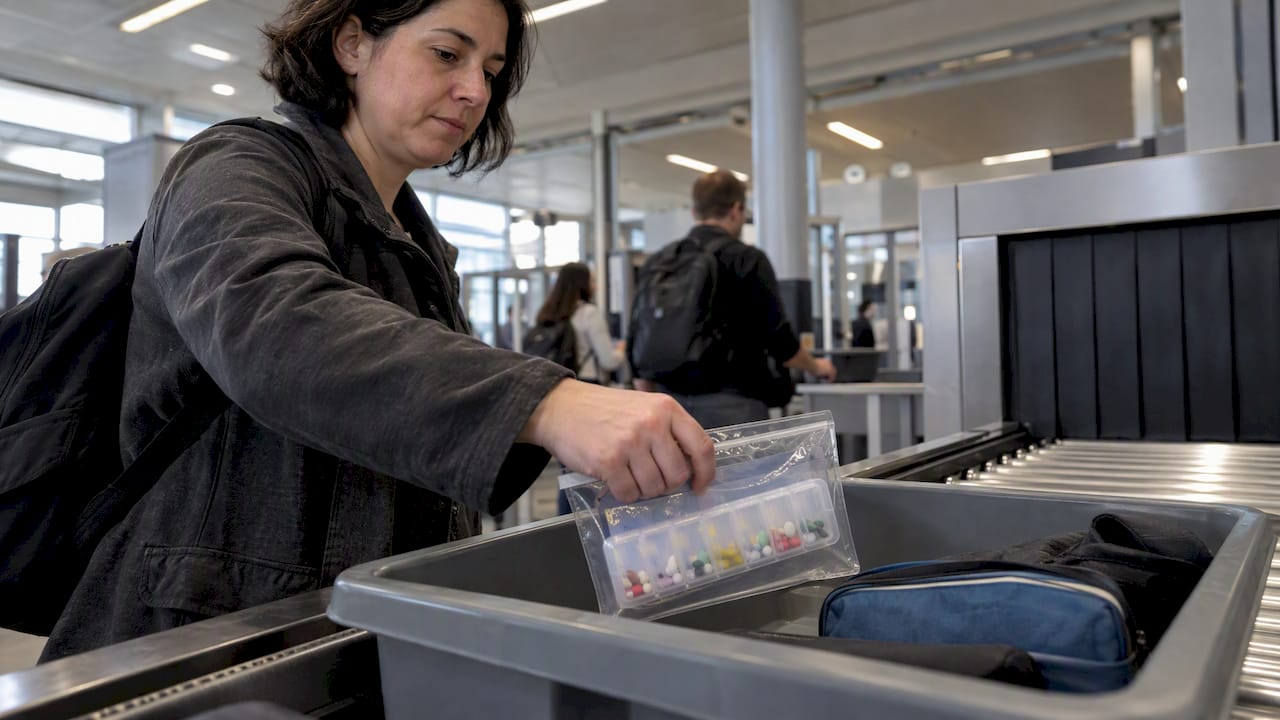
Screening officers aren’t trying to catch you out. They’re scanning for anything that reads as unusual on an X-ray, and loose pills rattling around in a bag can sometimes slow that down. A pillbox, a labeled bag, or even a clear pouch keeps things simple for everyone at the checkpoint.
Medically necessary liquids, injectables, and special supplies
Liquid medications play by different rules than pills. The standard 3.4 ounce limit doesn’t apply to medically necessary liquids, gels, and aerosols, but you have to declare them to an officer before screening begins. That includes insulin, liquid antipsychotics, injectable medications, and similar items.
Syringes, insulin pens, and pumps are allowed too. Pack them with the medication they go with, and bring ice packs or a small cooler if something needs to stay cold. Gel or ice packs used for medical cooling are permitted even when partially frozen.
- Declare medically necessary liquids separately before your bag goes through X-ray.
- Keep insulin pumps, pens, and syringes together with their medication, not scattered across your bag.
- Expect extra screening, including possible vapor analysis, if a liquid alarms during the scan.
Pro Tip: Pack medically necessary liquids in a separate, clearly marked pouch so you can hand it over the moment you declare it, instead of searching your bag while a line builds behind you.
Do you need original prescription containers?
No. TSA does not require pills to be in their original prescription bottles. But keeping the label information somewhere accessible, whether that’s the actual bottle, a printed prescription, or a doctor’s note, makes screening faster and matters more once you cross a border.
Here’s how to prepare your documentation before you ever reach the airport:
- Make a photo or photocopy of each prescription label, including the medication name, dosage, and prescribing doctor.
- Ask your doctor for a brief letter confirming your prescriptions, especially for controlled substances like certain anxiety or ADHD medications.
- Keep that documentation in your carry-on, separate from the pills themselves, so it’s easy to produce if asked.
- If you use a weekly pillbox, keep the original bottles or a photo of their labels in your luggage as backup.
Weekly pillboxes are genuinely useful for staying on schedule across time zones, and TSA has no issue with them. The only catch is that an officer or a customs agent might ask what’s in those little labeled compartments, so having your documentation ready means you never have to fumble for an answer.
What happens at the screening checkpoint
Most medications pass through the X-ray tunnel like everything else in your bag. But you can ask for a visual inspection instead, and that request needs to happen before your bag enters the machine, not after.
- Tell the officer you have medication and would like it visually inspected rather than X-rayed.
- Understand that requesting a visual inspection often means additional screening steps for you and your belongings.
- Stay patient. Extra screening isn’t a sign of trouble, it’s just how that request gets handled.
- Ask for a Passenger Support Specialist if you need extra time, have a disability, or want someone trained in disability and medical accommodations to walk you through it.
The final call on what passes through always rests with the officer on duty, and TSA is explicit about that. Clear communication upfront, rather than after a question is asked, tends to make the whole process smoother.
Flying internationally and returning through U.S. Customs
TSA rules get you through airport security, but Customs and Border Protection governs what comes back into the country. CBP generally expects medications in labeled, original containers with a valid prescription, and large undeclared quantities get treated seriously. A common guideline is to carry only a reasonable supply for personal use.
The FDA advises travelers to carry a prescription or a doctor’s letter written in English, and warns that medications purchased abroad may not meet FDA standards, which can lead to seizure at the border regardless of intent.
- Research your destination country’s rules before you pack, since some medications legal in the U.S. are restricted elsewhere.
- Carry your prescription and a doctor’s letter, especially for controlled substances.
- Pack only what you personally need for the trip, not a bulk supply.
Your step-by-step packing checklist
A little prep at home saves a lot of stress at the gate.
- Sort your medication by trip length, plus a few extra days in case of delays.
- Photograph or photocopy every prescription label before you pack.
- Keep daily medications in your carry-on, in a labeled pouch or pillbox.
- Pack backup documentation, including a doctor’s letter if you’re traveling with controlled substances or flying internationally.
- If you use a weekly pillbox, tuck the original labeled bottles into your checked bag as proof of what’s inside.
Pro Tip: Keep a photo of your prescription labels saved on your phone. If a bottle gets lost or a pillbox raises a question, you have proof in seconds without digging through paperwork.
Our guide to discreet medication carrying covers more on handling this calmly in public spaces beyond the airport, and it applies just as well at a checkpoint as it does at work or school.
Carrying mental health medications through security
Psychiatric medications deserve the same straightforward treatment as any other prescription, but we know the anxiety around them often runs higher. There’s a real fear that an officer will ask a question that feels invasive, or that a pillbox full of pills will draw a look you don’t want to explain.
Here’s what actually helps: label clarity and calm, brief answers. You don’t owe anyone your diagnosis. If asked what a medication is for, “it’s a prescription I take daily” is a complete answer. Officers are trained to screen for safety, not to evaluate your mental health.
Keep your psychiatric medications with your other daily medications rather than separated out, which avoids drawing extra attention to any single item. If you use a pillbox that sorts by day of the week, that’s completely normal and widely used, including by people managing physical conditions like diabetes or heart disease.

If declaring a liquid antipsychotic or injectable, state it plainly and let the officer follow standard procedure. The goal at every checkpoint is efficient, respectful screening, and being direct gets you through faster than being vague. For more on managing a pillbox without feeling exposed, our piece on pill organizer stigma walks through practical ways to carry medication with less self-consciousness, in the airport and everywhere else.
How to declare medications without slowing yourself down
Declaring a medication is simple: tell the officer before your bag goes through screening, not after something alarms. Say what the item is in a sentence or two, then let the officer guide the next step.
For liquids, gels, or injectables, pull the item out of your bag and present it separately rather than leaving it buried among other items. For solid pills you want visually inspected instead of X-rayed, make that request as your bag approaches the belt.

Clear, early communication is the single biggest factor in avoiding delays. Officers aren’t trying to confiscate medication you legitimately need, but they do need to understand what they’re looking at quickly. A caregiver managing medications for a parent or a family member can use a medication tracker to keep dosages, names, and schedules organized on paper, which doubles as a quick reference if a question comes up at the checkpoint.
Avoid vague answers like “it’s just my stuff.” Specificity moves the line faster for you and everyone behind you.
TSA accommodations for disabilities and medical conditions
TSA Cares exists specifically for travelers managing disabilities or medical conditions, including those requiring medication, equipment, or extra screening time. You can request a Passenger Support Specialist to meet you at the checkpoint and walk through the process with you.
TSA’s disability and medical conditions guidance details how medical devices, supplies, and liquids are screened, and confirms that travelers aren’t penalized for needing extra time or accommodation. If you manage a condition that makes lines, noise, or unexpected questions genuinely difficult, calling ahead of your trip to request support is worth the few minutes it takes.
This matters as much for mental health conditions as physical ones. Anxiety, sensory sensitivities, and the stress of public screening are valid reasons to ask for extra support, and TSA’s accommodation process doesn’t require you to disclose a diagnosis to receive it.
If your medication is lost or confiscated
If a checked bag goes missing with your medication inside, contact the airline immediately and file a lost baggage report, then call your prescribing doctor to arrange an emergency refill at your destination. Most pharmacies can work with an out-of-state or out-of-country doctor’s call-in for urgent cases.
If an item is confiscated at screening, ask the officer for the reason and request a receipt or documentation of what was taken. Keep your prescription information on hand, since it supports a replacement request with your pharmacy or doctor. For international trips, contact the nearest U.S. embassy or consulate if a medication seizure leaves you without access to something medically necessary.
Acting quickly, rather than waiting to see if the problem resolves itself, is what keeps a lost dose from turning into a lost week.
Carrying medication with dignity, not apology
I’ve flown with a pillbox full of antipsychotics more times than I can count, and the fear is never really about TSA. It’s about the look, the question, the moment someone decides your medication says something about you. It doesn’t.
Clear labeling and a little preparation protect you logistically, but they also mean you spend less energy bracing for judgment and more energy just getting to your gate. Everyone at that checkpoint deserves a calm, respectful interaction, including you.
— Michelle
A discreet way to organize pills for travel
Our 7 day pillboxes sort medication by day without drawing attention, which makes them a practical option for travelers who want to stay organized without carrying multiple bottles. They’re an accessory, not a substitute for your prescription documentation, so pack your labels or doctor’s letter alongside them.
Browse our full shop for pillboxes and other pieces designed around mental health advocacy, built by someone who packs a pillbox for every flight too.
FAQ
What are the new TSA rules for 2026?
TSA’s core medication policy remains consistent: pills face no quantity limit in carry-on or checked bags, and medically necessary liquids stay exempt from the 3.4 ounce rule when declared. Always check TSA’s official site before departure, since checkpoint procedures can be updated.
Can you take Viagra on a plane?
Yes, prescription medications like Viagra are allowed in carry-on and checked baggage under the same pill rules as any other medication. Keeping it in a labeled container or with a copy of your prescription helps if questions come up during screening.
Do pills need to be in original containers?
No, TSA does not require pills to be in their original prescription bottles for domestic screening. Keeping original labels or a copy of your prescription is still smart, since Customs and Border Protection and foreign authorities may expect documentation when you cross a border.
Can you fly with peptides and needles?
Needles and injectable supplies are allowed when they’re used with a medically necessary liquid or medication, and you should declare them at the checkpoint. Peptides and other injectable substances should travel with documentation from a prescribing doctor, since screening officers may ask what the substance is and why you’re carrying it.
Sources
- Medications (Pills) | Transportation Security Administration
- Brownsville CBP officers seize over 71,500 pills — U.S. Customs and Border Protection
- Traveling prescription medications — U.S. Food and Drug Administration
Recommended
- Dignity First: Carry Medication Discreetly at Work, School, and on Trips
- Pill Organizer Stigma: How to Use One Without Shame