
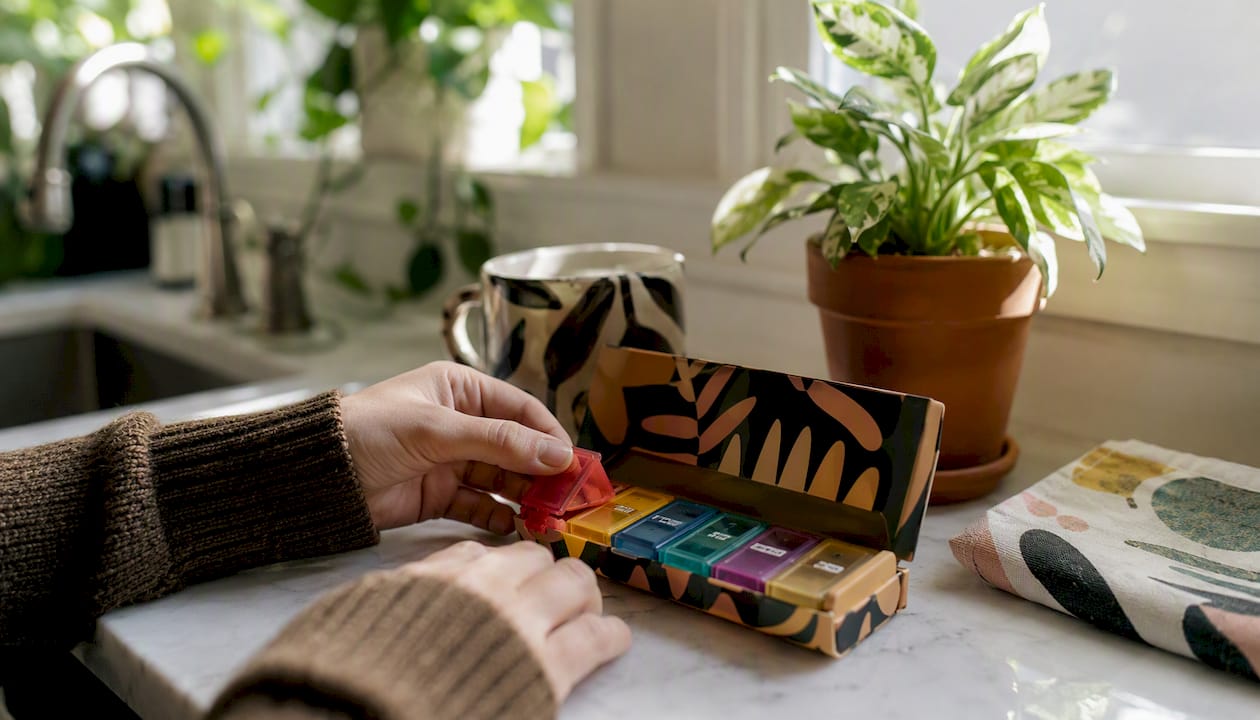
Pill organizer stigma is real, and it can quietly chip away at your willingness to take medication consistently. But here’s the encouraging part: a discreet design and a few simple habits mostly solve the problem. Research from 2026 found that stigma negatively correlates with medication adherence, and that medication literacy mediates that relationship. Separately, CHSNY reports that a meaningful portion of medication errors involving pill organizers come from loading the wrong pill into the wrong compartment. Both problems are solvable.
Three things you can do right now:
- Choose a discreet or stigma-forward organizer. Quiet compartments, neutral colors, and compact sizing reduce the visible cues that invite unwanted comments. Schizophrenic’s stigma-aware pillboxes are one option built with this in mind.
- Confirm safety with your pharmacist. Not every medication is safe to remove from its original packaging. A five-minute pharmacist check prevents the most common loading errors.
- Use private routines. Keep your organizer in a purse pouch or quiet case. Fill it at home, not at the office.
Pro Tip: If you feel self-conscious about your organizer rattling in your bag, a soft-lined zipper pouch eliminates the sound and keeps the case out of sight until you need it.
Key Takeaways
Pill organizer stigma affects adherence through medication literacy, but discreet design, safe filling habits, and neutral language together reduce both the embarrassment and the error risk.
| Point | Details |
|---|---|
| Stigma affects adherence | A 2026 Frontiers study found stigma negatively correlates with adherence (r = −0.259), mediated by medication literacy. |
| Loading errors are common | 12.7% of pill organizer medication errors come from incorrect compartment loading, per CHSNY. |
| Design reduces visibility | Quiet compartments, neutral aesthetics, and compact sizing lower the social cues that invite unwanted attention. |
| Language shifts help | Replacing “pills” with “medication for my health” reframes the act and reduces judgment from others. |
| Schizophrenic pillboxes | Schizophrenic’s stigma-forward pillboxes are styled as accessories, making consistent daily use easier and less embarrassing. |
Table of Contents
- Why does pill organizer stigma happen in the first place?
- What does the evidence say about stigma and medication adherence?
- When can a pill organizer actually cause problems?
- What design features actually reduce the stigma of pill organizers?
- How Schizophrenic approaches stigma-forward design
- How to set up and use a pill organizer safely
- How to talk about medication and push back on pill-shaming
- Living it: why stigma-forward choices changed things for me
- Schizophrenic’s stigma-forward pillboxes are worth a look
- Sources
Why does pill organizer stigma happen in the first place?
Stigma around medication management shows up in two distinct forms. Public stigma is the negative attitude others hold toward people who visibly take medication. Self-stigma is what happens when you internalize those attitudes and start to feel ashamed of your own health needs. Together, they create what researchers call the “pill-taker” identity: a social label that can feel like a public announcement of weakness, illness, or dependency.
Cultural narratives reinforce this. Many people in the United States grew up hearing that “natural” approaches to health are morally superior to medication. Pills get coded as a last resort, a sign that something is fundamentally wrong. When you pull out a seven-compartment plastic box at a restaurant table, you are not just taking medication. In the eyes of some observers, you are announcing a diagnosis.
A mixed-methods study from the HealthyVOICES project found that healthy individuals frequently hold negative views of “pill-taking,” with recurring themes including the belief that pills are inherently dangerous and a strong preference for “natural” remedies. These are not fringe opinions. They reflect widely held attitudes that shape how people feel about being seen with a pill organizer.
Understanding what self-stigma actually is matters here. Self-stigma is not a personal failing. It is a learned response to a culture that has not yet normalized medication as a routine part of health care. Recognizing that distinction is the first step toward changing how you feel about using an organizer in public.
What does the evidence say about stigma and medication adherence?
The connection between stigma and skipped doses is not anecdotal. A 2026 Frontiers study examined patients with multimorbidity and found a statistically significant negative association between stigma and medication adherence (r = −0.259, p < 0.001). In plain terms: stigma tends to reduce how much people understand about their own medications, and that reduced understanding leads to worse adherence.
That mechanism matters because it suggests two intervention points. You can work on reducing stigma directly, and you can build medication literacy as a protective factor.
On the safety side, CHSNY’s guidance highlights that 12.7% of medication errors tied to pill organizers stem from incorrect loading, meaning the wrong pill ends up in the wrong compartment. That is a meaningful error rate, and it is almost entirely preventable with a structured filling routine.
A pharmacy literature review published by Wiley adds important nuance. Multi-compartment compliance aids (MCAs) do not have strong evidence behind them for improving clinical outcomes across the board. The review also documented cases where inappropriate supply of MCAs caused practical and psychological harm, particularly for older adults. The takeaway is not that organizers are bad. It is that they work best when matched to the right person, with pharmacist input, rather than handed out as a default solution.
Key evidence points at a glance:
- Stigma negatively correlates with adherence, mediated by medication literacy (Frontiers, 2026)
- a significant percentage of pill organizer errors involve loading the wrong medication into a compartment (CHSNY)
- Limited evidence that MCAs improve clinical outcomes across all patient groups (Wiley pharmacy review)
- Inappropriate MCA supply can reduce independence and cause harm in some older adults
When can a pill organizer actually cause problems?
A pill organizer is a tool, not a universal solution. Used incorrectly or given to the wrong person without assessment, it can create new problems rather than solve existing ones.
Common risks include:
- Wrong-pill loading. Filling compartments from memory or in poor lighting increases error risk significantly.
- Moisture exposure. Many standard plastic organizers lack moisture seals. Humidity-sensitive medications, including some anticoagulants and capsules, can degrade, soften, or crumble when stored in an unsealed compartment.
- Complex polypharmacy. For people managing ten or more medications, a basic seven-day organizer often fails. PRN (as-needed) medications, variable doses, and multiple daily fill times become unmanageable and can worsen errors rather than reduce them.
- Cognitive impairment. When an organizer is imposed on someone with significant memory difficulties without a proper needs assessment, it can reduce autonomy and create confusion rather than support independence.
High-risk situations to watch for include variable PRN medications that change week to week, any drug with specific humidity or light-sensitivity requirements, and anyone whose cognitive state has recently changed.
Pro Tip: Before switching to a pill organizer, ask your pharmacist to do a brief needs assessment. A five-minute conversation can confirm which of your medications are safe to repackage, which should stay in their original containers, and whether a standard organizer or pharmacy blister packaging is the better fit for your specific regimen.
For people managing ten or more medications, smart dispensers and digital health tools may offer more reliable support than a manual organizer alone.
What design features actually reduce the stigma of pill organizers?
The clinical-looking, rattling plastic box is not your only option. Design choices have a measurable effect on whether people feel comfortable carrying and using an organizer in public. Design-focused reviews consistently show that users prefer discreet, stylish cases that mask the “medical” aesthetic and reduce the visible cues of illness.
Features worth prioritizing:
- Quiet compartments. Soft-lined or silicone-sealed lids eliminate the rattling sound that draws attention in quiet settings.
- Neutral or stylish aesthetics. Matte finishes, solid colors, and compact rectangular shapes read as everyday accessories rather than medical equipment.
- Moisture protection. Sealed compartments protect humidity-sensitive medications and extend the usable life of the organizer.
- Secure latches. Snap or slide closures prevent accidental openings in a bag or pocket.
- Travel-friendly sizing. A case that fits in a jacket pocket or small purse is one you will actually carry.
- Tactile, durable materials. Metal or hard-shell cases feel less disposable and less clinical than thin plastic.
The tradeoff between discretion and capacity is real. A slim, pocket-sized case typically holds three to seven days of a single daily dose. Someone managing multiple medications per day may need a larger case, which is harder to keep discreet. In that situation, a compact primary case for the day’s doses paired with a refill case kept at home often works better than trying to carry everything at once.
Organizers that lean into bold, intentional design, rather than trying to look like nothing at all, can also shift the dynamic. When a case looks like a deliberate accessory choice, it invites a different kind of attention than a beige plastic box.

How Schizophrenic approaches stigma-forward design
Schizophrenic was built on the premise that the objects connected to mental health care should not feel like something to hide. Michelle Hammer founded the brand from her own lived experience with schizophrenia, and the pillbox is one expression of that mission: a product that does not apologize for what it is.
The Schizophrenic pillbox is designed to look like something you would choose to carry, not something you feel obligated to conceal. The aesthetic is intentional, the messaging is direct, and the product sits within a broader ecosystem of advocacy work, including clothing, artwork, and public speaking, all aimed at making conversations about mental illness more honest and more human.
What makes this approach different from a standard discreet-design product:
- The product is explicitly connected to mental health advocacy, not just aesthetics.
- It is part of a community of people who have chosen visibility over concealment.
- Buying it supports an awareness initiative, not just a product company.
Pro Tip: If you want to carry your medication with more confidence but are not ready to make a public statement, start with a case that simply looks good to you. Confidence in the object itself is the first step toward confidence in using it.
The honest limitation: the Schizophrenic pillbox is a lifestyle and advocacy product, not a clinical dispenser. It is well-suited for people managing a straightforward daily regimen who want a case that reflects their values. It is not a substitute for pharmacy blister packaging or a smart dispenser for complex polypharmacy.
How to set up and use a pill organizer safely
A structured filling routine eliminates most of the common errors. Follow these steps each time you fill your organizer.
- Prepare a clean, well-lit surface. Lay out all your medication bottles before opening the organizer. Never fill from memory.
- Work from one bottle at a time. Open one bottle, fill its compartments across the week, then close the bottle before opening the next. This prevents mix-ups.
- Use tweezers or a pill funnel for small tablets. Handling tiny pills by hand increases the chance of dropping one into the wrong compartment.
- Label each compartment clearly if your organizer does not have printed day/time markers. A fine-tip permanent marker on a piece of tape works.
- Assign one person to fill the organizer. When multiple people fill the same organizer, the error rate climbs. Single-person responsibility is the simplest safeguard.
- Photograph the filled organizer. A quick phone photo before closing it gives you a reference if you later question whether a compartment was filled correctly.
- Ask your pharmacist which medications should stay in their original container. Some drugs require light protection, child-resistant packaging, or specific storage conditions that a standard organizer cannot provide.
- Do a weekly refill check. Before filling for the next week, confirm that last week’s compartments are empty. A full compartment means a missed dose.
On privacy: keep your organizer in a soft pouch inside your bag rather than loose in a pocket. If you take medication at work, a desk drawer or a private moment in a restroom removes the social exposure entirely. You do not owe anyone an explanation for taking care of your health.
CHSNY also recommends wiping compartments daily and doing a deeper clean weekly to prevent residue buildup, and they caution against sharing organizers between people.
How to talk about medication and push back on pill-shaming
Language shapes how both you and others think about medication. Advocacy guidance from CHSNY recommends replacing colloquial terms like “pills” or “drugs” with “medication” or “treatment.” The shift is small, but it reframes the act as health care rather than dependency.
Practical language swaps:
- “I take medication for my brain health” instead of “I take pills for my mental health.”
- “I have a prescription I take at this time each day” instead of “I have to take my meds.”
- “This is part of my health routine” instead of offering any explanation at all.
Why language matters in mental health goes deeper than word choice. Neutral phrasing signals to the people around you that medication is ordinary, not dramatic. Over time, that signal normalizes the behavior.
Behavioral tactics that reduce social exposure:
- Choose where you take your medication. A bathroom, a private office moment, or a parked car removes the audience entirely.
- Rehearse a one-sentence response for the moments when someone does comment. “It’s part of my daily health routine” ends most conversations without inviting follow-up.
- Compare your medication to other chronic-condition examples when it feels useful. Insulin, blood pressure medication, and thyroid treatment are widely accepted. Framing your medication in the same category, without over-explaining, shifts the social context.
Pro Tip: You do not have to disclose your diagnosis to normalize your medication. Deciding in advance how much detail you want to share, and with whom, removes the pressure of making that decision in the moment.
Short scripts for common settings:
- At work: “I take a daily medication at this time. I’ll just step away for a moment.”
- With roommates: “I keep my medication in my room. It’s part of my daily routine.”
- With friends: “It’s a prescription I take every day. Nothing dramatic.”
Living it: why stigma-forward choices changed things for me
I made the Schizophrenic pillbox because I got tired of hiding. For a long time, I kept my medication in the most forgettable container I could find, something that looked like nothing, because I did not want anyone to ask questions. What I learned, slowly, is that the hiding made things worse. Every time I tucked the organizer out of sight, I was reinforcing the idea that my medication was something shameful.
Switching to a product that I actually liked carrying changed the internal conversation. The organizer stopped being evidence of something wrong with me and started being part of how I take care of myself. That shift did not happen because of a single product. It happened because the product was connected to a larger decision to stop treating my diagnosis as a secret.
The advocacy work at Schizophrenic, the clothing, the art, the public speaking, all of it comes from the same place. If you want to read more about how pillbox advocacy connects to broader destigmatization, that context is there. The goal is not to make everyone visible in the same way. It is to make it possible to choose visibility without shame.
Schizophrenic’s stigma-forward pillboxes are worth a look
The Schizophrenic pillbox collection is designed for people who want a case that reflects their values, not one that blends into the background out of embarrassment. Each piece is styled to look like a deliberate accessory rather than a clinical supply item, which means you are more likely to carry it consistently and less likely to leave it at home on days when you feel self-conscious.
These are lifestyle organizers, not clinical dispensers. They work well for a straightforward daily regimen, typically one to two doses per day across a standard weekly cycle. If you are managing a complex polypharmacy regimen, a pharmacist consultation about blister packaging is still the right first step, and the pillbox can complement that rather than replace it.
Beyond the pillbox, Schizophrenic carries mental health awareness apparel and accessories that extend the same mission into everyday life. Every purchase supports the advocacy work behind the brand. Browse the collection and find the option that fits how you want to show up.
Sources
- Pill Organizers and Weekly Medication Boxes: Safe Use Tips for Better Adherence
- The impact of stigma on medication adherence among patients with multimorbidity: mediation analysis of medication literacy
- Multi-compartment compliance aids: evidence and risks (Wiley / pharmacy review)
- Mixed-methods study on perceptions of ‘pill-taking’ (HealthyVOICES project)
Recommended
- Awesome Pillbox | Schizophrenic.NYC Mental Health Clothing Brand
- Define Normal PillBox | Schizophrenic.NYC Mental Health Clothing Brand






[…] That consistency matters more than most people realize, and it’s worth reading more on why pill organizers don’t have to carry shame with […]