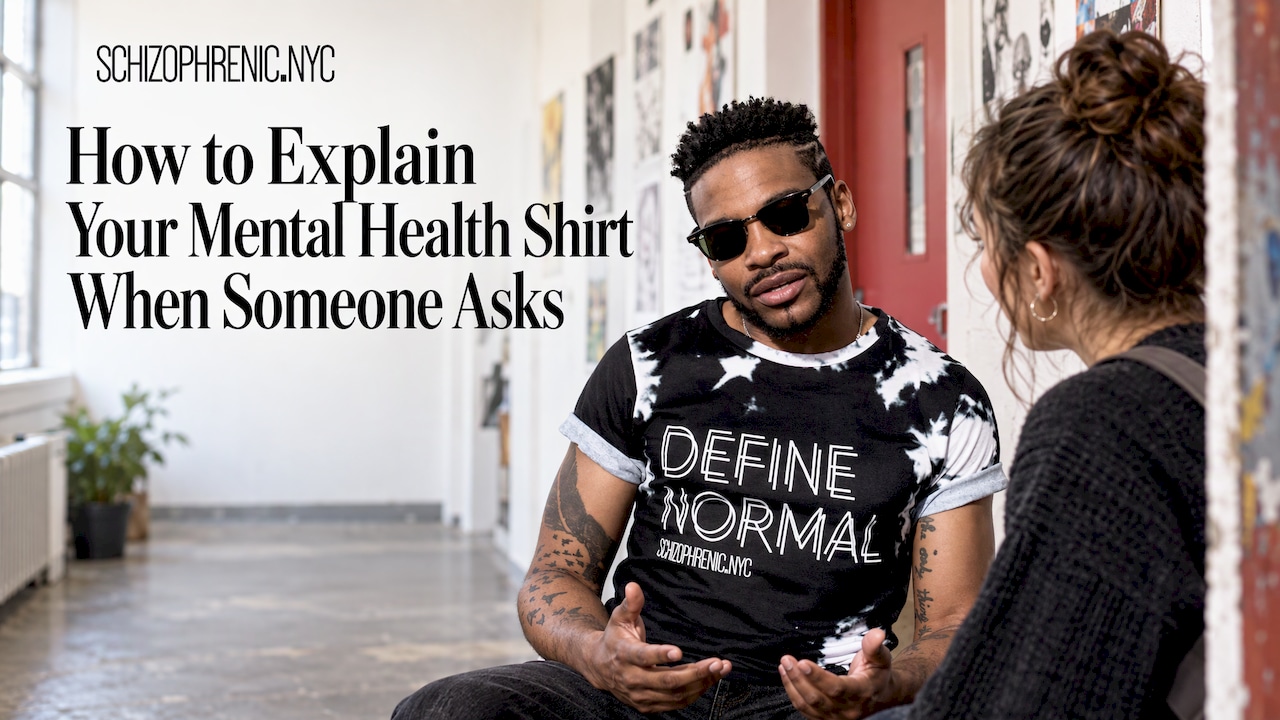
You can explain your mental health shirt with one honest sentence, and you decide how much more to say. Something like “It’s about mental health, and it matters to me” is enough. If you want to say more, you can. If you don’t, you can kindly decline. A shirt with a message is an invitation to talk, and you are always the one who sets how far the conversation goes.
This guide gives you words for the common moments: the curious stranger, the skeptical coworker, the person who says something hurtful, and the day you just don’t feel like talking. It also covers how to listen well when someone opens up, and what the research says about whether wearing your message really helps.
TL;DR
- Pick one short, true sentence ahead of time. A specific personal reason lands better than a generic “raising awareness.”
- Let curiosity lead. Ask a question back, listen, and follow the other person’s pace.
- If a comment stings, name what was hurtful and why, calmly, or simply end the conversation.
- You never owe anyone your story. Boundary phrases are part of wearing the shirt well.
- A shirt opens the door. What you say and how you listen inside the conversation is what changes minds.
Table of Contents
- Why people ask, and why it’s okay
- Decide your one sentence before anyone asks
- What to say in common moments
- When the shirt opens a real conversation
- When a comment stings
- Setting boundaries when you don’t want to share
- What makes a shirt’s message supportive
- Does wearing your message really make a difference?
- Our perspective
- Find a shirt with a message you’re proud to explain
- FAQ
- Sources
Why people ask, and why it’s okay
Most people who ask about your shirt are not trying to start a debate. They are curious, a little surprised, or quietly looking for an opening because mental health touches their own life. One designer of an ADHD-themed shirt told Slate that when a woman asked about her shirt and she explained it was about ADHD, the woman answered with support and mentioned a friend’s son who has it too. To the designer, that moment showed why mental health conversations need to happen outside pamphlets, doctor’s offices and health websites.
The same designer described the exchange as an opportunity rather than a burden, because a conversation goes both ways. That is a helpful frame to carry. You are not on trial. You are simply a person wearing something you care about, and someone noticed.
It is also normal to feel nervous. The CDC says it is normal to feel anxious or scared about how a mental health conversation will go. A little preparation takes most of that pressure away.
Decide your one sentence before anyone asks
The easiest way to feel steady is to have an answer ready. Think of it as a ladder with three rungs. You choose the rung in the moment.
- The short answer. What the shirt is about, in under ten words.
- The reason. Why it matters to you, in a sentence.
- The story. Only if you want to share it, and only the parts you choose.
The Mental Health America toolkit suggests it can help to create a plan before talking about your mental health, thinking through how you want to share and how the other person might respond. The same toolkit notes that when people living with a mental health condition share their stories, it can help others feel less alone and ease shame.
A few ways to build your sentence:
- Start with the topic. “It’s a mental health awareness shirt.”
- Add the why. “I wear it because I want mental health to feel as normal to talk about as any other health topic.”
- Make it specific. “My brother lives with it, and I’m tired of people whispering about it.” Specific beats generic every time.
- Keep it true. If you are not ready to share a personal reason, you don’t need to invent one. “I believe in the message” is honest and complete.
Say your sentence out loud once or twice in the mirror. It sounds silly and it works. The words feel familiar by the time you need them.
What to say in common moments
Here is a quick reference you can adapt to your own voice.
| Moment | You could say | Why it works |
|---|---|---|
| A curious stranger asks what it means | “It’s about mental health. It’s a topic I care about, so I like to wear it.” | Friendly, short, no pressure on either of you |
| Someone asks if it’s about you | “It is, yes. I’m happy to chat a bit.” or “It’s about the cause, but thanks for asking.” | You choose whether to disclose |
| A friend is quietly interested | “It matters to me because…” and one specific reason | Personal reasons open real conversations |
| A coworker seems uncomfortable | “I wear it to help people feel okay talking about this stuff. No pressure at all.” | Reassures without lecturing |
| Someone shares their own story | “Thank you for telling me. That sounds hard. I’m listening.” | Shifts you from explainer to listener |
| You’re not up for it today | “Thanks for asking, but I’m going to pass on talking about it right now.” | Clear, kind, final |
Notice that none of these require you to educate anyone on the spot. You are allowed to be a person in a shirt, not a spokesperson. One mental health awareness resource puts it simply: even one honest sentence tends to do more than a vague line about awareness.
When the shirt opens a real conversation
Sometimes the person asking is the one who needs to talk. That is where the shirt does its best work, and where listening matters more than explaining.
The CDC offers five tips for meaningful conversations: be flexible about the format, be ready to listen, ask open-ended questions, show concern and support, and end on a positive note with a plan to stay connected. It recommends phrases like “I’m listening,” “I hear that. This is hard,” “I’m here for you” and “Tell me more.” It advises steering away from lines such as “It will all be fine,” “Stop worrying so much” and “I know how to fix this.”
Two habits help most:
- Go slow and let them lead. The CDC suggests thinking about what you want to say beforehand, moving at a gentle pace and letting the other person take the lead if they are willing to share.
- You don’t need a solution. According to the same CDC guidance, when someone says they are struggling, they need your emotional support. If they seem to need more, you can point them toward a trusted adult or resources, including contacting 988, the Suicide & Crisis Lifeline, by call or text.
If you suspect a friend or coworker is struggling, the American Foundation for Suicide Prevention’s conversation guide suggests speaking privately, starting with an expression of care and then an observation, and being open about your own mental health to show you are willing to talk. It even offers a script along the lines of “I care about you and I’ve noticed you haven’t been yourself lately,” and reminds you that timing doesn’t have to be perfect. You can circle back later and say you have been thinking about them.
When a comment stings
Wearing a mental health message in public means sometimes hearing a careless remark. It might be a joke, an argument, or a stereotype delivered with a smile. You don’t have to absorb it, and you don’t have to fight it.
NAMI New York State suggests a two-part approach to insensitive comments: name the kind of comment it was (a judgment, an argument or a belittling remark), explain why it was hurtful, and then, where it makes sense, help people learn how to offer support, empathy and respect. In practice that can sound like:
- “That comment sounded like a judgment, and it landed hard. Here’s what it’s actually like.”
- “I’d rather you ask me than guess.”
- “I know you didn’t mean it that way, but jokes like that make it harder for people to speak up.”
Pick the version that fits the person. A close friend can handle a longer answer. A stranger on the subway can get a calm sentence and your back as you step away. Walking away is a complete response.
A mindset that helps: you are not obligated to change anyone’s mind in one exchange. Calm, clear and kind is already a win, and it is often what the other person remembers.
Setting boundaries when you don’t want to share
A shirt can say “I care about this” without saying “ask me anything.” Both can be true at once. Boundaries are part of advocacy, not a failure of it.
Verywell Mind’s list of ways to tell someone you’re not okay includes phrases you can borrow, such as “I’m not doing great, but I don’t really feel like talking about it right now,” and “I know you care, but I don’t feel up to a serious discussion right now.” They work for shirts too, because they thank the person and close the door gently.
Cornell University’s self-injury resource, written for people whose marks draw questions from strangers, suggests lines like “Thanks for asking, but it is not something I talk about with people I do not know well.” It stresses that your sense of safety and wellbeing come first. The setting is different, but the principle fits: you decide who gets your story.
If you want to practice boundaries more broadly, NAMI’s boundaries guide lays out four steps: develop your boundary, have the conversation, put it into practice and sustain it. Repeating a boundary kindly is allowed. So is changing it next week.

A useful trick is having two answers ready every day you wear the shirt: one for “I’m open today” and one for “not today.” Then you are never caught off guard.
What makes a shirt’s message supportive
How people respond to your shirt starts with what it says. Messages that are bold, humorous or blunt can all work, and many people find them freeing. The guidance from mental health organizations is about respect for the person behind the message.
Active Minds’ messaging best practices recommend respectful, person-focused language: a diagnosis is one part of who someone is, not their whole identity. The guide advises avoiding wording that dismisses a person’s resilience, suggests helplessness or places blame on them.
The Stamp Out Stigma guidelines point to inclusiveness, connectedness and compassion, with a tone that is assertive yet warm-hearted. They also note that people have disorders; they do not become a disorder.
When you choose a shirt, a quick check helps:
- Does it center people, not just labels?
- Could someone living with the condition read it and feel seen?
- Can you explain it in one sentence without apologizing for it?
If the answer is yes, you will find the explanation comes easily. If you’re curious about how this kind of apparel is designed and why, our guide to what a mental health clothing line is walks through it.
Does wearing your message really make a difference?
A shirt alone will not end stigma, and no one should expect it to. What it does is create contact, and contact is what the research highlights. A review of stigma-change approaches describes three strategies: protest, education and contact. Contact, meaning real interaction with people who have lived experience, produced larger changes in attitudes and behavioral intentions than education in a meta-analysis.
Stories matter too. McGinty and colleagues found that narratives pairing personal stories with the barriers people face in getting treatment can increase public support for helpful policies without increasing stigma. That is a good model for your own answers: a personal reason, plus what you wish people understood.
There is also something quieter. Describing why a clothing brand was founded, the Seattle Times reported that its founders chose clothing because it travels through hallways, sidewalks and classrooms, making mental health visible in everyday spaces. And the Slate designer said the moment she puts her shirt on, it acts as a casual reminder that “you can do this.” For many wearers, the shirt is for them first.
If you are also curious about how the conversation can reach beyond one person, the broader idea of fashion that supports social causes shows how everyday clothing can carry empathy and invite supportive talk.
Our perspective
We make shirts, pillboxes and art because we believe the most honest conversations about schizophrenia and mental illness shouldn’t be confined to a doctor’s office. Everyday life is where stigma lives, so everyday life is where we want to change it.
Our designs come from lived experience, and they are bold on purpose. When someone asks about one, we see it as the point, not an interruption. A great answer is rarely a speech. It is usually one real sentence, a smile, and a willingness to listen to whatever comes back.
Our advice is simple. Wear what feels like you. Know your sentence. Be proud of your story, and keep it yours until you choose to share it. Confidence can get you anywhere, and part of confidence is knowing you can say “not today” just as easily as “let me tell you.”
We design for people living with mental health conditions, for allies, and for anyone who wants to start the conversation. You are not alone in this, and you never have to explain yourself alone either.
Michelle
Find a shirt with a message you’re proud to explain
If you’re looking for something that opens the door the way you want, browse our mental health T-shirts, or explore the wider mental health awareness clothing collection, including tank tops and hoodies. If a smaller conversation starter suits you better, our pillboxes are designed to normalize daily medication in a way that’s easy to talk about. Everything we make is designed to spark conversations and reduce stigma, and you can see the full range at Schizophrenic.NYC.
FAQ
What do I say when someone asks, “What does your shirt mean?”
Start with the topic and one honest reason, such as “It’s about mental health, and it matters to me because it touches my family.” Keep it short and warm, then see where they take it. If they want more, you can share more. If not, you’ve already done something kind.
Do I have to tell people I have a mental health condition?
No. You can say you wear the shirt because you support the message, and that is true for many wearers. If someone asks directly and you’d rather not answer, a line like “Thanks for asking, but I’m not going to get into it” is polite and complete.
How do I respond if someone makes a rude or stigmatizing comment?
Name what the comment was and why it was hurtful, calmly, as NAMI New York State suggests. You can also choose to say nothing and leave. You don’t owe anyone an education, and protecting your peace counts as a good response.
What if the person who asks starts telling me about their own struggles?
Shift into listening. Phrases like “Thank you for telling me,” “That sounds hard” and “Tell me more” are the kind the CDC recommends. You don’t have to fix anything. If they seem to be in crisis, encourage them to contact 988 or a trusted professional.
Is it okay to wear a mental health shirt on days I don’t want to talk?
Yes. A shirt can be a quiet reminder for you, not an obligation to engage. Keep a “not today” phrase ready, and wear the shirt anyway if it makes you feel strong.
Sources
- Slate: designer of ADHD-themed shirts on de-stigmatizing mental illness
- CDC: How to Listen and Support Someone in Need
- CDC: How to Talk to a Friend About Mental Health or Drugs
- AFSP: How to Start and Continue a Convo About Mental Health
- Mental Health America 2024 BIPOC Mental Health Toolkit
- NAMI New York State: How to Cope with Insensitive Comments about Your Mental Health
- Verywell Mind: 14 Ways to Tell Someone You’re Not OK
- Cornell University: Wounds heal, but scars remain
- NAMI: Boundaries, what are they and how to develop your own
- Active Minds: Mental Health Messaging Best Practices
- Stamp Out Stigma Branding Guidelines
- Lessons learned from unintended consequences about erasing the stigma of mental illness
- McGinty et al.: Communication strategies to counter stigma
- Seattle Times: Starting a clothing brand turned pain into purpose
Recommended
- What Should I Wear To Support Mental Health?
- Mental Health Merch Etiquette: What to Wear and Say
- Allies Wearing Mental Health Merch: How to Do It Well