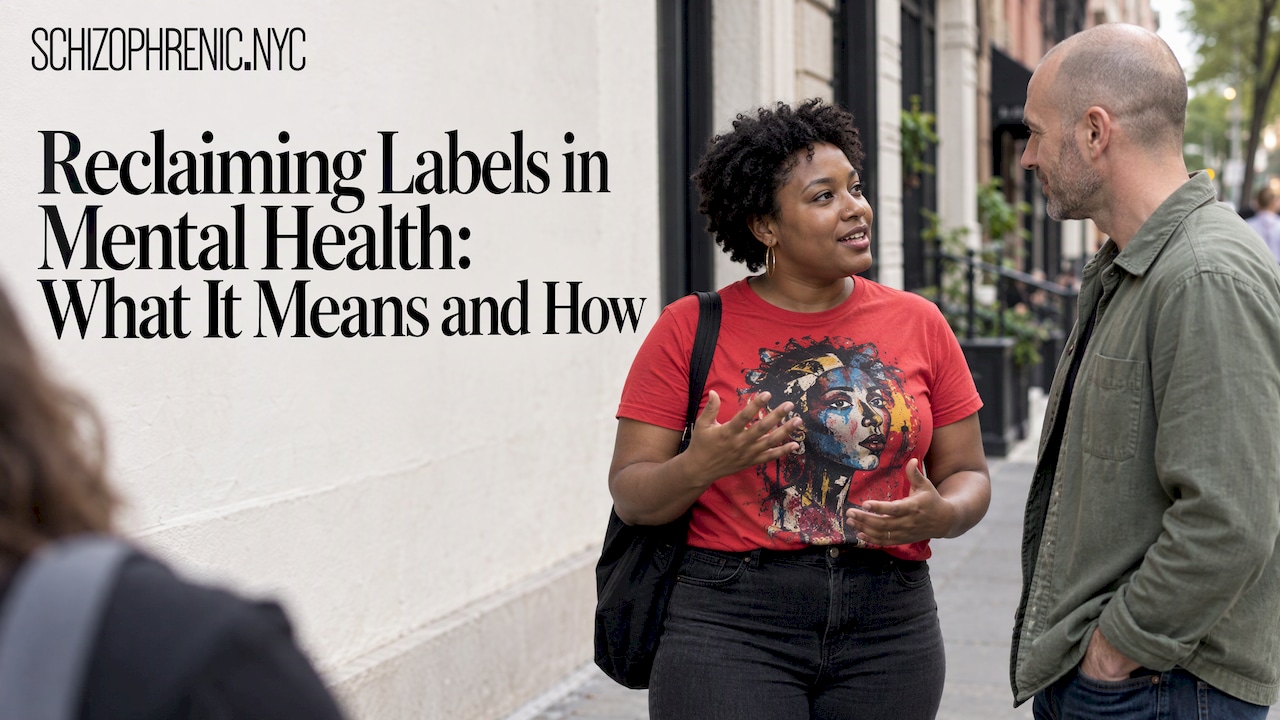
Reclaiming a mental health label means taking a word that was used about you, sometimes against you, and deciding for yourself what it stands for. A diagnosis is assigned by a clinician. Reclaiming is a personal choice that no one can assign. It is about authorship: you decide whether the word is a box, a map or a banner. At Schizophrenic.NYC, Michelle Hammer built a whole brand around that choice, and this guide covers what the research says, how to talk about labels respectfully, and what it looks like when advocacy leaves the clinic and goes out in public.
TL;DR
- Reclaiming a label is a choice made by the person who carries it. It is not the same as being diagnosed, and it is never something to impose on anyone else.
- Research suggests that having a mental illness identity is neither good nor bad on its own. What matters is what a person connects to that identity: shame, or community and pride.
- Neither person-first nor identity-first language is always right. When in doubt, ask the person how they want to be described.
- Art, clothing and public speaking can turn a private label into a conversation, as long as they speak from lived experience and do not speak for everyone.
- Our mental health T-shirts, pillboxes and prints are designed to make that conversation easy to start.
Table of Contents
- What reclaiming a label actually means
- Why people reclaim a label
- A label can be both a door and a map
- How to choose language for yourself
- How allies, clinicians and educators can talk about labels
- Beyond one person: why public reclaiming matters
- How Michelle Hammer put this into practice
- Perspective: why we put the word on the shirt
- Choosing wearable advocacy
- A few practical ground rules for reclaiming in public
- FAQ
- Sources
What reclaiming a label actually means
A diagnostic label is a clinical tool. It names a pattern of symptoms so that clinicians can plan treatment and so that insurers, schools and workplaces can understand what support is needed. You do not choose it, and in many cases you hear it at one of the hardest moments of your life.
Reclaiming is what you do afterward. Mental Health America describes how a history of discrimination and disempowerment led many people in the mental health community to look for ways to take back their identity and their role in their own care. In its guidance, people should be identified by the language they feel most comfortable with, whether that is client, consumer, peer, survivor or person in recovery.
Researchers who study activists’ self-images describe a related idea called resignification: temporarily identifying with a derogatory label and turning it into a source of pride. The word stays the same. The meaning changes because the person using it has changed who holds the power.
That is also why reclaiming is not the same as self-definition by diagnosis. Psychologist Denise Fournier argues that a diagnosis can help you understand how you struggle, point you to resources and connect you with others, and that it is best used as a tool for empowerment and self-advocacy rather than as the whole of who you are. Reclaiming at its best keeps that balance. The label is yours to use, and you are larger than it.

Why people reclaim a label
The reasons vary, and none of them is more correct than the others.
Because the effort deserves to be seen
The Hogg Foundation for Mental Health notes that some people feel their mental health challenges are central to who they are and embrace words like “mentally ill” or “crazy” as positive. It also points out that people in recovery may find it meaningful to include their condition when they talk about themselves, because managing it takes tremendous effort and time. Naming it out loud is a way of saying that the work counts.
Because a name gives a feeling somewhere to land
In a 2023 paper, Leigh Money describes identity labels as a kind of scaffold and lists six functions they can serve, including a mirrored reflection, a creative defense, something to play with, and a collective dream image. You do not need to adopt that whole framework to see the point: a word can hold something that you cannot yet explain.
Because community is easier to find with a shared word
Research on coming out proud found that people with serious mental illness who identify with the mental illness group are more likely to attend a peer support program. Peer support participants report a better quality of life, along with gains in self-reliance, independence, coping skills and feelings of empowerment. A shared word can be the front door to a room full of people who understand.
Because it can protect against self-stigma
Rüsch and Kösters note that having an identity as a person with mental illness is not good or bad in itself. It depends on what the person associates with it, and decisions about disclosure are a key response to public and self-stigma that can affect stigma stress and well-being. The same review reports on work by Paul Lysaker and colleagues. If people with schizophrenia reject stigma as unfair, insight does not weigh them down. If they agree with negative stereotypes about their group, greater insight can lead to hopelessness. The practical lesson is hopeful: the meaning you attach to the label matters a great deal, and that meaning can be changed.
A label can be both a door and a map
Most people who work with diagnoses on a daily basis describe the same two sides. NAMI’s schizophrenia and psychosis guide notes that formal diagnostic language can give some patients authority and hope by pointing to a path for treatment, while others may feel mislabeled or misunderstood. Psychologist Thomas Jefferys writes that a diagnosis can illuminate patterns, reduce shame and open access to treatment, and that it should work like a map, not a cage.
A study of university students found that they use mental health labels as “campus technologies”: to make their distress visible to the institution, to manage social situations and as a tool of self-discovery. The authors conclude that labels can be both a source of stigma and necessary and useful.
So the question is not whether labels are good. The question is who is holding the pen. When you choose how a label is used, it works for you: it opens doors to care, to community and to self-understanding. Reclaiming is the act of picking up the pen.
How to choose language for yourself
There is no official correct answer, and the guidance reflects that. The Hogg Foundation says neither person-first nor identity-first language is always right or wrong, that language is complicated and always changing, and that when in doubt, ask the person.
If you are deciding how to describe yourself, these questions can help:
- What does this word do for me? Does it make me feel seen, strong or connected, or does it make me flinch?
- Who am I using it with? A word can feel like pride among friends and be heavy in a job interview. You can have different words for different rooms.
- Can I change my mind? Reclaiming is not a vow. Many people try a word, keep it for years and set it down, or the reverse.
- Does it leave room for the rest of me? A strong identity label sits next to your job, your humor, your family and your taste in music. It does not replace them.
- Is someone else telling me to use it, or not to use it? Either way, the choice is yours.
Jefferys offers a useful move when a label starts to feel fixed. When someone says “I’m just wired this way,” he asks when they first learned to respond that way, shifting the conversation from identity to history, from a fixed structure to an adaptive pattern. You can ask yourself the same question without giving up the label. It simply keeps your story open.
How allies, clinicians and educators can talk about labels
The other half of reclaiming is how everyone else behaves around it. Two principles cover most situations.
Default to person-first language, and follow the person’s lead. NAMI’s StigmaFree campaign recommends phrasing such as “person living with schizophrenia” and “my brother living with OCD,” and encourages language that does not minimize, downplay or judge someone’s experience. The U.S. Department of Defense stigma toolkit puts the same idea in a clinical setting: providers should generally use person-first language, respect a patient’s use of identity-first language and, where appropriate, ask patients how they prefer to be referenced.
In practice, that means a person who calls themselves by a reclaimed word has made a decision about their own life, and respecting it is part of respecting them. It also means you do not hand that same word to someone else who has not chosen it.
Keep the person bigger than the word. Mental Health America points out that when people are seen only through a diagnosis, it is easy to focus on reducing symptoms alone, while recovery means helping people make the changes they want in their lives and building on their strengths and choices. Educators can do this in small ways. Alex Shevrin Venet suggests “my student who carries a bipolar diagnosis” instead of “my bipolar student,” and the word “support” rather than “help” to underscore belief in students’ capacity to improve their own lives.
The same applies at work. Teams that make room for honest conversation about mental health, such as the ideas in this piece on mental health at work, make it easier for people to bring their own words without fear.

Beyond one person: why public reclaiming matters
Private reclaiming changes how you feel. Public reclaiming changes what other people think they know. Stigma lives in assumptions, and assumptions soften when a real person walks into the room and says, calmly, this is my diagnosis and this is my life.
That is why many advocacy groups encourage openness. Talking about mental health, sharing on social media and answering misperceptions with facts are common recommendations in stigma-reduction guidance. Disclosure is still a personal decision with real consequences, and nobody owes the world their story. But for those who choose it, visibility does work that a pamphlet cannot.
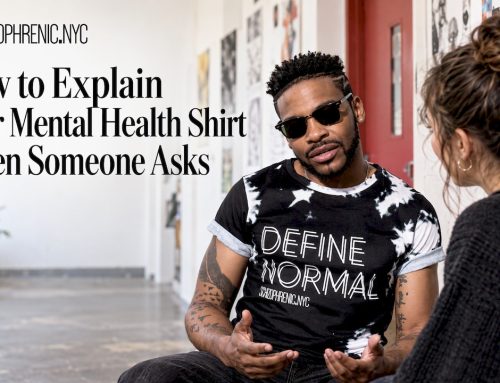
Here is where art and fashion come in. A message on a shirt does three things quickly. It tells people like you that you are not alone. It gives strangers a question to ask. And it lets you start a conversation on your own terms, on a day you feel like having it.
Public reclaiming also carries a responsibility: speak from your own experience. Someone who uses a reclaimed word about themselves is not setting a rule for every other person with the same diagnosis. Many people prefer different language, and that is as valid as the choice to reclaim. The best advocacy says “this is how I do it” rather than “this is how everyone must.”
How Michelle Hammer put this into practice
Michelle Hammer was diagnosed with schizophrenia at age 22. She is an activist, artist and speaker, and the founder of Schizophrenic.NYC, a mental health clothing and lifestyle brand built to reduce stigma. The name is the point. It puts the word people whisper on the front, in bold graphics, in public, chosen by someone who lives with the condition.
The approach rests on the ideas above. The word is chosen, not assigned. It comes with humor and design, so it invites conversation instead of silence. And it sits beside a wider body of work: news, activism stories, public speaking and multimedia content that give the label context and a human face.
Perspective: why we put the word on the shirt
We get asked a lot why we would put a word like that on a shirt. Our answer is simple: because it was said about me long before I said it myself.
When I was diagnosed, the word felt like a verdict. What changed things was not pretending it did not exist. It was deciding how I would carry it. Once I said it with confidence, the people around me had a different choice to make. They could be awkward, or they could be curious. Curious happens more than you might expect.
That is what our designs are for. A pillbox that doesn’t hide what it is. A T-shirt with a message about psych meds that says out loud what many people take in private. A print on the wall that tells a guest this house is a place where mental health can be discussed. Each one is a small, ordinary way to take the shame out of a conversation.
We never ask anyone to use a word they don’t want. Some people love identity-first language and some prefer to say they live with a condition. Both are valid. What we offer is a way to be visible if you choose to be, and a way for allies to show that they are listening.
Confidence can get you anywhere. It starts with owning your story on your terms.
Michelle
Choosing wearable advocacy
If you want to bring this conversation into daily life, there are a few simple ways to match the item to the moment.
- To start conversations with strangers: mental health T-shirts, tank tops and hoodies and sweatshirts put the message where people can see it.
- To normalize daily routines: our 7 day pillboxes turn a medication habit into something you can carry openly. Medication adherence is a part of many people’s coping mechanisms, and a pillbox that reflects pride makes it feel less like a secret.
- For small, everyday reminders: stickers such as “I’m Mentally Ill And I Don’t Kill”, along with buttons and tote bags, travel easily and spread the message at no effort.
- For your home or office: Michelle’s artwork, including prints and canvas prints, opens up a conversation in a space you control.
Michelle is also available for public speaking and for design and direction. You can find both on the Schizophrenic.NYC homepage for schools, workplaces and events that want to hear lived experience directly.
A few practical ground rules for reclaiming in public
Whether you wear a message, post about your diagnosis or speak at an event, these habits keep the conversation healthy.
- Speak for yourself. Say “I” instead of “we” unless you are asked to represent a group.
- Choose your moments. You can be open in one setting and private in another. Disclosure decisions can affect stigma stress and well-being, so they deserve thought, not pressure.
- Welcome questions, and set limits. Curiosity is the point, but you do not owe anyone your full medical history.
- Share facts along with feelings. Stigma-reduction guidance suggests answering misperceptions with accurate information.
- Respect other choices. A friend who prefers person-first language is not rejecting you, and you are not rejecting them.
- Keep your care team in the loop. Your identity is yours, and your treatment decisions belong in conversation with your doctor or clinician.
FAQ
Is reclaiming a label the same as accepting a diagnosis?
Not quite. Accepting a diagnosis means acknowledging what a clinician has told you. Reclaiming goes further: you choose the word, the tone and the setting in which you use it. Many people do one without the other, and both are legitimate.
Is it okay to use “schizophrenic” or “mentally ill” about myself?
That is your decision. The Hogg Foundation notes that some people embrace words like these as positive, and that neither person-first nor identity-first language is always right. When you are talking about another person, follow how they describe themselves, and if you are not sure, ask.
What should I say when I talk about someone else’s diagnosis?
Person-first phrasing such as “a person living with schizophrenia” is the widely recommended default, according to NAMI’s StigmaFree guidance. If someone tells you they prefer an identity-first phrase, use theirs. Asking how they like to be referred to is always welcome.
Can wearing a message about mental health really reduce stigma?
Stigma softens when people meet others who speak openly and calmly about their experiences. A shirt, pin or print gives you a way to invite that conversation without having to explain yourself first. It works best alongside facts, kindness and a willingness to listen.
Can a label help and hurt at the same time?
Yes. Clinicians and researchers describe labels as both useful and limiting: they can open the way to treatment and community, and they can feel like a box. Choosing how you use the word, and keeping your whole self in view, is what tips the balance toward help.
Sources
- Person-Centered Language, Mental Health America
- How to Stop Your Diagnosis From Defining You, Psychology Today
- Language Matters in Mental Health, Hogg Foundation
- Labels and the Self: Identity Labels as Scaffold, PubMed
- Reducing Self-Stigma by Coming Out Proud, PMC
- Honest, Open, Proud to support disclosure decisions, PMC
- Mental Health Labels as a Campus Technology, PMC
- Schizophrenia and Psychosis Guide, NAMI
- When a Diagnosis Becomes Your Identity, Psychology Today
- Words Matter: Inclusive Language, NAMI StigmaFree
- Mental Health Stigma Reduction Toolkit, Health.mil
- The Language of Choice and Support, Edutopia
- A Visual Culture of Stigma, ResearchGate
- About Michelle Hammer, Schizophrenic.NYC
Recommended
- What Is Mental Health Recovery: a Clear Guide
- Will changing the name of a mental illness help de-stigmatize it?
- How to Respond to Mental Health Stigma: A Practical Guide
- Why Language Matters in Mental Health: A Real Guide