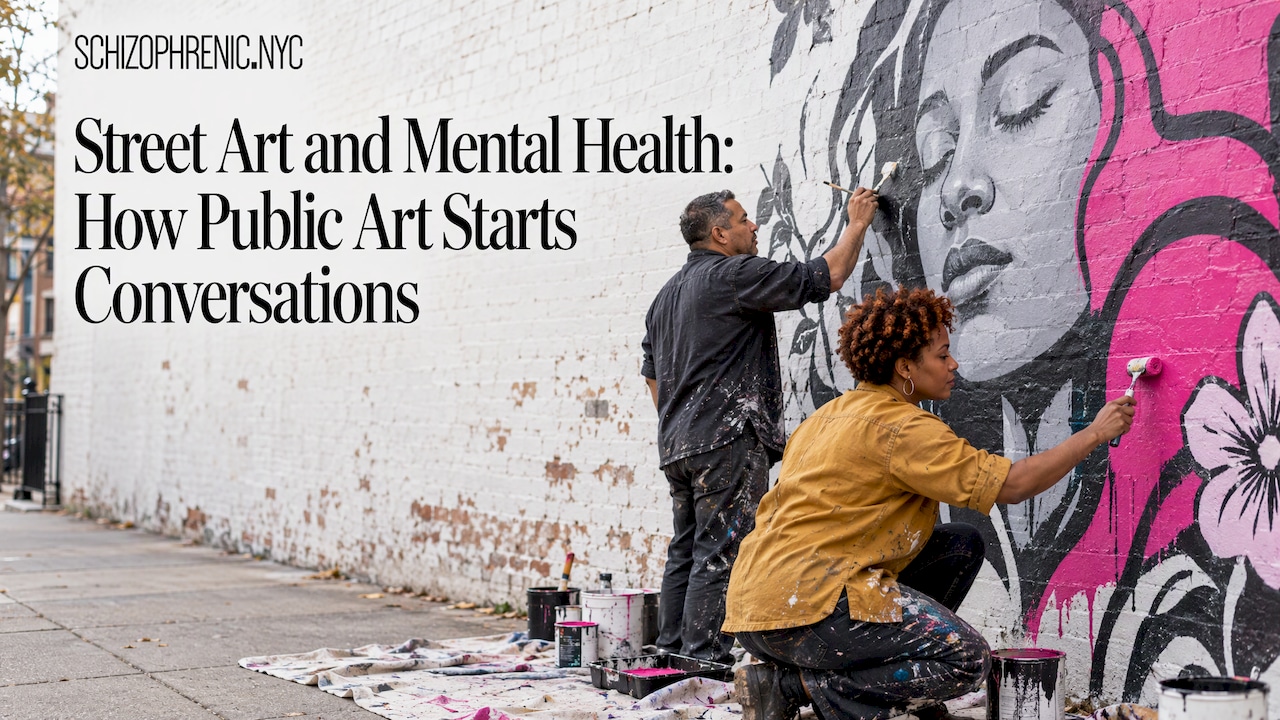
Street art helps mental health by putting honest messages where people already walk, wait and gather, so a topic that is usually whispered about becomes something a whole neighborhood can see and talk about. Research on community murals points to less stigma, more connection and a stronger sense of hope for the people who make them and the people who pass them. The same idea works on a smaller scale. At Schizophrenic.NYC, Michelle Hammer, a schizophrenia activist, turns bold original artwork into clothing, pillboxes and prints that carry the message past the wall and into daily life.
TL;DR
- Participatory public art, where people with lived experience help make the work, is linked in research to friendship, self-discovery, giving back and hope.
- Mural programs in Philadelphia and New York have measured reductions in stigma and gains in mental health awareness among residents and workshop participants.
- Good projects are built with people who have lived experience, not just for them, through workshops, feedback and public paint days.
- The evidence is encouraging but not complete: researchers are still working out exactly how murals produce their effects.
- You can carry the same conversation-starting spirit with wearable art, such as a mental health tee, tank top or pillbox from Schizophrenic.NYC.
Table of Contents
- What street art for mental health actually means
- What the research says about murals and recovery
- What New York has done
- How a community builds a mental health mural
- Why the message needs to move beyond the wall
- Ways to bring street-art energy into your own life
- What we offer
- Our point of view
- FAQ
- Sources
What street art for mental health actually means
The phrase covers a lot of ground: large murals about suicide prevention, benches painted with messages of support, stickers and posters, and community paint days where dozens of people add a brushstroke. What ties them together is the setting. The art is public, free to see and impossible to avoid, and its subject is something many people have been taught to keep private.
Researchers who study this work use a precise term: participatory public art. One 2015 paper in the National Library of Medicine’s PubMed Central defines it as voluntary, collaborative creative expression by a group of people to produce something of aesthetic value for permanent public display. The word that matters is collaborative. The wall is not decorated for a community; it is made with one.
That difference shapes everything that follows. A mural about mental health that was painted by people who have lived it carries a different weight than one that was commissioned from a distance. Passersby can feel that. So can the people holding the brushes.
What the research says about murals and recovery
The strongest evidence comes from Philadelphia, which has run community mural programs on behavioral health for years, and from researchers who studied them closely.
Benefits for the people who make the art
The 2015 paper by Mohatt and colleagues followed case studies of participants in these projects. It found that participatory public art can foster friendship, self-discovery, giving back and hope, and that it helps participants see themselves as contributing members of their community. For someone who has spent years being defined by a diagnosis, being seen as the person who painted the wall on the corner is a real shift.
The same paper notes that these projects offer peer and professionally supported chances for community integration for people facing behavioral health challenges. In plain terms: you are not just in a room with a counselor. You are working next to neighbors, artists and other people in recovery, on something that will stay up for years.
The researchers also point out that individual benefits can vary with how consistently a person takes part. Showing up regularly matters, which is one reason the best programs run over weeks, not a single afternoon.
Benefits for the neighborhood
A program called Porch Light, run in Philadelphia by Mural Arts together with the city’s Department of Behavioral Health and Intellectual disAbility Services, produced a published evaluation. It found that murals on behavioral health themes can reduce stigma among neighborhood residents. It also found that murals raised residents’ sense of collective efficacy, the belief that neighbors can work together to get things done, along with how residents rated the look of their neighborhood.
A 2013 study of a Philadelphia suicide-awareness project reached a similar conclusion from a different angle. Mohatt and colleagues found that mural-making can teach people about behavioral health conditions in a nonthreatening way and reach audiences who are hard to reach through traditional forums. Many people will never attend a mental health seminar. Almost everyone walks past a wall.
What researchers are still working out
The evidence is encouraging, and it is also honest about what is unfinished. Community-level effects such as a better-looking block and stronger social ties are measurable, but how murals produce them is still being studied. Philadelphia’s behavioral health department suggests the answer may lie in stories of beauty, resilience and hope that stand against the feeling of a neighborhood in decline. If you are an educator or advocate citing this research, that is the accurate way to say it: the results are promising, and the work of explaining them continues.
What New York has done
If you live in the five boroughs, you have probably walked past some of this without knowing it. The NYC Mural Arts Project launched in 2016. According to the city Health Department’s 2022 announcement of a new mural, it had by then created ten large-scale murals and two mural-benches around the city.
The same release shares evaluation figures from the project’s community workshops:
| Measure among workshop participants | Result reported by NYC Health (2022) |
|---|---|
| Positive change in stigma toward people with mental illness | 65% |
| Increase in mental health awareness and education | 58% |
Those are results for workshop participants, the people in the room, so read them as evidence that the making of the art matters as much as the finished wall. Earlier in the project’s life, a mural on 34th Street near the Port Authority Bridge, between 9th and 10th Avenues, put a mental health message in front of one of Manhattan’s busiest commuter corridors.
For readers in other places, the model has traveled. Porch Light, the Philadelphia program, builds teams of artists, service providers, participants and community members to make public art together. Its goals include improving the physical environment, creating social connections, fostering unity and empathy, and challenging stigma. Smaller community groups have followed with their own mural projects, built on the premise that more representation and dialogue around mental health can contribute to lower suicide rates.
How a community builds a mental health mural
If you are an advocate, a teacher or a clinician thinking about starting a project, the New York and Philadelphia programs show a clear pattern. Here is how it tends to go, and where it can go wrong.
- Start with conversation, not paint. NYC Health describes public events and workshops as an open space where participants and community collaborators discuss mental health and form bonds. Skip this and the mural becomes decoration. The talking is what shapes the message.
- Put people with lived experience at the table. The model brings together people with lived experience, professional muralists and service providers. Their stories decide the theme. A project that only consults people after the design is done misses the point of participatory art.
- Build a theme and design through feedback. Collaborators develop a theme, share drafts and revise. Expect several rounds. A message that feels hopeful to the artist may land differently on someone in crisis, so the feedback loop is also a safety check.
- Hold public paint days. The mural panels are painted at open events, which gives neighbors a way to take part. This is where friendships form and where the wider public meets the subject on friendly ground.
- Unveil it and keep the dialogue going. The Porch Light manual from Philadelphia’s behavioral health department says the aim of participatory mural-making is to increase access to behavioral health resources and reduce personal and social stigma. A mural that only gets applause on opening day has done half the job. Pair it with information on where to find support.
The manual also makes a point worth remembering: silence, invisibility and stigma are major barriers to treatment, and art that gives voice to unheard experiences helps break through them. If someone in your community is hearing voices, struggling with medication or afraid to tell their family, a wall that says out loud that this is part of life can be the first sign that it is safe to speak.
If you or someone you know is in crisis, call or text 988, the Suicide and Crisis Lifeline, which is available in the United States around the clock. Art starts conversations. It does not replace a mental health professional.
Why the message needs to move beyond the wall
A mural stays where it was painted. That is its strength and its limit: people come across it only if they live, work or travel nearby. Mental health advocacy, though, happens in classrooms, waiting rooms, offices, trains and family dinners.
This is where wearable art picks up the work. A graphic on a shirt goes to the places no wall can reach, and it invites the same thing a mural does: a question, a glance, a conversation. Someone asks about the design, and you get the chance to talk about what it means to you. For many advocates, that exchange is the whole point.
That is the idea behind Schizophrenic.NYC. We design clothing and accessories to spark conversations and reduce stigma around mental illness, using bold graphic artwork as the opener. Our mental health clothing line explains how the pieces connect to the advocacy, and our mental health awareness tank tops and artwork hats are easy places to start if you want something you can wear on a summer street or a walk to the clinic.

Ways to bring street-art energy into your own life
You do not have to paint a building to join this conversation. Here are ways people with different roles use art to talk about mental health:
- If you live with a mental health condition: wear something that says what you cannot always say out loud. A design you chose yourself can carry your story on days when explaining feels like too much. A pillbox with a bold design can also turn a daily medication routine into something that feels like yours.
- If you are an ally or a family member: wear or display art that shows you are a safe person to talk to. Visible support tells the people around you that the subject is welcome.
- If you are an educator or healthcare professional: use art to open a discussion with students or colleagues. A framed print or canvas in an office or classroom is a quiet signal that mental health is discussed here.
- If you are an organizer or advocate: pair events with art. Stickers, buttons and totes give attendees something to take home and keep the message going after the room empties.
What we offer
Michelle’s original designs appear across everything we make. You can browse mental health T-shirts, hoodies and sweatshirts, pillboxes and 7 day pillboxes, and mental health canvas prints. Our artwork collection includes buttons and 8″ x 10″ and 18″ x 24″ prints, and the shop also carries stickers, mugs, tote bags, necklaces, rings and earrings. If you would like a print for a wall of your own, pieces such as the Strap Print, 18"x24" are a good way to bring Michelle’s artwork indoors.
If you run an event, school program or conference, you can also hire Michelle for public speaking or for design and direction through our home page.
Our point of view
We believe the best mental health art is made by people who have lived it. That is how Schizophrenic.NYC started: with my own experience of schizophrenia and a conviction that the way we talk about mental illness needed to change.
I design bold, graphic pieces on purpose. Stigma thrives on silence, and a loud, colorful design is hard to ignore. When someone wears one of our shirts on the subway, they are doing what a mural does. They are putting a conversation in public view and giving other people permission to join it.
What I have learned is that confidence changes how a conversation goes. When you are proud of the artwork you carry, you can talk about your diagnosis without apologizing. That is why we make wearable art, pillboxes, prints and accessories: so that every day, in ordinary places, people can show up as themselves.
Murals bring neighborhoods together, and we love them. We want the same thing to follow you home, to work and to the next family dinner, and we hope our pieces help you start that talk.
Michelle
FAQ
Does street art really improve mental health?
Research on participatory public art links it to friendship, self-discovery, giving back and hope among participants, and Philadelphia’s Porch Light evaluation found reduced stigma among neighborhood residents. Researchers are still studying exactly how these effects happen. Art works best alongside, not instead of, professional care.
Why are murals used for mental health awareness?
Murals reach people where they already are, with no ticket or appointment required. They can educate people about behavioral health conditions in a nonthreatening way and reach audiences that traditional forums miss. A mural also stays up for years, so the message keeps working long after the unveiling.
How can I start a mental health art project in my community?
Begin with workshops or a public event where people with lived experience, local artists and service providers talk through themes. Build the design through several rounds of feedback, hold open paint days, and include information about local support at the unveiling. The NYC and Philadelphia programs described above are good models to study.
How can I support mental health awareness through art if I am not a muralist?
Wear it, display it and talk about it. Mental health apparel, pillboxes, prints and stickers let you carry a message into daily life, and each design can open a conversation. You can find Michelle’s original pieces in the Schizophrenic.NYC shop.
Where can I get help if I am struggling right now?
In the United States, call or text 988 to reach the Suicide and Crisis Lifeline at any hour. For ongoing care, talk with your doctor or a licensed mental health professional.
Sources
- From recovery-oriented care to public health: Case studies of participatory public art (PubMed Central, 2015)
- Porch Light evaluation (Philadelphia DBHIDS)
- A Community’s Response to Suicide Through Public Art (PubMed Central, 2013)
- NYC Health Department: unveiling of a new mental health mural (2022)
- Porch Light virtual tour: About
- Porch Light program page (Mural Arts)
- Painting a Healthy City: Porch Light manual (Philadelphia DBHIDS, 2016)
- Mental Health Murals (FC Mural Project)
Recommended
- How I’ve used art to express my journey with schizophrenia and reduce stigma around mental illness
- Wearable Art That Reduces Schizophrenia Stigma, Backed by Trials
- What Is Anti-Stigma Art? A Guide for Advocates
- How to Foster Open Dialogue on Mental Illness